

Terry’s Holywell investigations could shed new light on the origins of Antrim

A FORMER employee at Holywell Hospital says that new information about an ancient earthwork in the grounds of the facility could shed new light on the origins of Antrim - and he wants the world to come and see it!
A FORMER employee at Holywell Hospital says that new information about an ancient earthwork in the grounds of the facility could shed new light on the origins of Antrim - and he wants the world to come and see it!
Holywell was first opened with over 400 beds available for mental health in 1899. The site was originally selected in 1891 and construction later began in around 1894 under the direction of architect John Lanyon, the son of Charles Lanyon.
As the name suggests, the site was home to a holy well.
Meanwhile, the name Aontroim has variously been translated to or said to derive from the words meaning ‘single ridge’, ‘single hill’ or ‘single dwelling’.
Terry McCabe worked in forensic mental health with the Northern Health and Social Care Trust. In 2014, he and Sara Jane Reynolds, were overall winners of the Advancing Healthcare Awards for their project ‘Including the excluded – a creative journey’.
He always looked at the site and historic grounds as a true therapeutic setting and wanted to help turn it into a more comforting environment for patients and the community alike, outside as well as inside.
And now, with debate ongoing about the development of historical trails around Antrim, Mr McCabe said that he’d like to drum up more interest in the long-term preservation of the site.
This is particularly pertinent as the Trust seeks to abandon the crumbling asylum building for a modern mental health facility in the grounds of Antrim Area Hospital.
“We were planning different areas for patients to enjoy the outside of the grounds and walks for members of the public, to help everyone, including people with long-term health conditions.” he said.
“We had the Department for Communities involved, but then I took retirement during Covid and had a lot of things to do.
“There was an ecological survey done and it was sent to the Trust, there were a number of people involved in the plans, but everyone was too busy to take it further.
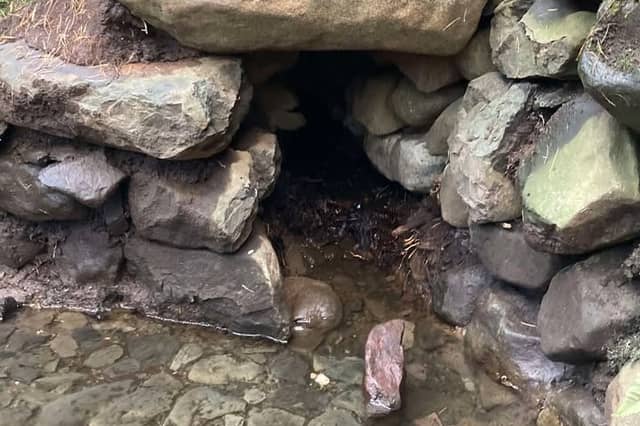
“I noticed that there was a diagonal line through the site and at the end, there was what I called a water feature, and it was very overgrown, and over the years I helped clear it away.
“It is a place where the water catches the light of the sun and it looks like some sort of a portal.
“I asked for help from some experts in archaeology and astronomy and I was told that the well is facing 270 degrees, oriented on the equinox sunset.
“This is halfway between the solstices and the same east west orientation of churches, in and around St. Patricks Day.
“This alignment is important in the Christian calendar, around Easter time, but also for Islam and Judaism, all the major religions, marking the start of spring.
“It would have been the original beginning of the New Year before the change to January 1st, and of course, still the start of the tax year!”
Going back to antiquity, Terry continued: “A long pathway leads up to the site from Steeple Road and another from Mallusk and these are thought to be ecclesiastical walkways from the monasteries in the area to the holy well. These would have been big broad walkways from east to west along the same orientation as churches.
“Before the Christian church these sorts of orientations were also important for the Pagan world.
“When the hospital was built, the idea was that the water from the well would be used in the building, but when they tried, the water level would fall and it was unreliable, which is why the nearby reservoir and dam was built.
“The original well was said to be 6ft deep and 4ft wide. Lanyon built an eight-sided pumphouse on top of it, which is now bricked-up.
“Some people may have theories on why a pumphouse would have eight sides!
“The stones from the original well are discarded near this area. Again, if we think of alignments, all the water is getting pushed up towards what I call the water feature, in a line to Lough Neagh, which once would have come in as far as where The Junction is now.
“Also in the area we have the Springfarm Rath and the ring barrows where Bush Meadows is now, and Rathmore, where the Kings of Ulster lived, and the Battle of Mag Line at Moylinney - so many important historic sites in very close proximity.
“My theory is that the name of Antrim could be more closely related to this water feature - all these straight lines seem to lead to it. The early inhabitants of Antrim would have relied on and even worshipped, the sun, the earth and water and all three of these things meet in this one place.
“Christianity then adopted or built on top of a lot of these ancient sites. This place is where the sun, the earth and the water all meet - rather than a single ridge, hill, or dwelling, maybe the name of Antrim relates to this single point or site?
“Sadly, the holy well has disappeared under a pumphouse and this water feature has been hidden for a long time. People need to see them and come to them, they are part of the story of Antrim.
“There are so many famous sites linked with the equinoxes like Newgrange, this place could be just as important - the soil in many parts of the site has never been tilled.
“Holy wells, health properties of the water and the hanging of rags have been found in many places and are not just linked with Christianity.
“It is thought that the well spring came from an esker, what was left behind by a melting glacier, which could be the origin of the ‘single ridge’ theory - you can see it on the road that goes off to Kells.
“The water that comes up through the stones is coloured and has iron in it, and iron content in water has always been connected to health and tonics.
“If you think about ancient times, and what could be seen at and from the Holywell site, it may have been much more important than first thought.”
Mr McCabe added: “Holywell is also full of wild nature. It has bogland too. It gets the sun all day. There are yew trees, which are now widely used for cancer treatment.
“The whole site lends itself to the ecological, the historical and therapy - everything about it makes it a place to get well again, mentally and physically.
“These themes need to be explored and tourism and historical agencies need to come and see it and discuss the best ways to maximise the tourism and wellbeing potential of this very important place.
“These sorts of developments don’t happen without grants and support, and grants and support, don’t come unless people have an interest and shout about what they have in their area.
“So I am inviting people to show their interest and get on board to promote and spread the word about what could be a very important historic site for Antrim and for the whole country.”