

The tragic birth of the Banshee
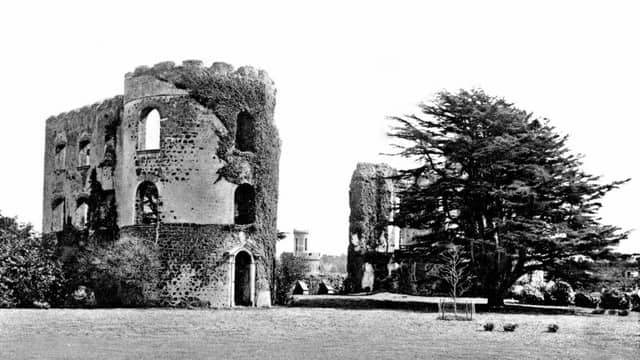

THE wail of the Banshee could be heard over the roar of the flames as Shane’s Castle burned in 1816. Indeed, it is said that the blaze started in the ‘Banshee Room’, which was kept just for the spirit in case she decided to pay a visit.
THE wail of the Banshee could be heard over the roar of the flames as Shane’s Castle burned in 1816.
Indeed, it is said that the blaze started in the ‘Banshee Room’, which was kept just for the spirit in case she decided to pay a visit.
But why on earth would the house of O’Neill have an open door policy for someone said to portend the death of one of their own?
It is a story as twisty as the gnarled branches of the fairy thorn...
From the outset, though, it is important to note that it would have been a brave person to scoff at the legend.
Back then she was venerated - and, yes, she was feared - even by the noble folk in the castle.
They lived in dread of hearing her song, which warned of approaching misfortune or death. That mournful wail, often at night or at the break of day, was said to resemble the ‘melancholic sough of the wind with the tone of a human voice’.
Each of the principal branches of the O’Neill family were said to have their own Banshee - and the one forever linked to Shane’s Castle had a name. She was called Kathleen.
The story goes that Phelim O’Neill, the King of Ulster and hereditary Monarch of Ireland, was a brave and generous prince - but he was proud and stubborn too.
He only had one child, a daughter of ‘faultless beauty, whose skin was white as cygnet’s down, and whose eyes were of the softest blue’.
One summer’s evening a visitor presented himself at Shane’s Castle Hall. It was a young chief called O’Cahan, who had travelled from Benbraden in the County of Derry. And he wanted help.
He complained about the tyranny of Turloch Mor, who had seized his lands, slain his brother and had driven his flocks and herds away.
Touched by this tale of wrong, O’Neill drew his sword and vowed to avenge his guest. At just that moment three drops of blood were seen to fall on his outstretched hand...
His standard was raised and his clansmen summoned. But when O’Neill clambered onto his trusty steed, it reared up and threw him to the ground.
Eveleen, an elderly fosteress at the castle, believed it was a sign. In tears, she begged him to abandon the mission as ‘Heaven had twice declared against it’.
But this proud descendant of a race of kings was deaf to her entreaties and climbed back on his horse and galloped off at the head of his men.
They soon reached Benbraden’s lofty woods when O’Cahan spotted his favourite milk-white cow - a gift from his now deceased father. It had been tied by the horns to an aged white thorn.
He raced over to loosen the knots, but was unable to release the animal - whereupon O’Neill impetuously ordered the branch to be cut down.
O’Cahan urged caution. The tree, he said, had stood there for a thousand years and was sacred to the great Banshee who would ‘revenge any injury done to her favourite tree’.
But O’Neill was having none of it. These were no more than childish tales - and if his men were unwilling to wield their blades, he would do it himself.
He drew his sword once again, but it was ‘shivered by an unseen agency into a thousand pieces’.
Undeterred, he seized another and the branch was severed. Before it hit the ground, a deep groan echoed throughout the forest and the cow fell down. It was quite dead.
It was said that O’Neill was shaken by the incident, ‘half wishing the deed undone’.
Nevertheless, they had a mission to complete and the men rode on to meet Tirloch Mor. The invader had no appetite for battle, however, and restored O’Cahan’s lands and made reparations for his loss.
After a three-day feast in the Rath of Tirloch Mor, O’Neill led his followers homewards, and by early evening the lofty towers of Shane’s Castle came into view.
The place had seldom looked better. The vesper gales sighed softly, and the last faint sunbeam lingered as it hung over the chequered vale.
But something was not right. In the distance he would see a large boat gliding through the waters of Lough Neagh. Then a piercing shriek rang out -just as the vessel and all aboard her slowly descended between two opening waves.
Troubled, he rode on to the castle gate. His daughter Kathleen, ‘the pride of his heart’, often met him there when he returned from his travels. This time, however, there was no sign of her.
The girl had disappeared.
For three days they frantically searched for her, but no trace was found.
Hope soon gave way to despair. But on the fourth day, as O’Neill lay exhausted with grief in his bedroom when he felt eyes upon him. It was his lost girl - his ‘lovely Kathleen’.
Her white robe floated loosely around and her brow was encircled by a shamrock wreath.
He reached to hold her to his heart, but her form was ‘insubstantial’.
And then she spoke.
“My father! We meet but to part,” she said.
“Before the dawn of morn I must hence away. Oh, why did you ruthlessly cut down that aged thorn of Benbraden?
“At that hour the great Banshee vowed revenge for the fall of her favourite tree, and to punish you most severely she seized on me and bore me hence unseen by all.
“Within your view - but, ere you could overtake our steps or break the magic spell - we passed into her light bark and sunk beneath the waters of the lake.
“And, now, selected from the throng who court her smiles, or dread her frowns, she roves with me among meads clothed with everlasting verdure. In friendly guise, we stray through every bright enchanting scene, breathing the balmy fragrance of the air, in bowers entwined with roses.
“Neither care nor grief can enter there. Her dazzling palace is formed of bright crystal, resting on shafts of the purest emerald and one eternal blaze of light is diffused around her happy guests. Celestial strains of music swell upon the breeze, from harps twined with wreaths of shamrocks, while reclining on tufts of flowers, we drink honey-dew from cups of shell.
“My father! Amidst these shining plains, which are free from pain, disease or sorrow, one wish alone unblessed remains - it is to share that bliss with you.”
And with that, she waved her hand and ‘slowly melted into air’.
O’Neill had played with forces best left alone, and he had paid a dreadful price for it.
But he ordered that a room be kept for her - just in case.
It was called the Banshee’s Room. It was furnished and had a bed. It was said that if the chambermaids neglected to keep it tidy they would be ‘allowed little rest for that night’.
And it was real.
In 1810 a writer from the Belfast Monthly Magazine visited the apartment at the top of the castle and was told that it belonged to the girl who ‘mourns lamentably previous to the death of anyone of that noble family’.
She was told the bed was made daily, and every night a small impression was observed upon it. As if someone had been seated there.
It is believed that the great fire started there in 1816.
Despite the best efforts of the household and tenantry, it was destroyed - along with an extensive library, heirlooms and valuable paintings.
To this day, farmers are loath to tamper with a fairy thorn.
And I, for one, don’t blame them...