

A journey back to 1902 to see Antrim town through fresh eyes!

SOMETIMES it takes the curious eyes of an outsider to help you see the treasures on your very doorstep. It is all too easy to become blasé about where you live - indifferent to the things that make your hometown unique and special.
SOMETIMES it takes the curious eyes of an outsider to help you see the treasures on your very doorstep.
It is all too easy to become blasé about where you live - indifferent to the things that make your hometown unique and special.
Back in 1902 a travel writer, who penned his eloquent pieces under the initials WJR, decided to find out why so many tourists from England Scotland were being lured across the Irish Sea for their holidays.
But he did not wish to focus on the seaside towns. No, instead he wanted to focus on a place that was thriving despite ‘the misfortune’ of being inland - somewhere like Antrim.
In doing so he created a superb pen portrait of the county town at the turn of the century, with a special focus on its many ‘antiquities’. Along the way, he also uncovered several fascinating nuggets of information which will surprise many who thought they knew it all!
But while these are places most locals will remember, to paraphrase The Beatles, some are gone and some remain.
Our guide was clearly quite taken by the ‘historic and picturesque town of Antrim’.
“Are some of our quaint inland towns and villages equal, if not superior, to many of our seaside places?” he asked.
“The town is pleasantly situated on the beautiful and fertile valley of the Sixmilewater. the Ollarbha of our ancient Irish poems and romances, once written Amhuin-Na-Fiodh and pronounced Owen-Na-Fio meaning ‘the river of the woods’.
“The origin of the Sixmilewater is due to English soldiers, chiefly the Earl of Essex’s men, who were quartered here. They received all of their supplies and ammunition from Carrickfergus, and had to make their way back to Antrim.
“When they arrived at the river it was half-way - that is six miles from Carrickfergus.”
Who knew the Sixmile was actually 26 miles long?
“The town is also situated close to the shores of Lough Neagh. Fishing, boating and bathing give it the tone of a seaside place.
“Lovers of golf will find an 18-hole course beside the crystal waters. There are some beautiful walks and drives in the neighbourhood which was require too much space in describing.”
So WJR limits himself to sharing his personal highlights, including the Round Tower.
“The perspective is superb. The tower is situated in a private gentleman’s demesne known locally as the Steeple.
“In addition to the Round Tower is the Witch’s Stone, remarkable for the tradition ascribed to it.
“Miss Ann Trim, after completing the most perfect Round Tower in all Ireland, eclipsed her work by alighting from the top, fell on the stone and made two impressions which are still to be seen to this day.
“Being the most perfect specimen little wonder we pause to survey it all in all its weird grandeur and sublime loneliness.
“It cannot but awaken thoughts of emotion.
“For as very long period the original town with its great monastry and church were all supposed to have converged near to the Round Tower. During excavations in the immediate neighbourhood it is nothing unusual to turn up fragments of human remains which help to vindicate the theory of a once populous district.”
But not all Antrim’s treasures were kept so polished.
“Not far from here is Holy Well, where the devout pilgrims used to gather.
“What a contrast and substitution: instead of a sacred shrine, a big asylum has been erected in this quiet haven.”
Clearly disappointed, he soon found other rich pickings when he moved towards the ‘new town’.
“The old original town only commenced to fall into decay with the advent of the new English and Scotch settlers, who came over here during Queen Elizabeth’s reign.
“For a long time, the native Irish did not look upon them with a friendly eye, and they had many feuds before reconciliation was made amongst them.
“It behoved the settlers to locate themselves in the modern town. The natives styled it Gall Antrim, meaning the town of the foreigners.
“We may safely infer from what is now known as the town of Antrim was first founded by the settlers. No doubt the site was chosen for strategic purposes, because when they were hard pressed by the native Irish they could take to the ships which were on Lough Neagh, and others of them could find refuge in Antrim Castle.
“Those were troublesome days when the town was walled in with gates at its chief entrances. Not a vestige of those walls now remains.”
But what did seems to have charmed that visitor 120-years-ago.
“The present town consists of one main street with several small side ones, giving it an air of antique quaintness. The houses and shops are principally modern and few, if any, are very old.
“For its size the hotel accommodation is good, and there are outward and visible signs of extensions and improvements in that direction.”
But his eye soon strayed the building that dominated the skyline - All Saints’ Church.
“The Parish Church of Antrim is of great beauty and remarkable antiquity, and occupies a prominent position in the town,” he wrote.
“Almost without intermission, divine service has been held in it for over 300 years.
“Its long array of incumbents, the families of distinguished persons who met to worship here are now beyond recall, many are laid to rest beneath the shadow of the church.”
Venturing inside, he soon realised that his positive first impressions were correct.
“Of the elaborate and beautiful stain glass windows one in particular is worthy more than passing note. It is to be seen in the Massereene transept.
“The date of it is unknown but it is of considerable antiquity probably brought from the continent by a former Viscount Massereene, or it may have done business in some older ecclesiastical building now extinct.
“The upper square has in the centre the figures of the Virgin and Child. The former is depicted standing bearing a crown and holding a sceptre. Above her head is a cross with the letters MAR.
“On the left is S Hieronimus (Jerome) with a double cross wand, and on the right is S Carolus, with bishop’s mitre and crozier.
“In the centre underneath is an angel preaching from a pulpit, with beneath it a three-fold flower springing from a single stalk - an emblem of the Trinity or, if we accept it in the double sense it gives it a two-fold meaning - the Trinity an the Irish three-leaf sprig.
“The lower square sets forth the martyrdom of John the Baptist. There are eight figures in it. In the background is Herod feasting with his Lords; in the foreground the Baptist kneels with his hands joined in prayer, while the executioner with a two-handed sword is about to behead him. Close beside stands Herodius holding a charger to receive the Baptist’s head.
“The figures are beautifully portrayed in a very life-like manner.
“There are some fine monuments inside the church to the memory of the Massereene family. They are indeed exquisite works of art.
“The Communion Plate has been in use for 200 years. It was the gift of Madame Abigail Parnell in the year 1701. It has been enlarged and beautified on several occasions.
“Around Antrim Church is the churchyard, in which there are many interesting tombstones.
“Many historic persons are buried here. Let me cite a few: Lewis Clotworthy, Sir Hugh and his son John, first Lord Massereene; Sir John Skeffington, second Lord Massereene; Owen O’Connolly, the discoverer and informer of the Rebellion in 1641; the Revs Jas. Cunningham, Thomas Gowen, Wm. Adair, John Rankin and John Abernethy, who knew the system of creation better than most men of the nation.
“Also Rev John Gordon Holmes and George V du Noyer, the geologist.
“It is computed that more than 10,000 persons are interred in Antrim churchyard. In a hasty survey we can only touch the fringe of so enthralling a subject. Every step you take leads to something new to attract attention.”
He was also struck by the warmth of the people he met.
“I have come across several books with pictures of Antrim town in them, and they were mostly printed in London. The visitors were English people.
“They spoke very highly of the town and its inhabitants - the exceeding courtesy and kindness they received everywhere they went.”
Next stop, however, was a place that few of the locals would ever see the inside of - Antrim Castle.
“In looking up the ‘Calendar of Documents Relating to Ireland’ mention is made of a castle here so far back as 1215. The original site or ruins of it are buried in oblivion.
“But not so as regards the present Antrim Castle which was erected in 1610 and took three years to build.
“Sir Hugh Clotworthy had a Covenant with the Crown, and this was part of the stipulation - to build a castle and to plant on the lands English and Scotch men, and to have them all well equipped with the weapons of warfare.
“The ancient venerable mansion of the noble families of Clotworthy, Foster, Skeffington and Massereene recalls to memory many an interesting episode in Irish history. It has been a mute witness of a thousand and one stirring scenes of the past - events of paramount importance were first the settlement, and then the Rebellion of 1641.
“The discoverer of the plot was Owen O’Connolly, who resided with Sir Hugh Clotworthy in Antrim Castle.
“The Puritan Rebellion, the Usurpation, the Restoration, the Revolution and Rebellion of 1798 have passed in panoramic succession before those ancient embattled walls.
“The earlier inhabitants of Antrim Castle did not sleep on beds of roses; they were exposed to many and very great dangers.”
It was very different in 1902, of course.
“The grounds are furnished with seats and arbours, from which extensive views of the magnificent inland lake are obtained. In this quiet haven or retreat alone with nature, what could be nicer?
“If the traveller should be privileged to visit Antrim Castle, the unrivalled Oak Room will command the highest admiration. It contains trophies and relics not alone of the Irish House of Commons, but curios of intrinsic value.”
It is heartbreaking to consider that practically all were consumed by fire just 20-years later.
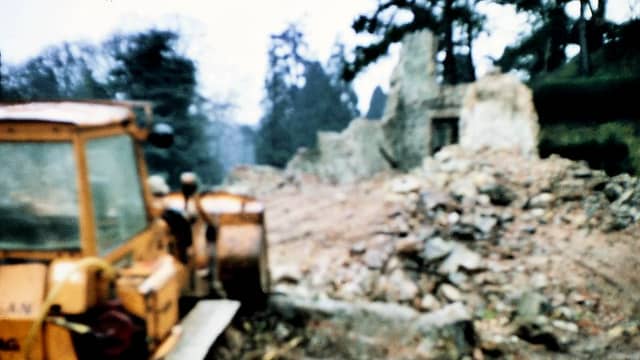
The skeleton of the building was finally demolished in the early 1970s, centuries of history crudely smashed to pieces by JCBs and then driven into the cavernous vaults under the building.
Undoubtedly WJR would have been utterly appalled.