

All day, all day, Domoney's planting!
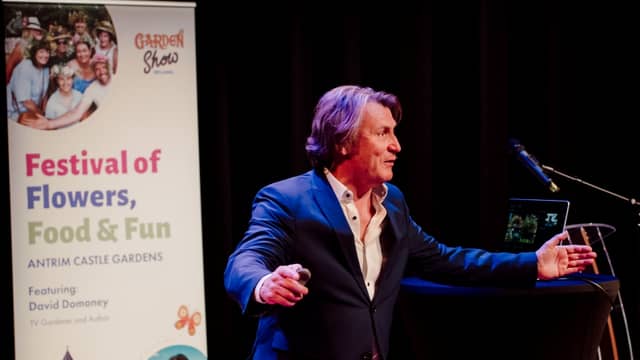

THE new ambassador for Garden Show Ireland has spoken about his admiration for Antrim Castle Gardens during a visit to the borough to launch the event and his new book. Back in November, David Domoney was announced as the ambassador for the 2025 event.
THE new ambassador for Garden Show Ireland has spoken about his admiration for Antrim Castle Gardens during a visit to the borough to launch the event and his new book.
Back in November, David Domoney was announced as the ambassador for the 2025 event.
He has stepped into the shoes of stepping into the shoes of celebrity horticulturist Diarmuid Gavin, who was behind the million pound projects, the Platinum Jubilee show garden in the Castle grounds and the Coronation Garden at Hazelbank.
A Chartered Horticulturist and renowned television presenter on ITV’s Love Your Garden and This Morning, David ‘brings a wealth of expertise, having won 36 RHS medals and been personally honoured by Prince Edward for excellence in horticulture’.
David also serves as a patron and ambassador for several environmental charities, including the RSPB and Thrive, a charity supporting those with disabilities through therapeutic horticulture.
In preparation for the 2025 event, the annual Spring Plant Fair will take place on Saturday 12 April at Civic Square, Mossley Mill, offering thousands of plants for spring planting from local nurseries.
Last week, the new ambassador was in town for An Evening with David Domoney at The Old Courthouse, Antrim.
The special event included an exclusive talk about his latest book, ‘Plants with Superpowers’, and a sneak preview of Garden Show Ireland 2025.
Highlights of this year’s show, will include his Garden in Glass Exhibition and the Wheelbarrow Garden Challenge
He also spoke about the remarkable capabilities of plants featured in his new book and gave expert gardening tips and insights.
Before the event, the Antrim Guardian caught up with Mr Domoney to ask him his thoughts about his new role.
He revealed that trips to Coleman’s Garden Centre in Templepatrick have helped to seal the deal.
“I was over here on several occasions, giving talks at Coleman’s,” he said.
“We were getting audiences of up to 250 people in and they were very successful.
“I had such a warm welcome. I then came and gave another talk, with another colleague from TV and then another talk after that.
“And whilst I was here, I was meeting some people from the council and I came around Antrim Castle Gardens and we got talking and the rest is history!
“I’ve got a brand new book out which is full of interesting topics and it just seemed like a natural progression to bring these talks and this information to a bigger audience.”
Mr Domoney was full of praise for Antrim and Newtownabbey Council’s promotion of the area as a ‘Botanical Borough’.
He said: “I’ve been very fortunate to visit the local colleges, including Greenmount, that are teaching horticulture.
“Not every council promotes horticulture and gardening like this. You can see it in Antrim Castle Gardens, the care and attention and work of the volunteers, and the events that are being held, like Garden Show Ireland and the Enchanted Winter Gardens, bringing hundreds of families into the area and making memories.
“It’s a very progressive thing that the council is doing, focusing on quality of life for residents and it is something I am very proud to be associated with.
“It's a massive area of green space. If you look at other areas across the UK and Ireland and the residents are very lucky to have this amenity and all the history around it.
“The dedication and the resources invested in keeping it at such a high level and the attendance of events are testament to how important it is.
“It’s such an amazing destination, and not just for events. It is somewhere that people come for a walk, recharge their batteries during the lunch hour and engage with nature.
“Not everyone has a garden at home, so it is a very important part of the community.”
David says that anyone, no matter how small their space, can get involved.
“There’s a separation between what people anticipate and the reality. Some people think gardening is just weeding, watering, and cutting the lawn. It is, but that’s just part of it.
“For me it is an engagement with nature and a release from today’s world where we are constantly interacting with technology.
“In some cases, 90 per cent of our lives are indoors, either in a car or at work or in bed, asleep or looking after the kids.
“We're spending more time indoors rather than outside. We’ve also got a rise in technology being an active part of our everyday life. We’re connected all the time through phones, tablets laptops, computers, plasma screens. It’s everywhere.
“The simple act of engagement with plants or a walk in a wooded area has direct correlation with brain activity and quality of life improvement.
“Positive neural transmitters like dopamine and serotonin are linked with these activities.
“Being amongst nature, the positive act of sowing seeds and waiting for them to germinate, is all part of that, and you don't need to be an expert.
“The simple pleasure of watching cress germinate on a kitchen windowsill, and then cropping that cress, putting it with a lovely bit of scrambled egg, and a little bit of salt and pepper and butter and granary bread, what is better than that?
“Ripping open a plastic bag to pull an apple out is completely different to picking a fresh one from the tree and rubbing it on your leg as if you’re just about to bowl in a cricket match before eating it. There’s a huge difference.
“The engagement with nature is so very important. Gardening shouldn’t be considered as a hobby. It should be considered as an essential part of life.
“Even if you have no space, you have still have a windowsill or a shelf.
“If light is coming into the room and there’s warmth and you can supply water, you can grow plants.
“House plants on the windowsill aren’t difficult, providing they’re not left to sit in water.
“One of the talks I will be doing during the show is making the audience an expert in house plants in 30 minutes.
“All of those things are key components to the quality of life and the tending - putting down the phone and getting a damp cloth and wiping the leaf of your plant, holding the leaf in your hand, look at the veins, the colour of the green, that is a another life that you are interacting with.”
David said that the sights, sounds and smells of plants and flowers are all very beneficial to mental health.
“There's a mindfulness in watching something in flower, the fragrance of Jasmine and honeysuckle.
“One of the biggest triggers of childhood memories is the smell of cut grass, it reminds me of the school playing fields being cut.
“Remember when you were in school and you smelt that outside and you knew the holidays were coming.
“Other smells like lavender and sweet pea, a lot of innocent things trigger memories and are key to taking us out of the pressures that we’re in at the moment to positive thoughts.”
Returning to his work with Coleman’s, we asked David about his relationship with boss Richard Fry and whether he concurred with a comment which made global headlines recently, when a supplier told the local businessman that Brexit had made it easier to do business with firms in Japan than Northern Ireland.
In a recent debate in the Commons on the Windsor Framework, Robin Swann MP even raised the issue at Westminster.
Addressing the potential impacts of Brexit and climate change on gardening, Mr Domoney said: “Some of the impacts are short term, some are long term.
“Richard is a very good champion of the importation of plants and the complexities of Brexit in regards to importation.
“He is far more qualified to talk about that than I am, and his wife, Lynn, who’s very, very good at that.
“And I think that somebody, like Richard is a strong character within the community, a very positive character.
“And again, someone who has passion for plants and gardening and brings it to many people through his retail store.
“So I think you’ll find champions like that about who will face up to these difficult issues with red tape, and they’re the people who’ll break through.
“He should be in politics, that guy!
“In terms of sustainability, I think the awareness of climate change and how it will impact the planet is more than it has ever been.
“I think there’s an awareness in children and awareness is the first sign of recognising it and dealing with it.
“There seem to be stronger moves towards redressing damage.
“It is difficult to know what the future will bring.”
David said he was delighted to see the resurgence of interest in gardening over the coronavirus lockdowns and continued enthusiasm for growing and planting.
“Lockdown inspired 1.7 million new gardeners to pick up a trowel, that’s what is estimated, but I think it was more than that.
“There were people who did a little bit of gardening who gardened a lot more.
“Prior to that, myself and one or two others were trying to champion the notion that gardening is good for mental health and physical well-being, but we were in a minority and looked at slightly skeptically, like we were trying to promote horticulture to sell more plants.
“And that’s not the case. Our thing was a connection with nature, but now that’s widely accepted as fact, which is very positive.
“And I think we are now all looking at our phones all the time, and people have had enough of it.
“Even when you look at the amount of people who are outside on a sunny day. And it’s not all associated with games or fun, it’s work emails and kids with iPads doing homework.
“I'm seeing a big uprise in enthusiasm among younger children in the simplest pleasures of growing or planting pots.
“And I find that with a lot of adults too. A walk in the park, kicking a football with the kids, a barbecue, a glass of orange juice and reading the paper in the morning in the garden, those are the important things.”
David said that with gardening now being encouraged at schools again, and with the immediate post-war generation being encouraged to be self-sufficient, there are at least two generations who have potentially missed out on engagement with the outdoors.
But he says he is heartened to see an upsurge in interest among young people.
“We had a massive house plant market in the 70s, 80s, and early 90s, which dwindled to nothing and now it is seeing one of the biggest upsurges in garden retail and a lot of that is driven by teenagers,” he said.
“There were gangs of young people going around Chelsea Flower Show looking at my display of 50 unusual plants, there’s a real craze around Monsteras with hashtags and social media pages.
“Teenagers that have got their own bedrooms or their student digs and they are keeping and growing plants and I love that.
“House plants are a great way to personalise and characterise their own space. And it’s another living thing that you’re sharing your space with.
“And, of course, they have the benefits of producing fresh oxygen and removing toxins from the environment created by cleaning, cooking and hygiene products.
“Especially, when we don’t vent the windows, house plants play a specific part in helping nullify those toxins and pumping out fresh oxygen.
“These are the type of topics I’ll be talking about at the Garden Show and I have a YouTube where there is lots of free information on how to engage with gardening and we’ve got about 280,000 followers now.
“Anybody interested in any aspect of gardening can just take a take a look at that.
“It will hopefully inspire people.”
David’s new book features facts about the amazing ability of plants - like how the Venus Flytrap can count, the snowdrop produces its own antifreeze, a potato can charge a mobile phone and the gingko tree can survive an atomic bomb.
“Each double page explains a secret and a power of plants that will make you feel like a child, learning something new again.”