

Angling club urges members not to consume fish as experts say algal blooms pose 'public health risk'
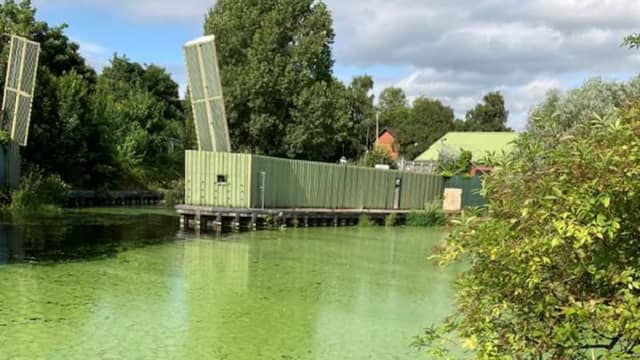

AN Antrim angling club has issues a stark warning to members after scientists said that blue-green algal blooms in Lough Neagh could have a profound ecological impact and present potentially significant environmental and public health risks. According to researchers at Queen’s University Belfast, the lough is in hypertrophic status – the worst category of waterway nutrient pollution.
AN Antrim angling club has issues a stark warning to members after scientists said that blue-green algal blooms in Lough Neagh could have a profound ecological impact and present potentially significant environmental and public health risks.
According to researchers at Queen’s University Belfast, the lough is in hypertrophic status – the worst category of waterway nutrient pollution.
More than 80% of the bacterial DNA tested from algal mats belonged to potentially hazardous microbes, including E.coli, salmonella and 11 others that can cause human illness.
The scientists tested samples from mats of algae at Toome Lock, Rea’s Wood, Antrim Boathouse and Ram’s Island in 2023.
Their work has confirmed the lough’s hypertrophic status – the worst category of waterway nutrient pollution
They found the samples to be ‘dominated’ by bacteria associated with wildfowl or livestock faeces or human-effluent wastewater treatment.
And they detected a large amount of toxins, including one that has not been discovered on the island of Ireland before.
Antrim and District Angling Club has urged members not to consume their catches, to take extra care when handling fish and take all precautions to wash and sanitise after contact with water and fish.
Dr Neil Reid from the Institute of Global Food Security at the school of biological sciences in QU, was the lead author of the report, said farmers had a key role in addressing the problem.
“Technological solutions to better use slurry, for example, through anaerobic biodigestion, as well as good on-farm wastewater management is needed urgently on most farms,” he said.
“So-called ‘nature-based solutions’ such as planting vegetation and leaving buffer strips along waterways or creating drainage swales, willow plantations and reedbeds could dramatically reduce the environmental footprint of farming avoiding any conflict with the productivity and profitability of the agriculture sector.”
He called for government to support a “just transition” for the agricultural sector, through agri-environment subsidies.
“Recent national and local political change should foster optimism that the environment and opportunities for change now exist,” he said.
The study, published in the journal Environment International, found the hazardous algal bloom (HAB) that developed in 2023 was “an unprecedented environmental perturbation to an internationally important ecosystem”, likely due to a combination of excess nutrient in the water, climate change and the effects of invasive species.
It says “significant investment” would be needed in wastewater infrastructure and in-lake remediation strategies.
A Lough Neagh action plan is in place to address the challenges facing the largest body of freshwater in these islands.
It includes a research programme to test potential solutions to the blue-green algal crisis.
Addressing its members, Antrim and District Angling Association said: “In recent weeks the large build up of Blue-green algal bloom has taken over the lough and has amassed as far up as the Airplane Pool at the Castle Gardens.
“Dr Neil Reid from Queens University confirmed not only the highest levels of hypertrophic contamination ever recorded on the Island of Ireland, but also the discovery of never before found bacterias that are extremely harmful to both animals and humans.
“We are now advising all members NOT to consume fish caught from the Six Mile River for the foreseeable future.
“Members are also advised to be extra careful when handling fish and take all precautions when fishing to wash and sanitise after contact with water and fish.
“We regret what is happening on our waters and as a committee, we want you to know that we, along with other lough based angling clubs and together with the UAF, LNP, LNT and SMWT are working hard to bring as much influence to remedy the algae problem.
“We trust you are enjoying your fishing and encourage you all to move to catch and release until further notice.”
With the Crumlin River also choked with green sludge, the Crumlin and District Angling Association has said that the situation is ‘much, much worse than last year’, adding: “The system is broken and needs fixing. We must protect our natural resources.”
A spokesman for the Six Mile Water Trust added: “We should note the risk to health. This is what we have inherited from years of mismanagement of our environment.
“Who's to blame for this ecological disaster? No easy or quick fix. However lets start with our rivers, that feed **** into the lough on a daily basis.”
Last week, environmental activists from the Slí Eile group confronted the owner of the Lough bed, English aristocrat Nicholas Ashley-Cooper, the Earl of Shaftesbury, on his way to a private meeting with Queen’s academics, and poured water over him.
A statement said: “Activists confronted the Earl of Shaftesbury and doused him with water from Lough Neagh, following his secretive meeting with academics at QUB.
“Save Lough Neagh and Slí Eile Activists then held a protest against the Earl’s visit.
“As one of our campaign demands, we demand the return of the beds and banks of Lough Neagh to the people of this island. While it is in the hand of an aristocrat who profiteers from the dredging of Lough Neagh’s finite glacial sand deposits, it complicates solutions to fully grapple with the vast array of problems that need to be addressed
“With a democratically owned and governed Lough, we can better explore granting Rights of Nature status and can more effectively regulate the pollution that enters through the deluge of waste being dumped into our rivers and streams.
“That QUB is meeting secretly with a colonial aristocrat away from public eyes while we see scenes of utter devastation around the shores of the Lough is cause for grave concern. Any discussions around this ecocide need public scrutiny, public input and public representation in all decision-making. Loughshore communities have been ignored for too long.
“The Earl got a taste of the poisonous waters of Lough Neagh, the same waters that are now filled with dead and dying wildlife. We hope this small taste of the toxic sludge he and his family have contributed towards creating will incentivise him to hand over to the people of Ireland what was never rightfully his in the first place.”