

Another strange tale from 'Carey's Folly' - the mystery of the plaque missing from ruins of Toome landmark
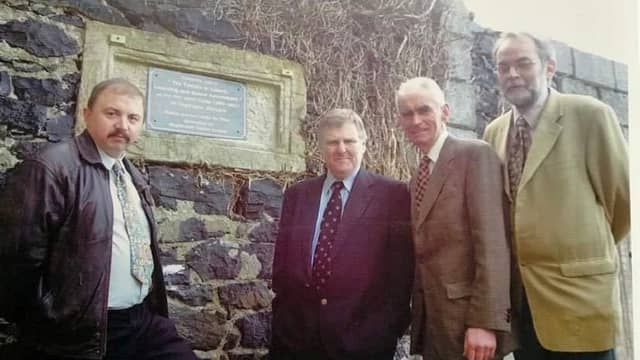

THE relative of an historical eccentric has contacted the Antrim Guardian seeking information on a plaque erected to his colourful ancestor - in the latest strange chapter of a ripping yarn dating back centuries. Stephen Collins’ great, great great grandfather William Carey from Lisburn was proved to be the relative of an eccentric clergyman who died in 1891, and inherited his estate - including the famed Temple if Liberty in Toome.
THE relative of an historical eccentric has contacted the Antrim Guardian seeking information on a plaque erected to his colourful ancestor - in the latest strange chapter of a ripping yarn dating back centuries.
Stephen Collins’ great, great great grandfather William Carey from Lisburn was proved to be the relative of an eccentric clergyman who died in 1891, and inherited his estate - including the famed Temple if Liberty in Toome.
This followed a long drawn out process where various pretenders to the inheritance came forward and were dismissed.
Mr Collins unveiled a plaque on the remains of the Temple of Liberty in 2002 by invitation of local Toome community group TIDAL and discovered a couple of years ago that the plaque had disappeared - and is now seeking information which will lead to its return.
The ceremony was covered in the Antrim Guardian at the time.
Traces of John Carey’s fame still remain around the borough - an ornate family grave in Duneane, an unusual Willy-Wonka style cottage, another plaque on the local primary school and a fountain and pump in the middle of Toome.
He was born on June 15 1800 in Duneane, probably in the townland of Cloghogue, son of John and Margaret Carey.
Two brothers died of fever. John later claimed a distinguished lineage, but though he inherited property from his father in 1842, the family was not particularly wealthy.
He attended local schools, and entered Belfast Academical Institution when he was about 20; in 1834 he was licensed as a Presbyterian minister by Ballymena Presbytery.
On April 2 1839 he was ordained in Albany, County Tyrone, the very first minister of the congregation but moved the next year to Brookvale, County Down.
But after two years, he was suspended by the local presbytery for ‘prevarication’ and alleged forgery. But worse was to come.
After the General Assembly continued the suspension, Carey was then accused of the attempted murder of a neighbouring minister, Joseph Dickey of Rathfriland, who had been his opponent: Dickey was shot and wounded by an unknown man while praying in his pulpit on 26 February 1843.
Carey’s alibi was not the strongest, but he was released and went to ground for up to seven years. Some say that he retired to his parents’ home near Toome, others that he emigrated to seek his fortune in either America or Australia.
He then reappeared as a flax merchant, and in 1850 came to live at what he called Rarity Cottage, Toome, apparently with a large amount of money in his back pocket.
He continued to pile up cash, by selling Lough Neagh sand, involvement in the local eel fisheries, and by lending money at extortionate rates; a penny per shilling per day.
By the 1870s, he owned about 400 acres in County Antrim.
While he had a reputation for penny-pinching, he was said to have secretly helped some of his poor neighbours and gave back to the Presbyterian church.
He took a great interest in the work of missionaries in India, founding a studentship for intending missionaries, paying for a church in Gujarat and establishing the Carey lectureship, a series of six to ten lectures delivered annually in either Assembly’s College, Belfast, subsequently the Union Theological College – or Magee College, Derry.
Carey also supported efforts to have the lower Bann Valley drained, and publicly backed the tenants’ rights campaign.
Perhaps his most well-known achievement came from a fall-out with the establishment.
When in 1866 the local landlord, Lord O’Neill, refused permission for Toome village hall to be used for a liberal political meeting, Carey built his own venue instead.
He constructed a ‘most elaborate’ meeting room, which seated 1,500 people, with a library of 5,000 books, a pipe organ which cost £600, and numerous statuary busts.
He called it ‘the Temple of Liberty, Learning, and Select Amusement’ and like the man who designed it, it was well known throughout the land.
He built a small school and a water pump for Toome, and endowed a charity to provide clothing and blankets to the local poor.
Described as ‘peculiar and solitary’ after Lord O’Neill successfully prosecuted him for libel, Carey was described in his obituary as ‘a popular figure throughout Ulster’.
He died unmarried on August 23 1891, without any close relatives; he intended by the provisions of his will and of earlier trust deeds to leave his estate of about £10,000 to the Presbyterian church and to charities, but serious legal problems ensured years of litigation and consequent attrition of the property.
In 1911, the Temple of Liberty was burned down, possibly by local people who had a grudge against the new owner.
In order to fulfil one of the conditions of the bequest, J. M. Barkley, the Carey lecturer in 1955, delivered a lecture in front of the ruins of the Temple, though he reportedly had ‘only one human and one goat as an audience’.
His outrageous monument still stands in Duneane graveyard.
In 1954, the Unionist MP for Mid Antrim Robert Simpson said that the Temple of Liberty, like the more famous one at Jerusalem, was dedicated to ‘a lofty ideal’, but was really to ‘annoy and get revenge on his enemy, John O’Neill’.
So he set to building the Temple of Liberty opposite O’Neill’s house.
When completed in the late 1860s, there followed the noise and merriments of concerts, dances and soirees.
Said Simpson: “The temple was a fine two-storey building with a spacious hall to seat more than 1,000 people, plus a ground floor with schoolroom and various ante-rooms.
“It also included a well-proportioned and equipped library.”
On the exterior of the front wall were busts of Washington, Columbus, Newtown, Watt and in the main hall there were niches on the walls with busts of philosophers, musicians, novelists, scientists and theologians.
The ceiling was expensively panelled, Simpson said, with inlaid carvings and paintings of ‘mythological conceptions and various heathen deities, while the windows were of stained glass’.
“There are folk still living who attended dances and lectures in the hall.
“One lady remembers her first evening dress dance there, which was a most splendid affair, attracting the best people, so it was said, from Derry, Antrim and Tyrone. During the evening, John Carey himself arrived in their midst, dressed as usual in black hat and coat.
“This was a dramatic interlude, for the dancing was stopped while Carey played on the great pipe organ at the far end of the hall.
“The villagers of Toome regarded the temple as a great asset, although they knew well that a hall to accommodate more than 1,000 people in a village of a few hundred people was ridiculous.
“And so the Temple of Liberty came to be known as ‘Carey’s Folly’.”
Simpson explained: “The bachelor Carey drew up his own will incorrectly and the whole estate of over £20,000 was thrown into Chancery.
“There were various claimants to hand, but finally Mr William Carey, a tailor and farmer from Broomhedge near Lisburn, was established as the heir at law and to him passed the ownership of the Temple of Liberty.”
The Temple soon fell into a state of poor repair, but was visited by numbers of tourists, who sometimes recorded their visit by writing or carving their names on any vacant space on the walls.
Simpson concluded: “At the beginning of this century, the building was gutted by fire.
“Today only a small piece of the once-grand building remains and is used as a cattle shed.
“But every now and again the plough turns up some old bust of Wellington, Nelson or Napoleon as a reminder of ‘Carey’s Folly’.”
And in 1911, reports from the British Newspaper Archive showed how keenly the loss was felt.
“A building known as the Temple of Liberty was completely destroyed by fire and there are allegations in the district that the outbreak was the work of malicious persona.” wrote one breathless scribe.
“The building stood in spacious grounds about a mile from the small town of Toomebridge, and was erected and endowed by the late Mr John Carey, a Presbyterian minister of some eccentricity, whose philanthropy made his name well known during his lifetime, and the disposal of whose estate brought it into even greater prominence after his death.
“Among the numerous schemes which Mr. Carey carried out was the establishment of the Temple.
“In large letters above the portals of the hall were the words: ‘Temple of Liberty, Learning and Select Amusement, dedicated, erected, and endowed by John Carey. A free gift to his country.
“The founder dedicated the temple to religious moral, educational, and charitable objects.
“Niches in the wails were ornamented with the busts of poets. orators, dramatists, novelists, philosophers, and musicians.
“The building was one of ‘the sights’ of the north of Ireland, and was visited every year by thousands of strangers.
“Its destruction has caused much regret throughout Antrim.”
Another report said: “Fate must have leered the tragic spectacle of the burning of the grotesque edifice which years ago the late John reared with such infinite expenditure thought, ingenuity, and money on the green plot of ground subjoining the railway at Toome.
“An ardent Liberal and land reformer, and one of the most eccentric of men, John Carey devoted some the best years of his bachelor life to the erection and embellishment of his strange-looking Temple of Liberty.
“Its walls, externally as well as internally, were adorned with carved faces of the great ones of the earth, nine of them forming an arch over the main entrance and the whole building, with its hall and anterooms and fine pipe organ dedicated to art, science and industry.
“But he made no provision for the maintenance of this pile of folly after his death, and for many years past it bad been in a mournful condition of neglect.
“Now the fruits of the old man’s laborious eccentricity have vanished in flame and smoke.
“The catastrophe is to be regretted for public reasons, as Carey’s Temple of Liberty had become an object of interest in that part the country and was visited by numerous tourists and others in summer seasons.”
Only the foundations of the Temple exist today, still B1 listed, while Union Theological College is said to have a very fine portrait of John Carey hanging in the Faculty Room.
If you can help relocate the plaque, contact the Antrim Guardian on [email protected]