

Antrim Fire Station officially reopens after £2.2m refurb
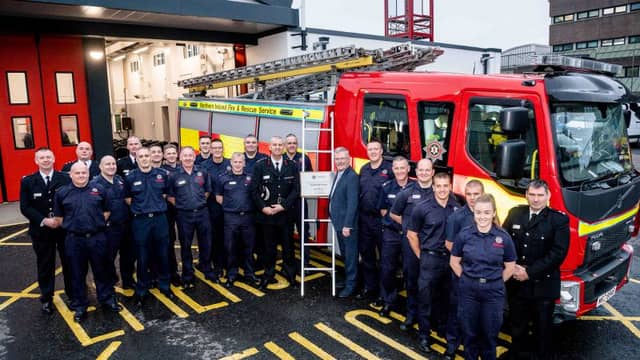

THE Health Minister Mike Nesbitt has paid tribute to local firefighters, their families and employers as he helped officially reopen Antrim Fire Station after a £2.2m refurbishment and extension. The Department of Health was the main funder of the project, which became operational in March and was designed by IBU and Kennedy Fitzgerald Architects.
THE Health Minister Mike Nesbitt has paid tribute to local firefighters, their families and employers as he helped officially reopen Antrim Fire Station after a £2.2m refurbishment and extension.
The Department of Health was the main funder of the project, which became operational in March and was designed by IBU and Kennedy Fitzgerald Architects.
The station accommodates nine full time and 19 on-call firefighters, who respond to fires, road traffic collisions, marine incidents, aircraft incidents and a wide range of special service calls and educational visits.
Mr Nesbitt inspected the parade last Wednesday, while crews were praised for recent work, including rescuing a man from the River Maine in Randalstown and for their work helping to fight a wildfire in Glenarriffe last summer.
The significant extension at the side and rear of the station included new welfare facilities for firefighters as well as bespoke kit rooms and cleaning facilities and the addition of a multi-use lecture and training space.
Dignitaries who spoke at the event last week included Ryan Thompson, Northern Area Commander, Jay Colville, Chairperson of the Northern Ireland Fire and Rescue Service Board and Aidan Jennings, Chief Fire and Rescue Officer.
The Health Minister toured the building and met some of the firefighters based at the Station.
Minister Nesbitt said: “I am delighted to see the tremendous work that has been undertaken at Antrim Fire Station, and having toured the facilities I cannot speak highly enough of the hard work, dedication and collaboration of all those involved in this refurbishment.
“The Station has been modernised, upgraded, and equipped to continue the vital work it has done since its inception in 1953.
“This refurbishment is much more than a new coat of paint. It’s about modernising our capacity to respond to the challenges of today.
“Whether it’s battling more frequent wildfires, handling hazardous material incidents, or rescuing those in need, this Fire Station now stands ready to face whatever comes its way.
“This Fire Station is an example of what can be achieved when we collaborate on a shared mission, and I can say with confidence that the efforts of all involved is plainly visible in the exceptional work I’ve seen today.”
Northern Ireland Fire & Rescue Service Chief Fire & Rescue Officer Aidan Jennings said: “Since becoming operational in March 2024, this investment has strengthened and enhanced our emergency response capabilities, not only in Antrim but across the entire Northern Area Command.
“This day holds particular importance for our Wholetime and On-Call Firefighters, who have served the Antrim community with remarkable dedication.
“We extend a heartfelt thank you to each of them, along with our District Management and Administrative Teams for their continuous support. Their dedication and commitment to serving the community especially whilst renovation work was ongoing is commendable.
“Antrim Fire Station is a cornerstone of the local community, protecting and serving the local people. I would like to acknowledge the vital role played by the families of our Firefighters, whose ongoing support is crucial, as well as the employers of our On-Call Firefighters in Antrim.
“We are immensely grateful to everyone who contributed to this project and to the local community for their continued trust and backing of their Fire & Rescue Service. Together we are helping to make Northern Ireland a safer place for all.”
Jay Colville, Chairperson of NIFRS, added: “This project was made possible thanks to a £2.2 million capital investment provided by our sponsoring department, the Department of Health. On behalf of the NIFRS Board, I’d like to express our gratitude to DoH for this essential funding, which not only strengthens the safety of the local community but also enhances the working conditions and safety of the dedicated Firefighters who serve here.
“I would like to thank the design team, DoH - Health Estates and the Contractors, working with our Facilities & Assets Department for the delivery of this first class facility.”
Back in 2022, in a presentation to the Probus Club, local historian Brendan Smith and Joe Bradley, son of legendary firefighter Pat, teamed up to tell the story of Antrim’s finest, parts of which we will now retell to our readers.
In 1917, the method of firefighting in Antrim was a method unchanged for centuries.
This was the bucket-chain system, manned by volunteers and at times assisted by soldiers of the North Irish Horse, when in camp at the Antrim Showgrounds.
Indeed ‘old-timers’ George Fleming from Menin Road and Sam Nicholl recalled assisting at the Antrim Castle Fire in 1922.
The first attenders used a manually operated pump, which was centrally stationed at Carson’s Entry in Church Street.
Initial assistance was provided by another manual pump from Randalstown. Both men battled vainly against the massive blaze, and after the good citizens of Belfast were eventually persuaded there was sufficient cause, they sent their Brigade to Antrim. As we all know, the castle did not survive and was destroyed.
Belfast Fire Brigade were again active in Antrim in the 1930s when they assisted at notable conflagrations such as Fawcetts Hotel and the Holywell Hospital Fire.
Holywell Hospital’s own equipment was good quality and manufactured to good standard by Shand Mason Co who were taken over by Merryweather Ltd (1922).
It wasn’t until World War Two that organised fire fighting came to Antrim.
A unit of the Auxiliary Fire Service was formed in 1942 and the first Crew consisted of Joseph Phelan and his brother Fintan, Joe’s father Pat Bradley and his older brother Michael, Jim Wallace, Bob Gribben, Lloyd McAllister and Tommy Adams.
Their first equipment was a small Bedford lorry and light-trailer pump which is small beer to modern equipment but a far cry from the bucket-chain.
Initially the equipment was stationed in a yard behind John McKendry’s Pub, at 35 Castle Street and then moved to a garage in Baird’s Yard in Church Street.
Their equipment was enhanced shortly afterwards with the addition of the Austin Tender, Beresford major pump and a low pressure pump.
This equipment formed the basis of a Retained Section in 1948 with Pat Bradley as Section Leader. They continued to operate out of Baird’s yard before moving to the present station in Castle Street in 1953.
The Antrim crew responded to several serious incidents during that decade, including two major aircraft crashes at Nutts Corner airfield and a major fire at Holywell hospital farm at Gally hill on New Year’s eve night 1950.
In 1953 a BEA Vickers Viking flying from RAF Northolt crashed after hitting a landing light pole with 35 on board. One member of crew and seven passengers survived.
Another crash involved a BEA Viscount crashed with all seven souls on board perishing. There was a query if the landing lights were actually on, and the possibility that a maintenance screwdriver may have had an involvement.
A new Dennis F8 appliance arrived in 1953 and this continued to be used until 1977 when it was kept as a standby pump and subsequently remained in service at the Brigade training centre Westland Road, Belfast November 1979.
An active Rescue Unit of the Auxiliary Fire and Rescue Service was attached to the Antrim Station from Februrary 1956, with a radio section and was mothballed when Civil Defence was stood down in the late 60s.
A Home Office Emergency pump - better known as the Green Goddess - was added in 1970 and that same year Section Leader Pat Bradley retired after 28-years active service. He was succeeded by Section Leader John Cochrane , who had joined in 1948, until he retired in 1977.
Other notable early entrants include Sam Scott (1952) , Section leader from 1983 until he retired in 1986 and Albert Hemmings 1956 until 1996.
Sam Scott's two sons joined in 1980 - Colin, who retired in 2018 and Crawford, who is still serving as crew commander.
Bernard Arbuthnot died of natural causes while still an active fireman and there was a formal funeral procession involving uniformed colleagues.
A notable incident occurred during very icy weather when the Antrim tender slid into the Co-Op shop and was followed by another tender from another station - to the embarrassment of all!
In 1980 the retained fire service had 20 men with Eamon Kearney in charge. Once the siren went off - or subsequently, pagers - attendees were required to be at the station inside five minutes.
Seven were selected on a first come first served basis, although it was noted that Pat could pull rank! As the Bradleys lived in Castle Street and worked across the road in Rea’s sawmill, he was rarely late.
In 2013, the NIFR’s longest serving firefighter was presented with a certificate of recognition at a special presentation night in Antrim Fire Station to his 50 years of dedicated service to the local community.
Watch Commander Ronnie Nicholl commenced service at the age of 18 on 29 August 1963 a retained firefighter in Antrim Fire Station.
He then took up promotion as Watch Commander for the Retained section in January 1995.
At the ceremony, Watch Commander Nicholl said: “NIFRS is a big part of my life and I am so proud and honoured to work for an organisation that plays a central role in keeping our community safe
“It has been a privilege to have served the local people of Antrim and beyond over the last 50 years, working alongside such courageous and dedicated colleagues.
“I’m fortunate to have enjoyed every minute of my career and I have no doubt it has helped keep me physically and mentally young.
“The role of firefighters has broadened rapidly over the years. Back when I first joined the Fire Service there was no such thing as breathing apparatus and it was mainly house fires we attended. Nowadays we attend a wide range of emergencies such as fires, road traffic collisions, specialist rescues, flooding incidents and collapsed buildings.
“I would like to thank all the colleagues I have worked with over the last 50 years and my family and friends for their support and patience for when my beeper goes off.”
In 1924, after a fire on High Street, there were calls from the Antrim Town Commissioners to petition the Council to consider the advisability of establishing a fire brigade for Antrim Town and the Union District of Antrim.
This was expected to cost £700 to £800 to procure an engine and hose lengths - almost £50,000 in today’s money.
In 1936, a newspaper told of how a portion of the Massereene Arms Hotel Antrim was badly damaged by fire. Three Fire tenders from Belfast, Ballymena and RAF Aldergrove were called.
In 1939, a letter was read to Antrim Rural Council from the Minister of Home Affairs sanctioning payment by the Council of a contribution not exceeding £45 towards the cost of an emergency fire hose and appliances for Antrim.
In 1945, at the conclusion of the war, it was agreed that sirens in Ballymena and Antrim formerly used as Air Raid warning would be used to call out the local part-time retained units of the National Fire Service. Antrim’s siren was situated on top of the Barbican Gate.
In 1954, the Minister of Home Affairs, Mr G.B. Hanna, opened the new £7,000 two-bay Fire Station in Antrim.
In 1954, there was another fire at the Massereene Arms Hotel.
Brendan and Joe acknowledged those who helped with their research: Sam Scott and his sons Colin and Crawford, John Cochrane's son Stanley, Pat and Michael Bradley and their family circle, NIRE Fire, the official journal of the Northern Ireland Fire Brigade and current members of the Antrim NIFRS.
Crawford is the third generation of his family to serve with the fire service in Antrim.
Back in July, Antrim firefighter James McCullough was joined by friends and colleagues for a photo outside Antrim fire station after celebrating his retirement and thirty years of service.
Mr McCullough was presented with a bronze and a framed letter from Chief Jennings.