

Antrim history carved in stone
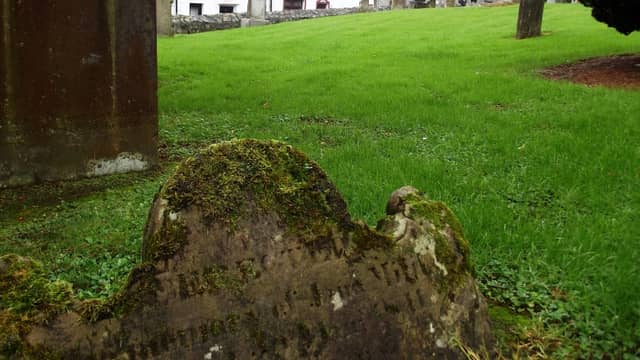

THERE’S something curiously captivating about an old graveyard. Yes, there are stories of heartbreak etched in those weather-beaten stones - particularly in the 18th and 19th centuries when so many children were taken too soon.
THERE’S something curiously captivating about an old graveyard.
Yes, there are stories of heartbreak etched in those weather-beaten stones - particularly in the 18th and 19th centuries when so many children were taken too soon.
But in the midst of the dead, the living history of the town is written too.
On a fine day, it is an engrossing way to wile away an hour or two, learning snippets about the people who passed this way many years before you or I.
And I am not alone. A visit to the archives reveals that many others have imagined the faces lost to those final resting places.
Back in 1962 writer Ann Ruthven paid a visit to All Saints’ in Antrim town centre where thousands of souls rest - many of the graves unmarked and others blasted clean over time.
And she soon found herself lured off the beaten track and away from the ‘marquee names’.
“I rather like graveyards. I find them very restful, even on wet days.
“I am not morbidly obsessed by tombstones and was frankly only mildly interested to discover that the ashes of Alexander Irvine - author of ‘My Lady of the Chimney Corner’ - had been brought to rest at Antrim.
“But I was very much taken with a headstone to which the rector, the Rev JH Hawkins, drew my attention.
“It reads: ‘Here are interred the ashes of the colours of the Dunbartonshire...’ It is difficult to decipher more. One presumes the missing word is ‘Regiment’.
“Now, why were the colours burned, and how did it come about that they should not merely have been put into hallowed ground, but marked by a stone? Strange speculations entertain the mind.
“I took a fancy, too, to a flat stone with no decipherable legends but a coat of arms - three right hands surmounted by a visored head above which rose an arm clutching a sword and about which curved leaves or feathers in bold design.”
There are many more stones still standing - some of them for centuries, each with a story to tell.
Ann concluded, wisely, that she would be back.
“One way or another I have had occasion to look into All Saints’ three or four times on my way elsewhere.
“I begin to feel, when I see the spire rising out of the sturdy square tower as I approach the town that this is a place one should stop in and visit.
“It pays not to rush through Antrim.”
Quite so, but perhaps one of her visits she should have considered a trip out to Muckamore too.
A curious reporter, known only as ‘The Chiel’, did just that in 1907 and - I’m glad to say - it is little changed almost 120-years on.
Muckamore, he said, ‘simply bristles with historic associations’.
“On the site now occupied by Muckamore House and gardens was once located one of the most celebrated monasteries in Ireland, founded St Colmanellus, who flourished about the middle of the sixth century,” noted the scribe.
“And the standing stones and raths and cairns would suggest that the neighbourhood has always been associated with activity in social and religious undertakings.
“Even within comparatively recent years - the ‘98 rebellion for instance - it was the scene of the meeting of the insurgents to make final preparations for that historic battle of Antrim which practically decided the fate of their cause.
“We find that the formation of the first Society of United Irishment in Belfast was soon followed by one at Muckamore and that this corps had arranged to take part in the review of 14th September 1793 which was frustrated by the appearance of the Fermanagh Militia.
“All warlike evidences have now disappeared. The little village hides itself away in a hollow to the left of the main road to Antrim - as if it were ashamed of its connection with the past.”
But then he chanced upon the old burial ground - ‘one of the quaintest little cemeteries you can find’.
“The little entrance fate is almost covered with bright green creepers, and there is a feeling of rest and peace within the walls that is exceedingly impressive.
“Immediately one has climbed the short flight of stone steps there is presented an array of tall iron railings as a reminder of days when the bodies of the dead were treated with scant respect.
“The cemetery is situated on the face of a little hill, and right at the top I can see a freshly-made grave on which the flowers are fragrant yet.
“Here and there peeping through the thick foliage and undergrowth are samples of ancient stones, but in most cases the records have been eaten.”
Some, but not all. One made of thick slate had a clear inscription which seemed to have been cut by the point of a knife.
Below a coat of arms and the motto ‘Industria Ditat’ - Industry Enriches - it read: ‘Here lyeth ye body of Nathaniel Waugh died Jany 13 1751 aged 19 years’.
Another small grave near the crest of the hill also caught his attention.
Though the top of the stone was broken, it read: ‘Servant of William Chaine and his wife and the nurse of their children of whom she was beloved. She died at her master’s house in old age affectionately attended to and regretted by all the family 3rd November 1837’.
Alas, the name of woman rewarded for her loyalty was lost.
The same can not be said of William. He was a man of means in his own right, but he became a major player when he married into the wealthy Whittle family - and it was their serious capital that helped him set up the bleachworks at Muckamore.
It was a lucrative move and soon the money was rolling in and they needed a grand home to reflect his growing status - so work began on Ballycraigy House, his ‘castle on the Rhine’.
Erected beside the location of the current 11th night blaze, this bonfire of the vanities proved to all and sundry that they had finally arrived. The Chaine gang were finally living the Downton dream.
And it seemed that this was one party that would never end.
In 1823 William Chaine decided to gamble everything on becoming Ireland’s biggest bleaching magnate - but for him to rise another had to fall.
And that patsy was the unfortunate Joseph Reford, the grandson of an early 17th century bleacher from Exeter. He had been invited to Antrim by the Clotworthys but when he began experiencing ‘cash flow problems’ he did not want to turn to his hosts.
Instead he set his sights on the nouveau riche Chaine clan, and the plot was hatched to fleece them of cash in a game of cards.
When he entered Ballycraigy Manor, Reford had no idea that the odds had been firmly stacked against him. William had planted a professional player at the table and he began chipping away at the errant Englishman. By the end of the night Joseph’s empire collapsed - like a deck of cards.
Chaine inherited bleachworks and greens, beetling mills, workers’ homes and a string of farms. Wealthy beyond his wildest dreams he set about a spell of rapid expansion. And if he could do that while driving any of his rivals to the wall, all the better.
Among his new acquisitions was the Muckamore Bleach Green, including the associated ‘houses, mills machinery, land, water courses, weirs, dams, rights’, a move that expanded his portfolio at the expense of the Thompson family from Greenmount. Soon New Lodge, Summer Hill, Firgrove, Moylena Cottage, Boghead and even the Antrim Quaker Meeting House were his.
The visitor to the burial ground then chanced upon another notable ‘resident’ - one of the people executed for his role in 1798.
John Storey had been in thick of it during the Battle of Antrim. He was blessed with a ‘brave and courageous nature’ but the same thing, apparently, could not be said for some of the troops under his command.
When the actual battle commenced, John was instructed to take his men into the town along what is now Railway Street - and dispose of any small pockets of resistance that they found.
But when John’s ‘fainthearts’ heard the roar of the cannon, the crack of muskets and the cries of the wounded at Market Square, they had to be forced to fight. Defeat was only a matter of time.
Realising that nothing remained in Antrim for him except certain death, John made tracks for a hiding place he had prepared for just such an emergency at Newpark.
But his escape was to be short-lived. He was betrayed by a so-called friend - a peace offering to help him bargain for a pardon.
He was tried on July 3 in Belfast by court martial and was sentenced to hang.
John’s head was then severed from his body, as was the custom of the day, and it was set up on top of the Market House, alongside James Dickey’s.
Ah yes, James Dickey. The promising young barrister from Crumlin breathed his last that summer too - laying down his life for his role in the Battle of Randalstown.
And this is where it gets tricky, for the courts ruled that the remains should not be released to the families, with the curious exception of leader Henry Joy McCracken.
Six others - William Magill, James Dickey, Hugh Grimes, Henry Byers and John Storey in 1798, and George Dixon in May 1799 - were long thought to have been buried near to where they had died. There would be no memorial. No headstone. They were effectively erased off the face of the earth.
So how come his name is listed on the Storey family burial ground at Muckamore?
The stone was erected by James Storey, said to be the last remaining member of the family who died in 1852, aged 66.
According to the stone, the John’s mother had died three years after the Battle of Antrim - her heart broken by the execution of her boy and the flight of his brother Thomas.
Their father died in 1818. The next name on the list was John ‘who died for his country, 1798’.So why was his name added 20 years after his death?
It is not known whether John’s decapitated body was eventually buried at Muckamore but it was ‘generally believed that it was’.
Says who? The claim was recorded in the 1870s by Miss Ellen McNally from Antrim, who was ‘a connection of the Story family’.
So maybe, just maybe, some time after 1818 John’s remains were returned and reunited with his parents.
Wouldn’t it be comforting to think that there was a happy ending, of sorts, to a very sad story of separation - in the truest sense of the word?
Our guide was intrigued.
“What a tragedy is hidden in the simple description,” he said.
“James Hope mentioned the incident in his song, ‘McCracken’s Ghost’.
“’While Storey lay martyred and Dickey lay dead, And the hands of oppressors on spikes placed their heads, Their spirits in glory triumphed to the skies, And proclaimed through the air that the Croppies would rise’.
“And here in this quiet little cemetery lies the hero without even the honour of a special epitaph.”
Before leaving, the writer noted many memorials to members of the Kelly family, who had been ‘captains all’. One had died in New Orleans, while another was lost in a hurricane off Mauritius.
There was a grave of the ‘philanthropic Bruce family’ who had an interest in Mill Row Church and lent their name to Bruce Memorial School.
“Almost every corner holds something of interest and I feel that my visit has not been in vain,” he concluded.
Indeed. After all, this was the history of Antrim carved in stone.