

Author Bruce resurrects the 'Ghost of Antrim Castle'!
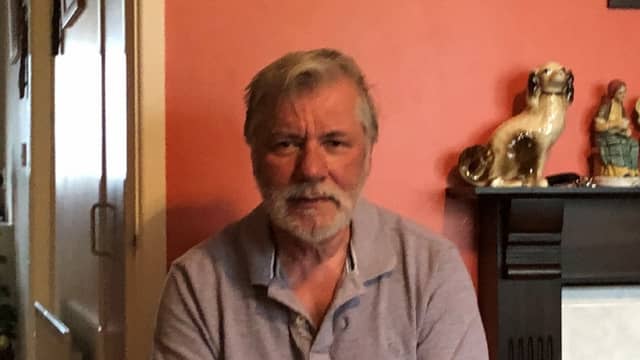

FIFTY-years-ago Antrim man Bruce Wallace bid a fond farewell to his hometown to pursue a career in Manchester - but in his imagination, he never left. The local man was born in Massereene Hospital in 1951 and lived with his family in the ‘prefabs’ on the Randalstown Road.
FIFTY-years-ago Antrim man Bruce Wallace bid a fond farewell to his hometown to pursue a career in Manchester - but in his imagination, he never left.
The local man was born in Massereene Hospital in 1951 and lived with his family in the ‘prefabs’ on the Randalstown Road.
In time they moved to the new houses on the Menin Road, a stone’s throw from Antrim Primary where he has happy memories of being taught by former Mayor Paddy Marks.
With his 11+ in the bag, Bruce pursued his studies at Ballyclare High School before starting as a student nurse at Holywell Hospital in 1968 where he qualified in 1971.
And then he found himself at a crossroads. He could stay or he could move to England to climb the career ladder - and he opted for the latter.
He moved to Manchester in 1972 and held various posts in Mental Health before moving to the University of Bedfordshire in 1994 as a Senior Lecturer.
Along the way he met his wife Denise in 1979 and together they had two children, Niall and Suzanne. More about them later.
Bruce may have moved on, but family ties ensured that he often returned home.
His mum, ‘a lively and sharp 94-year-old’, still lives in the town as does one of his two sisters.
“My wife and children spent many holidays based in Antrim and when not exploring Dunluce Castle, Portrush, Portstewart, Downhill, Ballycastle, or the Glens we spent quite an amount of time in the Castle Grounds - if not browsing the famous 50p Shop!” he told the Guardian this week.
“Sadly my father died in 2000. He first introduced me to Quigley’s billy goat as he was sometimes based at what was known as the ‘hut’. This was the small building used by the fishery for patrolling the Lough in search of poachers.
“I’m sure readers of a certain vintage will recall that goat!
“Down the Randalstown Road the old castle wall traveled some distance and at one point, close to the new entrance for the Boat Club, was another gate in the wall.
“This led down a small path past Quigley’s house and then over a small bridge. Eventually, you would arrive at the lough.
“Local legend had it that close to Quigley’s house was a large white billy goat with a penchant for attacking unwary travelers.
“Due to the nature of the terrain - the small hillocks, dips, and thicket - the goat could remain out of sight but close to whoever was passing before choosing his moment to charge!”
As the years passed, Bruce found that many of these childhood memories remained remarkably vivid - particularly the historic parkland that was the backdrop to so many of his adventures with his pals.
“When I lived in Menin Road I frequently visited the castle grounds,” he said.
“You walked down through Menin Road to Castle Street via Gaynor’s entry and its famous sweet shop.
“Walking up Castle Street you either entered the grounds through the main entrance, next to the old police barracks, or you went through the gate in the castle wall and past the caretaker Mr Creighton’s house to get to the lily ponds and castle ruins.
“I remember many a day playing at the castle ruins and the ‘Wedding Cake’. The Pump House was still standing too, although derelict.
“And then there were the tunnels. They were a magnet for children as you could disappear in one place and appear somewhere completely different. One even opened close to the edge of the river.
“There was also a large patch of tall bamboo close to the corner where the remaining tower still stands that allowed you to take cover when playing hide and seek.
“It was a popular game but occasionally other children became fed up looking and decided to end the game with some other youngsters still hiding!
“Children were often told not to play around the castle ruins or go into the tunnels as they were dangerous but telling children not to is often an open invitation for those children to see what all the fuss is about.”
Bruce often regaled family and friends with stories from his youth and slowly an idea took shape.
Why not commit his experiences to paper? Better still, he could cast his own children as the stars.
“I’m now retired I have been working on a story for a number of years, on and off - but I’ ve finally finished it.
“The book is loosely based on my own experiences enjoying the space and adventures linked to the old castle grounds, before the new road and loss of Castle Street.
“It is primarily aimed at older children but it would probably appeal to those old enough to remember the grounds when we were kids ourselves.”
Entitled ‘The Ghost of Antrim Castle’, the plot centres on the brief spell when locals became deadly serious about the seriously dead.
“I never personally met the White Lady but I did get to experience the adventure around which the book is loosely based,” explained Bruce.
“In the late 60s a ghost apparently appeared at the castle ruins attracting a lot of attention.
“It turned out eventually that a pair of barn owls had decided to nest in the ruins, but the hunt created a lot of excitement.”
The gardens have certainly changed since those halcyon days - so what is Bruce’s verdict?
“My views on the current grounds are rather ambivalent,” he said.
“I like the way the grounds have been paved and opened up as a local amenity. The cafe is very good and the gardens look very impressive.
“The other positive is the number of activities that have taken place in the grounds attracting visitors.
“The negative element is the sudden, quiet demolition of the ruins by the council when over many years opportunities existed to restore, or at least reduce the gradual disintegration, of the castle.
“I can only guess at how an attraction like the original castle would now stand in such delightful surroundings.”
‘The Ghost of Antrim Castle’ is available now on Amazon for Kindle, with a paperback to follow soon.