

Before leaving for the last time, evicted Randalstown farmer issued chilling curse
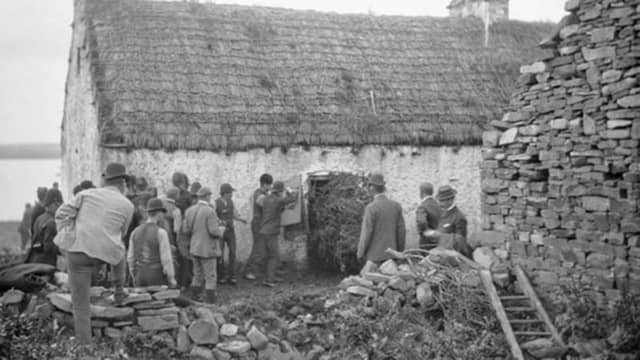

THERE’S an old Irish adage that says ‘you will never plough a field if you only turn it over in your mind’. It speaks of the necessary toil needed to work the land - the back-breaking work that will not do itself.
THERE’S an old Irish adage that says ‘you will never plough a field if you only turn it over in your mind’.
It speaks of the necessary toil needed to work the land - the back-breaking work that will not do itself.
Farmers would undoubtedly nod in agreement. It can be a hard life. The hours are long and the rewards often small.
But they know they will reap what they sow if they are just out standing in their own field.
And that was doubly true before the mechanisation of the way of the life during the 20th century.
Before that it was a Herculean task, demanding stamina and ingenuity to bend unruly crops and livestock to your will.
Rents were often high and they had to be paid, even when times were tough.
The alternative was to be kicked off your plot, leaving your family in penury.
That’s exactly what some locals faced back in the 1880s when a string of families were evicted from their farms.
And how they reacted underlines just how profoundly troubling the move was on them.
Back in June 1882 a farmer named McIvor who lived near Randalstown purchased a small holding nearby.
The previous tenant had been shown the door - and he was clearly not happy with that state of affairs.
A few days later a curious letter landed on the doormat. It contained no words, but the message was all too clear.
Inside was a ‘hieroglyphical inscription of a coffin’. This was a warning. Give up the farm or face the consequences.
The police were called but no arrests were made.
But the threat was taken seriously. The local constabulary confirmed that they would be patrolling the neighbourhood of McIvor’s farm nightly.
Another farm, about a mile from Randalstown, was at the centre of a dispute that same month.
The land had been purchased by a farmer called Gribben under similar circumstances.
When he took possession and began his labours, the former tenant arrived and said he would pay a heavy price if he put the spade in his ground.
Gribben downed tools - and went to the police.
The man who threatened him was brought before the magistrates and was bound over to keep the peace.
Old fashioned violence was perhaps to be expected, but another case in the district in the summer of 1882 went further still.
A farmer was forced to give up his farm after a decree was obtained against him for a private debt he could not or would not pay.
As resistance was expected, a stipendiary magistrate, with a police force of 50 men under Inspector Talbot from Antrim, boarded the train to Randalstown.
They disembarked at Cookstown Junction and embarked on a ‘rapid march’ to the farm.
But when the ‘ejectment’ was being affected something rather curious happened - a series of events that proved that the ‘old superstitution of cursing the ground is not extinct’.
After possession had been taken of the house, the evicted farmer bolted away and was seen systematically going around the farm and dropping on his knees in the four corners of each field.
When he eventually returned, the magistrate asked him what he was doing.
The breathless man confirmed that he was cursing the land, so nothing would grow.
He added that he was also praying that before the month was out, the man who ejected him would be in hell.
If he couldn’t have it, no-one else would.
Feelings were clearly running high - but then, so were the stakes.