

Behind the scenes at the Museum
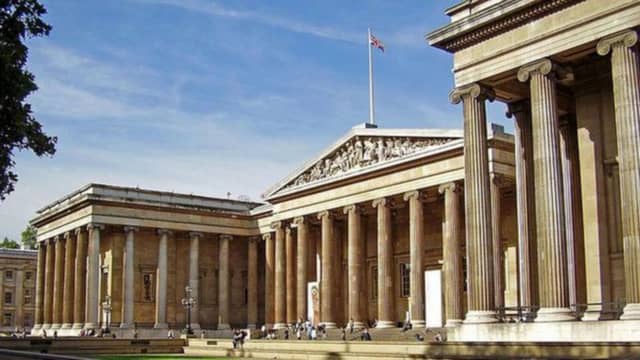

AS the provenance of items in museums is being thrown into sharp relief, particularly in the wake of the Black Lives Matter movement, the Antrim Guardian has had a look through the collection of the British Museum and has uncovered some local treasures buried deep within its imposing walls. The Museum’s ownership of a small percentage of its most famous objects originating in other countries is disputed - and remains the subject of international controversy through repatriation claims, most notably in the case of the Elgin Marbles of Greece, and the Rosetta Stone of Egypt.
AS the provenance of items in museums is being thrown into sharp relief, particularly in the wake of the Black Lives Matter movement, the Antrim Guardian has had a look through the collection of the British Museum and has uncovered some local treasures buried deep within its imposing walls.
The Museum’s ownership of a small percentage of its most famous objects originating in other countries is disputed - and remains the subject of international controversy through repatriation claims, most notably in the case of the Elgin Marbles of Greece, and the Rosetta Stone of Egypt.
A statement on the Museum’s website said: “The British Museum's collection has grown since 1753 and the acquisition of the founding collection of Sir Hans Sloane.
“Objects have been acquired in a variety of ways. Some objects are subject to questions about, or requests for, return to other countries.”
Statements on the most frequent requests and information on the current status are applied to items like the aforementioned Parthenon sculptures, the Benin Bronzes, human remains and items which may have been stolen by Nazis in World War Two.
Claims which have been settled include drawings, clocks and porcelain.
We went for a deep dive into the Museum’s website to find some of the less famous - and less controversial - pieces from our very own borough which are currently squirreled away in the London institution, and tell the story of the people who helped put them there.
From Antrim town, perhaps the most eye-catching item is an intricate glass bead, described as ‘barrel-shaped, blue with white and blue collar either end and two groups of vertical ribs with blue and white bosses between’.
The bead is described as being from the Celtic culture, from around the ninth or tenth century.
It was ‘found’ in Antrim town and remains on display in the museum, unlike many other pieces found locally.
It is said to measure to centimetres and is mentioned in Marzinzik’s Masterpieces: Early Medieval Art.
The bead was purchased from George Eastwood, from the Nightingale collection, and was acquired in 1862.
It now resides in the Britain, Europe and Prehistory Department.
An older piece is a ‘flaked and polished stone axe’ - with a chip in the butt.
The Neolithic/Bronze Age piece was excavated in Antrim.
It is not on display and was bequeathed to the museum in 1964 from the collection of Charles Taylor Trechmann.
Trechmann, who was born in 1885, was a local amateur archaeologist and geologist in North-East England, had an early friendship with Canon William Greenwell.
He excavated Hasting Hill, the finds from which are in Sunderland Museum and was a member of the Prehistoric Society from 1935.
He was a chemist by trade and following the sale of his family business he travelled widely, making important contributions to the study of the geology of New Zealand and the Caribbean in particular.
After his death in 1964, most of his collection was bequeathed to the Natural History Museum, which transferred his archaeological collections, mainly neolithic flint, to the department of Prehistoric and Romano-British Antiquities.
His Egyptian collection was bequeathed to the Royal Scottish Museum in Edinburgh.
Jumping forward in time, there are also several prints featuring views of Shane’s Castle from a series entitled ‘Milton's Views’, by Thomas Milton after William Ashford.
Milton’s Views is a series of topographical prints made by Milton, published either by the artist and by Walter.
The prints date from 1783 to 1793 and the British Museum houses a bound volume of the incomplete set.
One of the descriptions reads: “View of the castle across a bay; a group of people in the right foreground, with a horse and cart in the right foreground; in the middle distance on the left, a man riding a horse on a beach, a dog by his side, three cows standing in water; across the bay, the castle in the background; a ship sailing on the left.”
Two were purchased from Edward Daniell and acquired in 1877.
He was a major dealer in fine art and prints.
In business from 1827, the British Museum’s Prints and Drawings Department purchased much from the firm.
His successor was Walter V. Daniell, first in Mortimer Street, and later (c.1901) at 33 King Street, St James’s Square.
Two more were donated Nan Ino Cooper, Baroness Lucas of Crudwell and Lady Dingwall, in memory of: Auberon Thomas Herbert, 9th Baron Lucas of Crudwell and 5th Lord Dingwall.
The vast majority if items are fascinating alloy trade tokens, issued in the seventeenth century in England, Wales and Ireland by corporations, merchants and tradesmen.
There are arrow and axe heads uncovered in Crumlin and Donegore and from Lyles Hill, near Templepatrick, around 11 pottery vessels uncovered by an excavation were donated by the Ulster Museum in the 70s and are not on display.
Some of the Randalstown finds came from the Lough Ravel Crannog, located between the town and Toome.
In the 1970s, the Ulster Journal of Archeology said that the 19th century excavations of the crannog situated in Lough Ravel ‘have provided both museums and private collectors with a considerable body of material’.
James Graham-Campbell from the Department of Scandinatian Studies at University College in London told how a ‘somewhat drab’ pennanular brooch underwent detailed appraisa by Dr Francoise Henry in the 1960s, to support her theory that the Hiberno-Saxon style was a native Irish development.
The British Museum houses one of the bronze brooches uncovered at the site, made up of a hoop with animal head terminals with pear-shaped settings and sunken squares in centre, marked with cross-hatching.
There is also a pin-head with an incised six-pointed star within a rectangular panel.
The Celtic jewellery dates from the fifth or sixth century.
The brooch was purchased from the collection of Robin Day through French dealers Rollin & Feuardent and Sotheby’s auction house and was acquired in 1913.
Another find from Lough Ravel is an iron spear-head with a leaf-shaped blade and two projecting prongs from socket, said to be either Celtic or Viking in origin, from the ninth or tenth century.
The item was donated in 1880 by Sir Augustus Wollaston Franks.
Born in Geneva, Switzerland in 1826, Franks’ long career at the British Museum began in 1851 with his appointment as assistant in the Department of Antiquities.
He went on to serve as the Museum’s first Keeper of British and Medieval Antiquities and Ethnography (1866-1896).
He ‘greatly enriched the Museum's holdings through careful acquisition and the donation of his own vast and valuable collections’.
Franks died in London in 1887 and is buried in Kensal Green cemetery.
The monument above the grave has achieved Grade II Listing.
Franks was also one of the Trustees of the Christy Collection and associated Christy Fund, which from the late 1860s made major contributions to the development of the Museum's ethnographic and archaeological collections.
As a Trustee of the Christy Collection, Franks often used both the Christy Fund and his own money to acquire objects which were later presented to the British Museum.
Franks’ numerous donations to the Museum included a group of portraits registered 1895,0420.1 to 251.
His bequest included 70,000 items of printed ephemera including over 50,000 bookplates, trade cards, other printed ephemera and miscellaneous prints of various kinds. Each group of objects has its own form of registration number.
A Celtic iron knife from the Lough Ravel dig was donated in 1883 by Thomas William Usherwood Robinson.
A collector and manufacturer, of Hatfield House, Houghton Le Spring, County Durham, he also owned a brewery and was a church warden.
A Fellow of the Society of Antiquaries, he was a friend and collaborator of Canon Greenwell.
He was known to have a fine collection of flint and bronze implements.
From Toome, among the items now to be found in the British Museum is a small polished stone axe from the Neolithic or Bronze Age period.
It was acquired from Sir John Evans in 1870, funded by the Christy Fund.
Henry Christy bequeathed an additional £5000 for the development of the collection after his death.
The Christy Fund has enabled the museum to acquire many thousands of artefacts since it was established in 1865.
Sir John Evans as an academic and intellectual and collector of Nash Mills, Hemel Hempsted, Hertfordshire.
He was president of the Geographical Society, 1874-76; Vice-President of the Royal Society from 1876, Treasurer from 1878, President 1885-92; President of the Anthropological Institute from 1877-78; President of the Numismatic Society 1874-1908.
Sir John made a fortune in the paper industry with John Dickinson & Son, and used it to form large collections of antiquities (mostly now in the Ashmolean Museum), and patronise scholarship.
He donated objects to the British Museum and on his death in 1908 the rest of his collection passed to his son Arthur John Evans, the Keeper of the Ashmolean and later excavator of Knossos, and to his daughter Harriet Ann Longman and then in 1933 to his younger daughter Joan Evans.
How these local items got into the hands of the great and the good of global antiquity - well, that is a story for another day!