

Body worn cameras trial to begin in Antrim ED
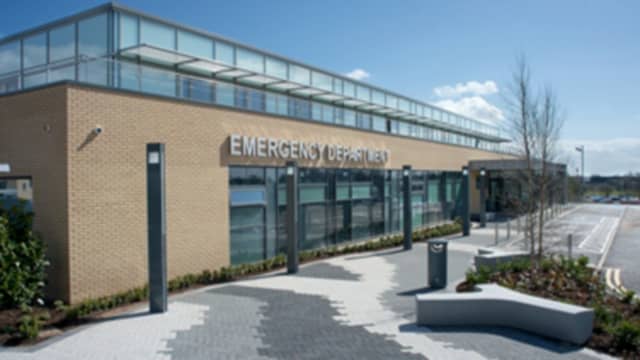

A REVIEW of security staffing did not take place as part of a consultation into body-worn cameras being used in the Emergency Department of Antrim Area Hospital. The Trust will be the first in Northern Ireland to pilot the scheme, which is aimed at reducing the number of incidences of violence and aggression towards healthcare staff, and enhancing safety for patients.
A REVIEW of security staffing did not take place as part of a consultation into body-worn cameras being used in the Emergency Department of Antrim Area Hospital.
The Trust will be the first in Northern Ireland to pilot the scheme, which is aimed at reducing the number of incidences of violence and aggression towards healthcare staff, and enhancing safety for patients.
Following a public consultation on the proposal, the Board of the Northern Health and Social Care Trust gave the go-ahead for the 12-week trial to start in September, which will carry the trial into the heart of the ‘winter pressures’ seen across healthcare settings.
Out of a total of 114 responses, 91% said they agreed with the Trust’s plan to pilot the use of body-worn cameras within the Emergency Department.
Analysis showed that 2,374 people were reached via the Trust’s website, 5,748 through X, formerly Twitter, and 323,773 on Facebook.
There were two information evenings with a total of 17 attendees.
Hundreds of local organisations and groups were also contacted.
Of the 114 responses, 104 agreed with the pilot, seven disagreed and three were unsure.
While most responses were in support body-worn cameras, a few concerns were raised.
Some respondents questioned whether body-worn cameras alone would significantly reduce incidents of abuse. Additionally, there were apprehensions about the potential misuse of the cameras.
It was highlighted that the use of the cameras is staff discretion, suggesting the need for guidance.
Others noted that cameras should not replace direct interventions to prevent patient-on-patient aggression.
The Trust responded by saying that a training programme is in place for all ED nursing staff with a focus on the Management of Violence and Aggression (MOVA) and the use of Bodyworn cameras are seen by the Trust as ‘a compliment to this training and forms part of a wider toolkit which can be utilised by staff in their response to an incident’.
The devices will not be set to record, meaning patient and healthcare work interactions will not be captured and they will only be activated for recording within the parameters of set Trust protocol and guidance on incidents of violence and aggression.
In terms of invasion of privacy, the importance of dignity and the vulnerability of patients, the Trust said said: “As healthcare providers we fully recognise that some service users with medical conditions or loss of mental capacity may sometimes display unintended or unintentional incidents of violence and aggression.
“Operators, being senior and experienced nursing staff will have the ability to factor such considerations when conducting a dynamic risk assessment which in-turn will inform whether a recording is made, ceased or retained.
“For example, clinical practice will not be recorded, nor will interactions in areas such as bathrooms.
“Sensitivity will also be given to individuals in a state of undress and distress. Professional judgement will be paramount in determining whether recording is suitable.”
In line with legislation, the Trust has a range of measures and strict standards to protect data held.
Data will not be kept for longer than it is needed and this is set out within the privacy notice and is in accordance with the Department of Health (DoH) Good Management, Good Records Disposal Schedule.
When devices are being activated for recording, the nurse will give a verbal announcement that they are activating their device and will briefly reference in said announcement their reasoning for activating the device.
A further verbal announcement will be given when the nurse decides to stop recording, typically at a point when the nurse perceives the situation to have calmed or de-escalated.
Body-worn camera footage will go onto a secure cloud-based system, which can only be accessed by designated senior staff.
The footage cannot be viewed or deleted from the camera itself. Access to data and functionality is controlled via software permissions.
The system retains a complete audit log of system activity detailing all parties accessing data, when data is accessed and how it is processed.
All service users captured on body-worn camera video footage, which was triggered by a violence and aggression incident, will have a right to request a copy of the footage from the Trust.
An Equality Impact Assessment (EQIA) was completed for this proposed service reform in line with the relevant law, section 75 of the Northern Ireland Act 1998.
The Trust added that the devices will be clearly visible on nursing staff uniforms and have a front-facing screen, by default, not be set to record.
There were also noted queries regarding whether the Trust conducted a review of security staff for involvement in the pilot; that the Trust did not clearly state if an offending patient would be refused medical treatment and that incidents would already be captured on CCTV by security if evidence is required.
The Board heard that no patient would be denied treatment, and that a review of security staff contracted by the Trust was ‘outside the scope of the pilot’.
Whilst there are security CCTV located throughout the ED, these are not in all areas and do not offer sound or a first person view of the recorded incidents.
The meeting also heard that unions, which originally had concerns about the proposed pilot, are now fully behind the trial.
As part of the consultation, Trust staff liaised with top police officers working in the field of body worn cameras, health trusts in England who are already using the technology and the Northern Ireland Ambulance Service, which has reported less aggression incidents since the introduction of cameras.
Anne O’Reilly, chair of the Trust Board, said: “Sadly, we have become accustomed to reading headlines about health and social care staff being attacked or subjected to wholly unacceptable abuse.
“We know that the vast majority of people who attend our Emergency Departments are respectful of our staff and only a very small number engage in unacceptable behaviour – but even one is one too many.
“Of course, it’s disappointing that we are even having to consider such action, however, we hope that this pilot will act as a deterrent and make people stop and think about their behaviour towards our staff, and indeed other patients.
“It’s encouraging to see that the overwhelming majority of respondents to the consultation (91%) are supportive of this pilot going ahead and, as a Board, that gives us a great deal of reassurance that this is the right course of action.”
Last year, the Department of Health launched a new framework to help tackle violence and aggression towards health and social care staff, accompanied by the campaign strapline: “Violence and aggression. It’s not part of the job.” It was developed by the DoH in partnership with HSC Trusts and Trade Unions.
The Northern Trust has also established its own internal MOVA (Management of Violence and Aggression) working group and has developed a staff toolkit to equip managers with a dedicated resource to support team members and colleagues who have been impacted by violence and aggression in the course of their duties.
Audrey Harris, the Trust’s Director of Medicine and Emergency Medicine, said there was collective recognition of the need to enhance safety for both healthcare professionals and patients in high-pressure environments.
She added: “We owe it to our staff to do all we can to address violence and aggression in the workplace.
“Emergency Departments are always extremely busy and staff are working in very challenging circumstances under huge pressure to provide care for all those who come through the doors; they need our support.
“They should not have to deal with or tolerate any form of abuse; nor should patients have to witness those kinds of unacceptable behaviours.”
During the trial, signage will be placed in the Emergency Department to make patients and visitors aware.
When the pilot concludes, it will be fully evaluated and an outcomes report brought back to Trust Board.
The consultation ran from 23 January – 1 May 2025.