

Borough braced for nuclear annihilation
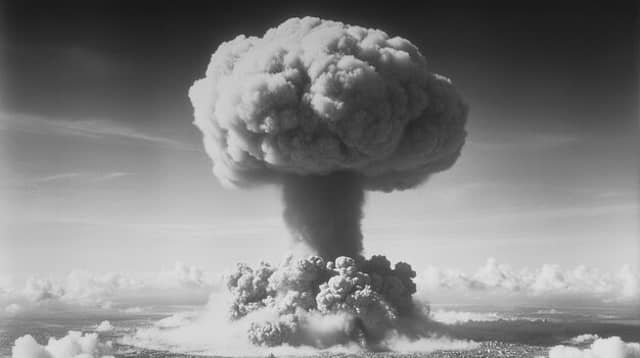

BACK in 1984 the threat of nuclear annihilation seemed all too real - a case of ‘when’ rather than ‘if’.
The Cold War was continuing to bite, and even perfectly sensible folk harboured dark fears of itchy fingers hovering over launch buttons in Washington and Moscow.
It was the era of ‘Two Tribes’ by Frankie Goes to Hollywood, ‘99 Red Balloons’ by Nena - and it was the year of ‘Threads’, an apocalyptic vision of life in a northern town after the bomb dropped.
The uncompromising BBC drama was strong meat by any standard, and images of mushroom clouds, melting milk bottles and that baby horrified audiences and galvanised a generation.
But even before it aired, it has emerged that the Borough had been quietly bracing itself for the terrifying fall out of a full-blooded nuclear attack.
Yes, in May 1984 details of local plans ‘in the event of nuclear war’ were unveiled - and probably did little to dilute mounting disquiet!
It was confirmed that Antrim Borough Council’s offices at the Steeple, a building which now ironically looks like a bomb went off, was to be administrative headquarters of the district if the worst were to happen.
At a ‘Civil Defence Seminar’ in the Dunadry, the Northern Ireland Office confirmed that Sam Magee, then the council’s town clerk, would be promoted to ‘district controller for Antrim’.
His team would have a mixture of civilian officials and military personnel and the mild-mannered Mr Magee would assume ‘autocratic power’ in the area if it became cut off from the regional control centre.
An NIO emergency planner said the nerve centre at the Steeple would be tasked with the collection and dissemination of information, advising the public and ‘establishing local priorities’.
They would also organise ‘survival tasks’ and volunteers and provide a control centre and public shelters.
Preparation was key. While still in ‘peace time’, the council was charged with designating and training a control team and preparing their headquarters - and to earmark community centres for ‘war time functions’.
Scary stuff. But it was not the first time locals had been forced to confront the nuclear threat.
Back in 1957 the UK Atomic Energy Authority was considering building one of their new-fangled nuclear power stations in Northern Ireland - and they reckoned a site on the eastern shore of Lough Neagh between Antrim and Lurgan was the most promising.
The water, they said, was key - as they would need vast quantities of the stuff for cooling purposes and waste disposal.
It never happened, of course - and thank goodness, according to one wag writing two decades on.
‘At least Sellafield continues to give us more than our fair share of nuclear waste products via the Irish Sea which warmly laps Ulster’s enriched shores. Where else could you get fresh fish already half-cooked?’ he asked.
‘When it came down to economics, Northern Ireland never did have the concentration of population or industry to make a nuclear power station viable. Pity, really, because pouring radioactive waste into the lough might have helped sterilise the sewage before the water was returned to the drinking supply...’
Joking aside, in 1964 the serious question of nuclear war surfaced again when the province took part in a ‘mock attack’.
At 5am on a Saturday morning a shower of missiles was air burst over Belfast, Larne, Ballymena, Carrick, Bangor, Newtownards - and Antrim - to assess the potential impact.
Unsurprisingly the attack, which was organised by the Northern Ireland Hospital Authority, caused ‘widespread heavy damage’.
With Belfast all but wiped out, doctors, nurses and auxiliaries from the reserve pool at Muckamore Abbey were prepped to receive casualties.
The war games continued in 1970 when members of the Royal Observer Corps took part in a ‘nuclear war’ over an otherwise unremarkable weekend in June.
A number of imaginary hydrogen bombs were dropped by the enemy on various parts of Britain, including Northern Ireland, and volunteers from ROC outposts plotted the positions and power of the explosions and tracked the deadly radioactive fallout. All this data was fed back to the underground operations room.
Progress was charted by Air Commodore Dennis Rixson, Commandant of the ROC, who was taking part in a visit to the province at the time. He even addressed VIPs at a special meeting in Hall’s Hotel in Antrim.
As the 1970s proceeded, there was evidence that local people were playing a quiet part in the UK’s nuclear umbrella.
People like local farmer Alec Coleman, who tended the land at Coleman’s Corner out at Lisnalinchy near Ballyclare.
Under the telephone table near the front door sat a squat grey box that provided him with a direct link to the UK’s national nuclear defence chain. It was one of nearly 300 in County Antrim back in 1978.
Each week they dutifully switched it on and listened to the regular ticking sound that indicated that the system was working. If it was silent, they had to report the fault. To the post office.
But what if there was an attack?
“We haven’t really been told what to do,” said Mr Coleman. “My idea would be to telephone as many and let them know what is happening. I suppose I’d phone the police station first.”
By the mid-1980s there were a network of bunkers in Northern Ireland too - though Government Minister Nicholas Scott insisted that both Protestants and Catholics would share the space! Yes, Whitehall insisted that no efforts would be spare to ensure that volunteers and scientific advisors came fairly from both communities...
By 1988 the threat even entered debate on much more grounded matters when Dr McGuigan, the chairman of the Northern Board, tried to end the debate about the location of the new Area Hospital - when he warned that ‘only a nuclear war’ would prevent it coming to Antrim!