

Bringing the Battle of Antrim back to life to mark 225th anniversary
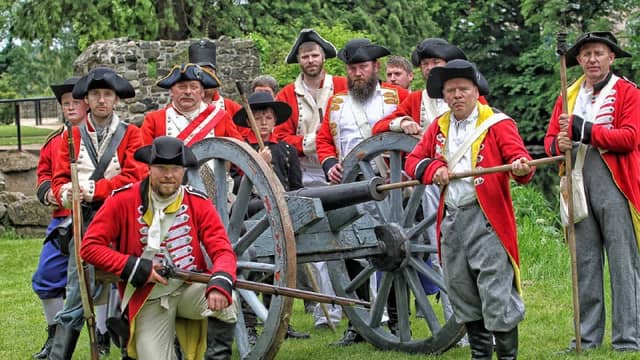

THE organisers of a thrilling, up close re-enactment of the Battle of Antrim have pledged to bring this key moment in local history back to life this weekend. Albert Titterington, Director of Country Lifestyle Exhibitions - the organisers of Antrim’s hugely popular Irish Game Fair - has highlighted the huge significance of the Battle back in 1798, and revealed an exciting programme for spectators in the town on June 3.
THE organisers of a thrilling, up close re-enactment of the Battle of Antrim have pledged to bring this key moment in local history back to life this weekend.
Albert Titterington, Director of Country Lifestyle Exhibitions - the organisers of Antrim’s hugely popular Irish Game Fair - has highlighted the huge significance of the Battle back in 1798, and revealed an exciting programme for spectators in the town on June 3.
The re-enactment will mark the 225th anniversary of the bloody events - and there will be two ‘performances’ in the Castle Gardens at 10.30am and 2.30pm.
Spectators will thrill to the crash of muskets, the flash of bayonets, the clash of pikes and swords, and the billow of gunpowder smoke from the cannon and other weaponry.
All this will be played out against the sound of marching kilted pipe bands and the traditional echo of Lambeg drums.
There will also be an historical display of artefacts and a chance to visit the re-enactors encampment in the break between performances to give families the opportunity to really immerse themselves in ‘real living history’.
And better still, it’s free of charge!
Albert Titterington said it was timely to revisit the turbulent events that unfolded that fateful day.
“It is no exaggeration to claim that the Battle of Antrim was a pivotal battle in the 1798 Rebellion and indeed a pivotal event in the history of Europe,” he said.
He added that a unique map of the time had been created featuring the major battles of the rebellion as, a clever visual way to literally put Antrim’s history ‘on the map’
“We only need look first at the history of the times and the changes it could have brought.
In the late 1700s revolution was in the air with the American Revolution 1775-1783 and the French Revolution 1787-1799.
“These revolutions and tensions between France and England, leading to the outbreak of war between France and England in 1793, inspired the setting up of the Society of the United Irishmen in 1791, firstly in Belfast and then Dublin.
“The membership of both societies was initially middle-class, and Presbyterians predominated in the Belfast society while the Dublin society was made up of Catholics and Protestants.
“Their main objectives were parliamentary reform based on universal male suffrage and complete Catholic emancipation and the elimination of British rule in Ireland.
“This desire for change ultimately filtered down into a radical working class movement organised on military lines.”
Albert highlighted the events which were to take place in Antrim that would have huge historical significance.
“On 6 June 1798, Henry Joy McCracken, the leader of the United Irishmen in County Antrim, issued a proclamation calling for the United Army of Ulster to rise.
“He knew that the magistrates were due to meet in Antrim town on 7 June and sent orders for garrisons in Randalstown, Larne and Ballymena to be attacked, while he and James Hope, with the men of Belfast and South Antrim, would lead the main attack on Antrim town before marching on Belfast in conjunction with the United Irish rebels in County Down.
“However, the attack on Antrim was repelled and the United Irishmen scattered in disarray.
“Had the small British garrison not stood firm and the 10,000 plus Antrim rebels joined up with the Down, Wexford and other groups of rebels, the history of Ireland, Britain and Europe could have been very different.”
The re-enactment will be filmed and photographed on the day.
Both performances will feature red coated troops with cannon, muskets, and fife and drummers facing rebels armed with muskets and pikes together with their Ulster Scots pipe bands.
Antrim based, Living History Ireland, will field over 100 people in costume.
The rebels will attack troops defending part of the wall of the old castle as part of a noisy and colourful pageant indicative of what actually happened in the battle.
An informative commentary will be carried on throughout the re-enactment, and, when it is finished, the leaders of the combatants, Major Daniel Seddon and Henry Joy McCracken, will be interviewed, and the public can also speak with them and examine their weaponry.
Two cameos of the Battle will be re-enacted including the attack on Lord O’Neill, the County Governor, which ultimately resulted in his death and the legend of local woman Peggy Gordon who it is alleged helped retrieve the British Cannon when they were overrun.
To illustrate the pivotal role that the Battle of Antrim played in the Rebellion and ultimately in the history of Europe and of course to literally ‘put Antrim on the Map,’ the organisers have produced a copy of the Beaufort 1797 map of Ireland (the map which would have been used by the British forces) with the main battle sites marked on it.
Albert added: “The public will have a unique opportunity to ‘mix and mingle’ after the performance with the re-enactors at the re-enactors’ encampment, chatting with those involved and examining the period costume and authentic weaponry of the time.”
The event is being co-ordinated by Country Lifestyle Exhibitions Ltd in association with Living History Ireland and the management team of the Castle Gardens.
For further details call : 028 44839167 or email [email protected]
There are other events celebrating the 225th anniversary of the battle including a play and battlefield bus and walking tours on June 5-9. For further details visit : https://antrimandnewtownabbey.
gov.uk/events/2023/june/
battle-of-antrim-225th-anniversary