

Budding journalist Max has his own big news story with major heart op

HE’S often graced the pages of the Antrim Guardian and has even presented a bulletin of BBC Newsline, but now Antrim boy Max Buick is making the news himself after undergoing his third open heart surgery. Neale and Carol Buick’s nine-year-old son Max had twice already undergone open heart surgery by the age of six, with the first operation required on the day he was born.
HE’S often graced the pages of the Antrim Guardian and has even presented a bulletin of BBC Newsline, but now Antrim boy Max Buick is making the news himself after undergoing his third open heart surgery.
Neale and Carol Buick’s nine-year-old son Max had twice already undergone open heart surgery by the age of six, with the first operation required on the day he was born.
Max also has ADHD and autism and a condition called Duane Syndrome.
The couple were told that he might not survive into childhood after he was born, but the youngster is now proving those initial predictions wrong and is a popular pupil at Riverside School.
Carol explained: “He has had his third Open Heart Surgery which is called the Fontan.
“The 6-7 hour long procedure will give him a new circulation system. This should make his oxygen levels higher and Max in turn will be pinker and less blue in colour.
“He should have more energy. During previous operations he has struggled with fluid on the lungs.
“We were expecting this at this surgery and yes Max has struggled. He also had another three hours in theatre to get lung drains in and also get a PICC line.
“He has been unbelievably strong, brave, resilient and Neale and I and all our family and friends are incredibly proud of him. In Max's words he said ‘let's do this and let's get back home to Antrim’.”
The Fontan procedure is a type of open-heart surgery. Children who need this surgery usually have it when they’re 18–36 months old.
The Fontan procedure is done for children who are born with heart problems like hypoplastic left heart syndrome, tricuspid atresia, and double outlet right ventricle.
Normally, the right ventricle pumps blood to the lungs to get oxygen, and the left ventricle pumps the blood with oxygen to the body. But in some types of heart problems, one ventricle is too small.
Then, the other ventricle not only has to pump blood to the lungs, but also to the body. And the blood that it pumps to the body is a mix oxygen-rich blood and oxygen-poor blood. The body can’t thrive if it doesn’t get enough oxygen.
After the Fontan procedure, the blood from the lower body goes directly to the lungs. The blood with high oxygen goes into the heart.
This way the single ventricle only pumps blood to the body; only pumps blood with high oxygen to the body and there is no more mixing of oxygen-rich blood and oxygen-poor blood.
During the Fontan procedure, the surgeon disconnects the inferior vena cava (IVC) from the heart and connects it to the pulmonary artery using a tube.
They will also makes small hole between the tube and the right atrium. This hole lets some blood still flow back to the heart.
It prevents too much blood from flowing to the lungs right away so they have time to adjust.
Doctors can close the hole later.
Children who have the Fontan procedure usually spend one to two weeks in the hospital to recover. They get round-the-clock care and monitoring. They also get medicines to help the heart and improve blood flow. They will keep taking some of these medicines at home.
During this time, the care team teaches parents how to care for their child at home.
They usually can go home when they are feeding well, growing well, and gaining weight and many kids thrive and do well after heart surgery.
Children like Max who have undergone the procedure will need to see a cardiologist regularly for further monitoring.
The procedure was initially performed in 1968 by Francis Fontan and Eugene Baudet from Bordeaux, France.
Max and Carol were first whisked to Evelina London Children's Hospital, a part of Guy's and St Thomas' NHS Foundation Trust, from Belfast International Airport at the start of March in an air ambulance operated by Woodgate Aviation.
They have also been looked after by Ronald McDonald House and have had visits from friends and family from Antrim.
Ronald McDonald House provides free ‘home away from home’ accommodation.
The charity runs 14 houses across the UK to give families a warm and comfortable place to rest, eat and relax, just moments away from their child’s hospital ward.
It hasn’t been an easy time, with Max spending time in Intensive Care and PCCU - the pediatric critical care unit.
Max is also on a low fat diet now due to a condition called chylothorax to reduce the production of fatty fluid build up.
“Max is so happy and upbeat,” said Carol.
“My wee heart warrior amazes me every day but especially his strength and determination.
“He is back to chatty Max and checking my Facebook.
“He now is very much part of the ward round and has questions every time they come round and some of them are very funny.
“Max is loving meeting all the nurses, doctors, physios, play specialists, dietitians, cleaners, actually anyone who will chat and say ‘hi’.
“He has a star chart and is rating each professional he meets out of 10 Stars!
“Everyone is loving him and he is becoming quite the celebrity
“He is missing home and all the people he knows and speaks to daily. The staff in London have been absolutely amazing.”
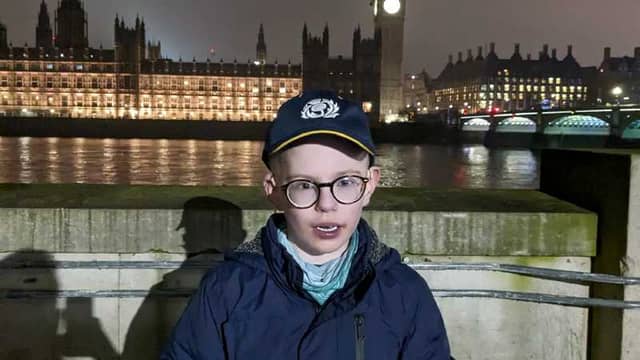
During his stay, Max was promoted to ‘PICU 1 co-ordinator’ and was given a pass, and before surgery even bumped into DUP politician Edwin Poots near the Houses of Parliament.
And he’s been asking his physiotherapists to patronise a special bedside ‘shop’ he has set up.
He’s also been catching up with his school work and of course, keeping an eye on the news, clutching his trusty notebook!
We at the Antrim Guardian and all our readers wish Max all the very best for his recovery and hope to see him back home soon.