

Clan gathering comes to Randalstown
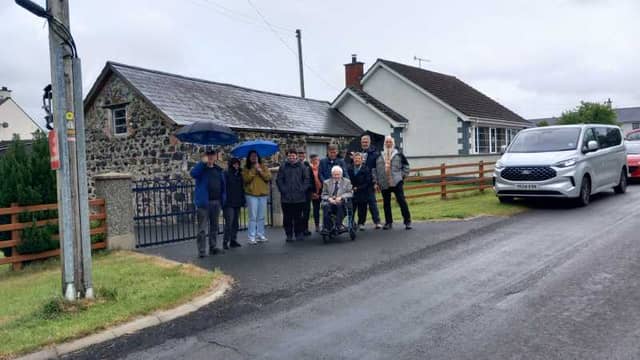

A GROUP of sixteen Clan Hannay members hailing from the USA, mainland Britain and a few from Ulster descended on the area between Randalstown and Ballymena during the recent late May Bank Holiday in a tour of sites linked to the Scottish origin Hanna family surname. The Clan Hannay Society in Wigtownshire, SW Scotland hosts an annual Clan Gathering in the village of Sorbie at the clan’s historic castle, Sorbie Tower, every year.
A GROUP of sixteen Clan Hannay members hailing from the USA, mainland Britain and a few from Ulster descended on the area between Randalstown and Ballymena during the recent late May Bank Holiday in a tour of sites linked to the Scottish origin Hanna family surname.
The Clan Hannay Society in Wigtownshire, SW Scotland hosts an annual Clan Gathering in the village of Sorbie at the clan’s historic castle, Sorbie Tower, every year.
This year the opportunity was taken to have an event following the Gathering in County Antrim, a county with many links to Scotland and where many Scots came from to settle in the north of Ireland in the 17th century.
The tour began in Randalstown at the Old Round Church, an 18th century Presbyterian church, where many Hannas worshiped in the 18th century before emigrating to Colonial America.
It was also an epicentre of the United Irish Rebellion of the 7th June 1798 that involved more than one Hanna family member.
The group then visited the farmhouse where William Hanna the Hollywood cartoonist’s grandfather, Peter Hanna, was born in 1841 in Aughalish townland just outside Randalstown.
They then visited the John Hanna Linen Works in Kellswater, Connor Parish which was founded in 1798 and is still going strong today as the principal site for finished Ulster Linen.
They then saw a typical old Ulster Scots farming clachan called ‘Hannastown’ in Cromkill Townland before the half day event culminated with a dinner at a very congenial historic pub, The Thatch Inn, in Broughshane.
The tour was well received and the overseas visitors enjoyed their visit.
The Clan Hannay historian, Dr Keith Hanna, provided a geopolitical and social history talk at each location to illuminate this unique south County Antrim Hanna heritage trail and how the region’s local history and geography impacted the mass overseas emigration of Hanna families from Ulster in the 18th and 19th centuries that has spread the surname across the world.
In April, the Antrim Guardian revealed that a new connection had been made by the Dr Hanna between the area and one of the world’s most famous animators.
Dr Hanna was born in Kilkeel but now lives in Wales.
According to Dr Hanna, the relatives of William Hanna, the cartoonist, knew that his grandfather, Peter Hanna came from Ireland with his brothers to Michigan in the late 1800s but they lost track of where the family were from in Ireland.
Because the family moved around a lot in America, they lost track of their Ulster roots.
Dr Hanna took up the story, saying: “About two years ago I tried to bridge the chasm and after several false trails I discovered that Peter Hanna was born in 1841 near Randalstown on a farm farmed by a group of Hanna brothers, who all left en masse for America such that the family surname subsequently died out in the townland completely by the early 1900s.
“I have shared this information with the son of William Hanna the cartoonist, David Hanna, in Los Angeles.”
Born in New Mexico in 1910, William Hanna joined a California engineering firm after studying engineering and journalism, but lost his job in the Depression.
As he could draw, he found work in cartoon production on the West Coast.
In 1930, he joined Harmon-Ising Studios, which created the Looney Tunes and Merrie Melodies cartoon series.
In 1937 he joined Metro-Goldwyn-Mayer as a director and story man in the animation department.
Joseph Barbera was working as a bank accountant with the Irving Trust Company in New York City during the early 1930s when he started submitting cartoons to magazines; he sold his first to Collier’s magazine and decided to forsake banking for cartooning. He joined MGM as a sketch artist in the same year as Hanna.
Within a month, they had teamed up with and the greatest team in American cartooning was born.
At MGM, Hanna and Barbera created the Tom and Jerry characters and produced more than 200 films in the series between 1940 and 1957.
They won seven Oscars from the Academy of Motion Picture Arts and Sciences for their cartoons between 1943 and 1952.
After MGM closed its animation division in the 1950s, Hanna and Barbera moved into TV, founding their own company - Hanna-Barbera and made a huge number of cartoon series for television.
The pair’s first production - Puss Gets The Boot won an Oscar nomination. Three years later The Flintstones were born, before Hanna Barbera swapped the stone age for the space age with The Jetsons.
Many others followed: Top Cat, based on the Phil Silvers character Sergeant Bilko, Wacky Races with Dick Dastardly and his sniggering hound Mutley, Yogi Bear, The Hair Bear Bunch, Huckleberry Hound and Hong Kong Phooey.
They were derided for employing cut-rate, limited animation techniques, which allowed for the timely production of television cartoons, but they were praised for the quality of writing found in their most successful productions.
Their production company also produced the highly popular Scooby-Doo animated cartoon series.
William Hanna died just over 24 years ago. Cartoon Network, which screens many Hanna Barbera favourites, said: “William Hanna will be remembered as one of the all-time great animators.
Another famous William Hanna was the founder of Randalstown Rugby Football Club (RRFC) which celebrated its 75-year anniversary recently in 2022, the club having been founded in 1947.
Rev Hanna’s grandson, William D Hanna, William D. Hanna was born in Belfast and studied in Edinburgh, Limoges, and at the College of Europe in Bruges. He was an Irish and European diplomat and served as EU Ambassador in Tanzania, Uruguay, Bangladesh and Ghana.