

Council proposes parking charges at Mossley Mill as staff prepare to move from Civic Centre, blaming train users

ANTRIM and Newtownabbey Borough Council says it is ‘committed to reducing the need to have two dedicated Civic administration Buildings within the Borough’, according to a planning document. The Antrim Guardian revealed last year that there are plans to rent out Antrim Civic Centre, which is only a decade old, and move staff to Mossley Mill. It is understood that the tenant is the Education Authority.
ANTRIM and Newtownabbey Borough Council says it is ‘committed to reducing the need to have two dedicated Civic administration Buildings within the Borough’, according to a planning document.
The Antrim Guardian revealed last year that there are plans to rent out Antrim Civic Centre, which is only a decade old, and move staff to Mossley Mill. It is understood that the tenant is the Education Authority.
As part of a planning proposal to introduce a paid ticketing and barrier system to the car park, a document said that ‘plans are underway to locate staff from other sites to Mossley Mill’ and due to the nature of the site there are limited areas available to increase the size of the current car park.
The site has also recently been the location for anti-immigration protests outside full monthly meetings of council.
A Design and Access Statement has been prepared in support of a Listed Building Consent submitted on behalf of Antrim and Newtownabbey Borough Council.
The application seeks permission to install an Access Barrier System with standalone ticket machines within Mossley Mill Site.
The report said: “This installation focuses on the council’s ability to control the who enters the facility’s limited car park, as members of the public have been observed parking their cars, then using the train station, returning nine hours later, therefore depriving the staff and other users of the Mill amenities the ability to park at the Mill.
“On investigation, the car park is used by members of the public who use the nearby train station, parking and leaving their car before 8am and returning after 5pm rather than using the railway car park. These spaces will be required to accommodate relocated staff and members of the public.
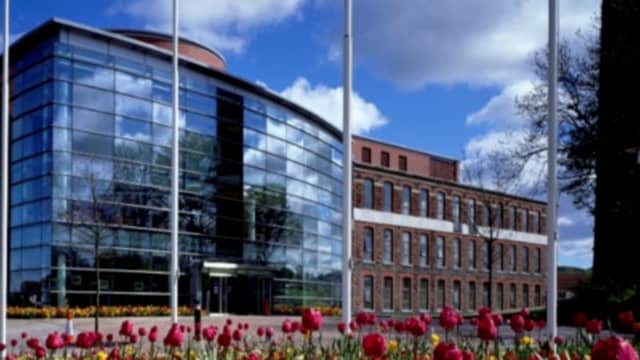
“The site is a refurbished former Linen Mill complete with mill pond and steeple chimney with a mill race comprising of two four-storey office wings north and west with a glazed circular stair well connecting them, a courtyard with a modern design arts and theatre building.
“Any cable trenching works will done on the grassed verge which will be reinstated. The barrier system will be located within 15m of the main entrance from Carnmoney Road North.
“The site has historically evolved to accommodate a range of uses over time, reflecting the adaptive and layered character typical of the heritage environment. The proposed location for the access barrier is within 15m of the access road leaving Carnmoney Road North within external boundary of Mossley Mill straddling both exit and entrance lanes, additional width will be taken from the no-parking hatch.
“A new island will be constructed where the barrier arm mechanisms will be housed, communication ducts will be extended from existing to provide power and data.
“Two ticket payment kiosks will be installed, one beside the disabled bays to the front of the Mill, the other will be located to the rear of the Theatre.
“If in the future the barriers are deemed not to be required then they can be removed with no detriment or damage to the historical fabric of the building, (the) traffic island can be removed and the tarmacked over, payment machines can be moved and blanking plates put over access ducts.
“Consideration has been given to complement the character and setting of the listed building. The lightweight and reversible nature of the barriers system ensures that no permanent or physical alterations are made top the listed building.
“The proposal achieves a sensitive balance between Heritage protection and the function of access control supporting the long term stewardship of this Heritage site.”