

Dáithí's Law: giving and receiving the gift of life
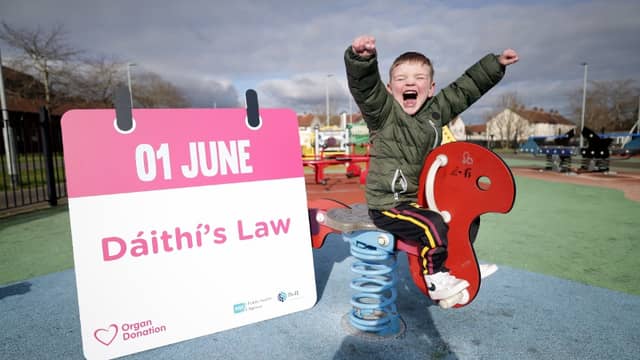

GIVEN the choice most would do all they could to save a life. Well, wouldn’t we? The heart-breaking truth is that 15 people languishing on the organ transfer waiting list in Northern Ireland in 2021 died before that life-saving call came.
GIVEN the choice most would do all they could to save a life. Well, wouldn’t we?
The heart-breaking truth is that 15 people languishing on the organ transfer waiting list in Northern Ireland in 2021 died before that life-saving call came.
But things are changing - and the seismic shift has been largely driven by a six-year-old boy from Belfast and his family.
From June 1, all adults in Northern Ireland will be considered potential organ donors unless they choose to opt out or are in an excluded group.
The Northern Ireland (Executive Formation and Organ and Tissue Donation) Bill received Royal Assent this week, finally bringing the province into line with England, Scotland and Wales.
The council has been a vocal supporter of the move. They voted unanimously to back the change back in 2019 - and the move was enthusiastically applauded by little Dáithí Mac Gabhann who was present in the council chamber with his father.
Dáithí was born with Hypoplastic Left Heart Syndrome, which left him with half a working heart. He had his first procedure at just four days old. In January 2018 his parents received the devastating news that a transplant would be his only hope - and he has been waiting ever since.
But with Dáithí’s Law now on the statute books there is now fresh hope for the youngster and people like him.
This week the Guardian looks back at some of the local people who have given and received the gift of life.
The legal landmark will undoubtedly be welcomed by a former Antrim soldier who has been seeking to enlist more volunteers to consider organ donation for decades..
Almost 35 years on from the death of a teenager he had raised as his own, local man Ian Yarwood has made an impassioned plea for people to consider a living legacy after their own death.
Ian knows what difference it can make - after all, he has been there.
Nothing can replace a loved one, but he insists that the comfort his family and friends have drawn from making sure that four people were not taken in the first place helped them in their darkest hour.
The local man admits that the events of summer 1988 will stay with him forever.
Eighteen-year-old Billy loved the open road and he desperately wanted a motorbike - and he was not going to take no for an answer.
His mum Anne and Ian were initially hesitant, but eventually agreed and on July 7 they travelled to Ballymena to pick up a gleaming new 125cc Gamma racer.
“He was so excited,” recalled Ian.
“I got him the bike, leathers, helmet, signed all the documents and off he rode into the sunset, waving to me. He was delighted - we both were.
“We used to warn him about speeding, road safety and all the usual but his mates all had motorbikes and they were a great group of lads so we thought he would be fine.”
Life as they knew it changed forever on July 31 when reports filtered through of a single vehicle road traffic accident on the Dublin Road in Antrim.
It happened near a sharp bend heading out towards Crumlin - and it involved a young man on a motorcycle.
A nurse living nearby heard the commotion and she administered CPR until the ambulance arrived. But it was clear that the patient’s injuries were bad. Very bad indeed.
Initially, Billy was taken to the Waveney Hospital but given the severity of his injuries, he was quickly transferred to the Royal Victoria.
His mother had been informed and was racing towards Ballymena - while Ian was unaware of the tragedy unfolding until he was approached by a UDR patrol in Tardree Forest.
“The patrol commander was a good friend of mine and he informed me of what had happened and I started heading to Ballymena too, hoping that we were only looking at a few broken bones.
“On my way along the A26 I saw an ambulance coming the opposite way with its blues and twos on. I knew Billy was on board. I just had a real gut feeling about it.
“In case I was mistaken I headed on to the Waveney but I was immediately informed to get to the Royal Victoria. Anne was already on her way.
“I eventually got there and met up with Anne and we were told that he had suffered massive brain injuries and was on life support with very little chance of survival.
“How do you prepare for something like that? He had that bike for three weeks and it was the end of him.”
They remained at his bedside knowing their boy was not going to wake up. This was a long goodbye. Every parent’s worst nightmare.
But out of that unimaginable darkness came a powerful beam of light. This could not be allowed to be a senseless loss of a promising young life.
With Billy slipping away from them, they decided to seize the opportunity to give hope to other families also facing heartbreak and loss.
After Bishop Cahal Daly administered the last rites, arrangements began in earnest for transplant - and they were determined to help as many people as possible.
At that time kidney transplants were common in Ulster hospitals, but experts from London and Manchester jetted over to assist with the removal of the liver and heart too.
“The consultant, Mr Evans, explained to myself and Anne that this was a first for Northern Ireland. Surgeons were flown in on Learjets to give the gift of life.
“A six-year-old girl from Edinburgh got a kidney, and a nine-year-old girl from Manchester got the other one. A 40-year-old man from Birmingham got Billy’s liver.”
Billy died on August 8 - and the numbers 8/8/88 will be forever burned into Ian’s memory.
A life had been lost, but four more had been saved, and many of them will have gone on to have children too.
Ian has urged everyone to make their wishes known when it comes to organ donation.
“I’ve drawn so much comfort from the fact that some good came from a tragedy,” he said.
“That week in the RVH was the worst ever and I hope and pray that no-one reading this finds themselves in the same situation.
“It’s not a comfortable conversation to have, but it’s an important one.
“Anne and I never regretted our decision. Billy’s dream of joining the Royal Air Force never came true, but his death saved the lives of four people.
“There are people living and breathing today because of what happened here in Antrim on a summer’s day more than 30-years-ago. That’s amazing.”
Inspired by the modern miracle of organ donation, Antrim man Drew Murray volunteered to go under the knife to become a living donor.
Back in 2015 he was deeply moved by the plight of a little girl undergoing constant dialysis treatment when she was featured in a morning television segment presented by Eamonn Holmes.
“I said to my wife, Trish, if I could help that wee child, I would,” said Drew.
“But I wasn’t sure what I could do.
“The wee soul was missing out on her education because of it and it just wasn’t right so I phoned the City Hospital and with help from the Northern Ireland Kidney Patients’ Association, things started from there.”
Drew, then 56-years-old, then went on to attend an initial consultation where, after undergoing a general health check, he learnt that he would first need to make some lifestyle changes if he were to be considered a candidate for live donation.
“It was a real eye opener,” he recalled.
At 17 stone, the surgeon was unwilling to operate on Drew owing to the potentially lethal danger of placing him under anaesthesia, and he was further surprised to learn that his high blood pressure put him squarely in the ‘borderline’ category at risk of Type Two Diabetes.
Therefore, Drew was told that he would not be eligible to donate a kidney until his weight dropped to 13 stone.
Sticking to his stern new fitness regimen, Drew also joined the Randalstown-based weight-loss group We Slim Together for support and weekly weigh-ins and, around four months later, he had managed to lose an impressive four and a half stone.
Returning to the City Hospital for a number of appointments, tests, CT scans and x-rays- or, as he described it, a ‘wee MOT’ - Drew was given the thumbs up and matched with a 54-year-old woman from London.
She had previously received the devastating prognosis that there was a 99 per cent certainty that a viable kidney donor would not be found for her, and so Drew’s determination to donate came as a particularly welcome beacon of hope for her and her family.
“My kidney went to her and her partner donated his to someone else and I think all in all, it resulted in three kidney transplants that day.
“And, because it came from a living donor, the kidney should last 12 to 15 years whereas a kidney which comes from a deceased person may only last five to six years.”
Despite having the opportunity to pull out of the transplant right up until the last minute on the day of the operation - November 11th, 2015 - Drew insisted that he never felt any real sense of doubt or reluctance around going ahead with the procedure.
Afterwards Drew was ‘thrilled’ to learn that the woman who received his kidney recovered well after the op, adding that it was ‘all you need to hear’.
“I’m so pleased I could help that woman and if it encourages one more person to do it, then that’s brilliant,” he said.
Word of Drew’s altruistic actions quickly spread through a community amazed at his resolve to save the life of a stranger in need. Eventually, news reached Eamonn Holmes - the very man who drew his attention to the urgent need for donors in the first place.
“Thank God for people like Drew,” Mr Holmes said.
“Drew Murray claims I was the inspiration he needed to make the decision to donate a kidney to a stranger. But he’s my inspiration and I hope he inspires lots of other people too.
“Drew is quite simply a good man, a decent man who was brave enough and generous enough to make a momentous decision which in the end saved three lives. In my eyes, he’s a hero we should all be proud of.”
Quite so. What a gesture. What a gift. Remarkable in the truest sense of the word.
But what about those living on the edge who have been given a second chance?
Back in 2017 Antrim man Mark Smyth knew that without a liver transplant he was a dead man walking - but he also knew that his family and friends were marching by his side.
Doctors had warned that he had at best 20 months to live if he did not receive a transplant. The father-of-four knew that time was not on his side.
Faced with that dreadful deadline many would have thrown in the towel, but in that extraordinary Antrim Guardian interview Mark insisted that he had no intention of leaving his loving family any time soon.
Through no fault of his own or his family he suffered a disturbing childhood trauma that cast a long shadow over the rest of his life. Even now, over three decades on, it remains too intensely personal to share publicly. But it’s there nonetheless.
He suffered from depression and anxiety and was eventually prescribed heavy duty medication to combat the symptoms. Unbeknownst to him one of the tablets he took, often washed down with booze, was nick-named ‘the liver eater’.
Serious damage was being done, though he was oblivious to it until his body starting shutting down in December 2016. The ticking timebomb was primed to explode.
“My stomach was churning and eventually I went to the toilet and was violently sick,” he recalled.
“I vomited pints of clotted blood, some of it red, some of it black. It was a very frightening experience.”
He called his mum Shirley and she raced over to help him. An ambulance was called and he was taken to hospital where he was rushed into theatre. Surgeons warned that he had a ‘50/50 chance’ of surviving the operation - and that the road to recovery would be a long one.
“Up to this point we had no idea what was wrong. He was never in hospital, yet here he was at death’s door.
“It was heart-breaking to watch. I didn’t think he was going to make it. I was actually planning his funeral in my head.”
He pulled through - only just - but it was clear that the only thing that could save him was a transplant.
And then the call came. There was a liver. A family were saying their goodbyes to a loved one, but they wanted to honour their wishes and offer the organs for transplant after life support was switched off.
He was in theatre later that day and it proved to be anything but routine. The surgeons worked for 12 and a half hours to keep their patient alive. His kidneys had started to fail, he had bled profusely and there was 10 stone of fluid to contend with.
Heavily sedated, Mark was taken to Intensive Care and given dialysis.
His mum Shirley said he was in a ‘sorry state’ when they got to his bedside - but he had lived to fight another day.
He returned to Northern Ireland in August 2018 and was soon getting stronger by the day. He was, said Shirley, ‘like a new man’.
“Thank God, he’s on the mend. It will be fantastic to get him home again.
“Our lives have all been on hold for the last 20 months but now he has been given a second chance. It’s a miracle. It really is.
“There were times when he was really low and in a lot of pain when I couldn’t imagine there being a happy ending to this.
“The support we have received has been phenomenal. People we didn’t even know have approached us to say that they were praying for us.
“I couldn’t pray for Mark to get a new liver, though, because for that to happen someone else had to die.”
After the initial elation, Shirley admitted that she had been thinking a lot about the benevolent stranger who had given an extraordinary gift to her boy.
“You do think about that family and what they are all going through. We can never thank them enough for what they have done.
“It’s overwhelming really, to consider that in their darkest hour they still thought about others.
“Mark was really ill. He could not have been more sick - but we’ve got him back because someone, somewhere decided to become a donor.
“Through their death, they are giving life to another. It’s a wonderful thing to do - to save another family from going through the heartbreak of loss.
“We are so lucky. So blessed. So grateful.”