

Did a Presbyterian help burn down Antrim Castle?
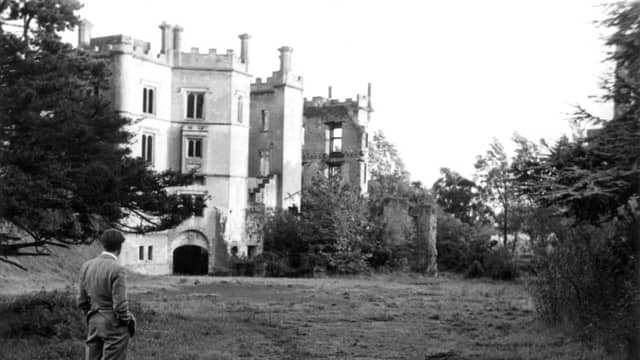

THIS year Antrim Town held a number of commemorations to mark the anniversary of the burning down of Antrim Castle, writes Stephen McCracken. The castle went up in flames in the early hours of the 28th of October in 1922 as a result of arson which was unanimously blamed on the Old IRA.
THIS year Antrim Town held a number of commemorations to mark the anniversary of the burning down of Antrim Castle, writes Stephen McCracken.
The castle went up in flames in the early hours of the 28th of October in 1922 as a result of arson which was unanimously blamed on the Old IRA.
History has more often than not aligned the IRA with the struggle of the Roman Catholic people’s fight against the past inequalities.
Indeed, it has attracted a lot more from one side than the other, however when we look at the South Antrim area at the time when Antrim Castle burned down, the old narrative may not be quite what it seems - or to be expected.
Over the past few years, I have collected and heard a number of stories from South Antrim including ‘old IRA’ activity from the 1920s.
One tale was that the Presbyterians actually were involved with the burning down of Antrim Castle - which seemed quite ridiculous and normally probably wouldn’t have seen the light of day.
Looking back at my previous research found that many Presbyterians, over 100 years earlier to 1922, had tried to take the previous incarnation of Antrim Castle in 1798.
Next year marks the 225th anniversary of that conflict.
Continuing the radical strain within the local population and taking into consideration the past 120 years of redirection towards Unionism, it seemed very unlikely that the Presbyterians would have been involved with the 1922 castle destruction or associated with the aims opposite to that of the Unionist community.
However, within the Military Records held in Dublin we have a witness statement by a man whose family had previously come from Cranfield on the Shane’s Castle estate, but now resided at Altmore House in Tyrone, by the name of O’Shiell.
O’Shiell’s father had been a lawyer and he then carried on his father’s occupation, he was running as a candidate in the 1918 election and had campaigned in Antrim and Randalstown, narrowly avoiding a riot in the latter town, when two groups of opposing ideological Protestants clashed during his speech on market day.
His statement was given to the Judicial Commissioner of the Dail Eireann Land Court a few years previous to the burning of Antrim Castle, which shows that the ‘secret’ President of Sinn Fein for this South Antrim area was in fact a Presbyterian pig farmer.
The transcript is as follows: “One day, he took me by car to attend a meeting of the South Antrim Comhairle Ceanntair (Sinn Fein county committee who oversee the parish branches. The branch itself would’ve been called a Cumann of Sinn Fein).
“It was to meet in the house of its President, who was a large farmer, and a Presbyterian in religion.
“The farm was situated in that progressive agricultural country between Antrim Town and Randalstown.
“We drove up a pleasant avenue, lined with trees, coming to a large, handsome dwelling-house. Our host, the President, whose name I am sorry to say I have forgotten, was a tall, spare, young man, in the early thirties, I should say, with a neatly cut brown beard.
“He was a cultured, quiet-spoken man, with a remarkable knowledge of Irish history and traditions, a very sincere, fervent and convinced Nationalist of the strongly separatist and republican type.
“He gave me a meal, after the Comhairle Ceanntair. I was, of course, not a member; neither was Eamon Donnelly who was also present, nor, I imagine, old Dobbyn from Belfast.
“The President was a good chairman, and was re-elected to that post, despite the fact that some ignorant bigot raised the question of his religion - the one jarring note; but he was promptly and effectively sat on by the others, and reminded that this was not a meeting of the Ancient Order of Hibernians.”
This statement shows that at the time of the castle burning down, three years previously, the head of the Sinn Fein council for South Antrim was a respectable Presbyterian pig farmer.
The deposition goes on to state that the agriculture supporters filled a public house in Randalstown.
Collected personal local folklore actually gives a name to this man and another who was involved in the burning down of Antrim Castle, both of these being of separate religions.
One being a tall 6 foot 2 inch farmer from between Randalstown and Antrim. Local lore also states that this Presbyterian farmer and others were personally responsible for the burning of Lord Massereene’s summer barges moored on the Lough on the same evening of the burning down of the castle.
I have been told that these barges had the Massereene cost of arms engraved and were not liked by the local Antrim fishermen.
Of course many others could have been involved of various religious persuasions.
We do not have any solid evidence to attach the burning of the castle on anyone, only folk lore and names and memory - which keep repeating themselves.
The official verdict for the attack and burning down was inconclusive and no insurance was paid out.
O’Shiell lost the election in 1918 and returned back to Dublin where he was practicing.
His great uncle, who he was very proud of, was General James Shields (who boasts his own statue in Washingon DC) who was a soldier, statesman and lawyer.
He later become a Senator in Washington.
General James’ father Charles would often visit his father’s home at Cranfield on the Shane’s Castle estate and noted within the Shiells family archive is a story of how Charles Shiells saved two children on the lough, belonging to the Shane’s Castle land agent.
By October 1922, the Old IRA was basically a spent force, many of its leadership in the north had been arrested and interred.
Michael Collins, who had been in real control of the northern IRA, had been assassinated in August 1922.
It would have been highly unlikely if this Antrim/Randalstown undercurrent of nationalism was able to raise its head in 1922 to attack the Castle - reprisals would have been swift and extreme.
Maybe a candle being knocked over did in fact start the fire, however too many questions remain unanswered and this could have been an orchestrated rouge attack, when it was realised that the castle had been left unguarded by the RUC when they withdrew their protection.
On the recent commemoration tour, we were told a number of small fires were started around the castle and one of its residents were heard shouting that ‘they’ had set the place on fire.
However in a twist of fate within my research when I thought I was ‘done’ with the burning of Antrim Castle, I have come across a witness statement to the Irish Bureau of Military History from an IRA C-Company 2nd Battalion Captain called Thomas Fitzpatrick (born, in Cavan going by the name of Bob McDonnell) who was previously a Lieutenant in the British Army and who served all over Europe including the Dardanelles and Palestine.
He said: “That night the 2nd Battalion were detailed to burn Ballymena station, making a feint attack on the barracks in Antrim town.
“They were to burn Massereene Castle, which at that time was guarded by a force of ‘B’ Specials.
“During the attack on Massereene Castle they' carried out Lady Maseerene, who was pretty old, and had her wrapped in rugs on the lawn, while the castle was being destroyed.”
This testimony was taken in 1950 and is fairly conclusive that the IRA burned down Antrim Castle - Fitzpatrick was the Officer in Command of the Northern IRA.