

'Dr Alexander Irvine was vain, obsessed with his legacy and his writing was poor'
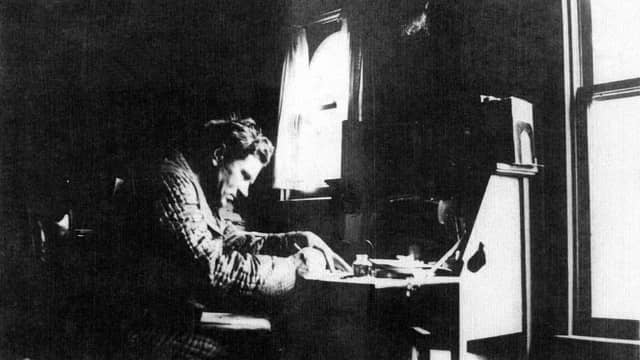

TALK about slaughtering a sacred cow. Alexander Irvine has been venerated as Antrim’s most successful literary son - a man who rose from the most humble of starts to global fame.
TALK about slaughtering a sacred cow.
Alexander Irvine has been venerated as Antrim’s most successful literary son - a man who rose from the most humble of starts to global fame.
He was the son of Anna and Jamie, she a Catholic and he a Protestant who ran a modest cobbling business from the small cottage in Pogue’s Entry they shared with their 12 children.
Life was hard and the privations were many.
Irvine later recalled scraping offal from the pavement near a butcher’s shop to get a morsel of meat to quell the all-pervading hunger. He worked as a lad too to supplement the family’s income, taking jobs as a paper boy and even as a scarecrow to earn a few pennies.
But despite the aching poverty, his was a house filled with love. And, ultimately, that was enough.
Blessed with a fierce intelligence, the Antrim man eventually decided to widen his horizons. There was a stint in the navy before he attended Oxford University (1887-88).
Then came the momentous decision to cross the Atlantic, where the lessons of his own upbringing saw him drawn to missionary work with the impoverished people on skid row at the Bowery in New York.
Shortly after he landed, on July 12 1889, came the devastating news that his beloved mother had died back home in Antrim.
He worked on through is grief, answering his new found calling by pursuing further studies at Yale (1900-1904). During his final year there, his father died in Antrim Workhouse.
Irvine had left that life behind him and he was determined to make the most of the opportunities he had created for himself.
But he did not forget. In 1913 came ‘My Lady of the Chimney Corner’, his immortal tribute to his mother. It was a global smash that cemented his name in the literary world.
There was another side to the Antrim man too. In 1916 Lloyd George personally asked him to become Chief Morale Raiser for the exhausted troops at the western front.
More books and plays would follow, and there were infrequent trips back to Antrim - the last in the 1930s when he paid an emotional final visit to Pogue’s Entry where his extraordinary journey had began all those years ago.
When he finally breathed his last on March 15 1941, plans were soon drawn up to reunite him with his parents, who lay in the grounds of All Saints Church.
The second World War was raging, however, and the long journey home would not be made until July 1946 when his ashes were finally returned to his childhood home.
From his birth in abject poverty to his death in a mansion in the Hollywood hill, this was a true rags to riches story.
But what if it were not all strictly true? What if it was his journey was his real life’s work - carefully curated by the man himself?
Well, that’s was fellow literary giant John Hewitt believed and the Belfast man had an advantage over many - because he had actually met Irvine.
Writing in 1957 before he too left Northern Ireland by sending himself to Coventry, he admitted that he knew ‘the Legend’ long before he had read the books.
‘For the period between the wars the best loved Ulster author was Dr Alexander Irvine, and it is likely that no book with an Ulster setting sold more copies than ‘My Lady of the Chimney Corner’, and no literary portrait has proved more generally acceptable than that of Anna, the rather idealised evocation of the author’s mother’, said Hewitt.
‘I grew up somehow always knowing Alexander Irvine’s name, the title of his book and a rough outline of his career from the streets of Antrim to the pulpits of the New World through the varied activities of stableboy, Royal Marine, milk roundman, mission worker, actor, author.
‘My parents, eager in their attendance at the lectures he gave on his periodic visits to Belfast, provided the easily assimilated information. But it was not until the thirties that I encountered Irvine himself.
‘He then engaged in a temperance campaign in a local church, and rather against my will I was persuaded to go one evening to hear him.
‘I had recently read his popular book for the first time, and had found it, while moving in parts, on the whole poorly written, cloyingly sentimental and insufferably stage-Irish in its rendering of the Antrim dialect’.
Nevertheless, he was rather surprised to concede that he was impressed by what he saw and heard.
‘Listening to him very critically, if not at first wholly unsympathetically, I was soon convinced of his platform skill. My standards were high, for I had heard many good and, maybe, three excellent orators.
‘With my new-found respect, the following Sunday I went back to hear him deliver a sermon proper. This, too, was a first-rate achievement, well proportioned and memorable’.
And that’s when the penny dropped.
‘By then I had discovered the key to his remarkable character. He was truly a self-made man.
‘An artist at heart, he had taken himself and his material and had carefully built-up and composed a superb personality, which, so far as I could ever find out, fitted in every part. Voice and gesture, even the physical appearance itself had been shaped and determined by the creative mind within.
‘This was clearly the reason why his writing was inferior. His true medium was the spoken word of Alexander Irvine, and the best of his thought had gone into the creating and keeping consistent of that image and its attendant legend’.
A few days later Harry Midgley, another enthusiast, persuaded Irvine to give a talk in the Labour Hall, then in York Street.
‘His address was magnificent, his gestures more emphatic than I had so far seen. A wide range of experience and knowledge, never to be guessed from his pulpit utterances, was brought to bear upon the problems of social justice and the historical role of the Church in relation to them.
‘This was the Irvine who, along with the turbulent Jack London, had been among the founders of the Socialist Party of the United States. When we foregathered in a little tea shop afterwards he was still a little on the crest of the tide of his eloquence, and we who were there felt the stir and movement of a great occasion in our hearts.
‘Irvine’s appearance at the Labour Hall caused some consternation in certain quarters, for always before his local sponsors had been respectable citizens of a conservative temper.
‘I cannot set down the whole story here, but on his next visit to the city he told me a great deal about the backstage scene that resulted from his deviation.
‘Incidentally, on this occasion - it was at breakfast in the Kensington Hotel - he forecast light-heartedly who would be at his ultimate interment in Antrim Churchyard, and what would be publicly said of him.
‘In due course they were there to a man, and the eulogies followed his prophecy. I was not there, but I read about it.
‘At any rate, after his Labour Hall oration Irvine never gave a public address in Belfast again, although he came back a couple of times. On his last visit he gave a brief talk on the radio in Children’s Hour.
‘This time he stayed with my sister and her husband for several weeks, endearing himself to their two little daughters, remembered still as an old man who told them marvellous stories and sent them lovely dolls from California.
‘While he was at this hospitable house, John Luke made the drawing for the fine portrait now in the Belfast Art Gallery.
‘Having read with the greatest care every book of his which has come my way, I believe that I understand him.
‘By far his best work is from the early autobiography, ‘From the Bottom Up’, which has its place with the books of Frank Norris, Upton Sinclair and others in the American literature of social protest. There is in it a frankness in statement and an economy in expression which he never afterwards attempted.
‘To set page after page of this volume against the relevant passages in the later ‘Autobiography of the Fighting Parson’ is to reveal how much Irvine made of himself, suppressing, generalising, elaborating, adding, rephrasing, to achieve greater consistency with the Legend, until a portrait of a man emerges complete and whole, which on another level might be taken as tinctured with insincerity, with vanity, with an avoidance of unpleasant facts.
‘So far as he is remembered now, the Legend is triumphant and the celebrated Pogue’s Entry is, save by pedants, accepted as his birthplace.
‘But it was surely in full realisation of his own share in our general need for pardon and forgiveness that he asked for his mother’s epitaph to be engraved ‘Love is Enough’, and the same stone covers the ashes of a great-hearted and lovable man’.
Compare that with the oration given over his grave in Antrim by the Bishop of Down and Dromore, the Rev WS Kerr.
“He was, in his generation, the most distinguished son of this town. By his aspiring courage and fortitude he rose above the penury and illiteracy of his youth.
“Few men can have had a more severe or prolonged struggle.
“Our admiration goes out to Irvine, not only for the ability and determination by which he broke his birth’s invidious bar, but for his faithfulness to high ideals.
“He did not devote himself to the acquisition of wealth or station. Less brilliant, less cultured men than he have done that successfully and with the world’s applause. He gave himself to the unselfish service of man.”
Quite the tribute. And Alexander Irvine, if Hewitt is to be believed, expected no less...