

DUP leader has ‘no holds barred’ discussions with locals
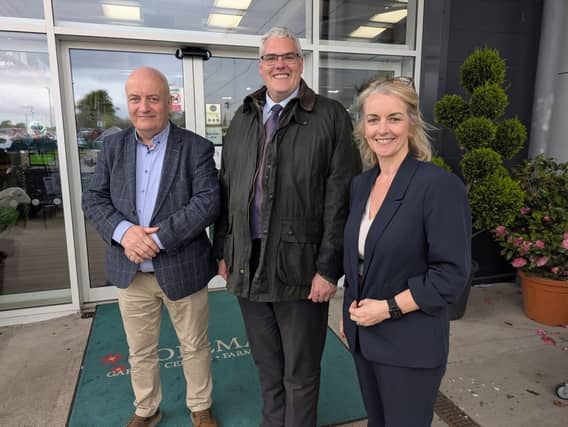

DUP leader Gavin Robinson visited the South Antrim constituency last week to speak to voters about pressing issues in the area.
Accompanied by South Antrim MLAs Trevor Clarke and Pam Cameron.
He met with community and sports groups in Mallusk and local businesses in the borough, saying he enjoyed a ‘no holds barred’ discussion on ‘a whole host of issues’ with residents, covering issues like ‘immigration and social cohesion, wastewater infrastructure and community services’.
Mr Robinson said that there was awareness of the resurgence of nationalism across the UK and the threat to the union, and a desire for better traction on council services.
But he added: “There has been a lot of engagement with local councillors and with Trevor and Pam and it is encouraging as party leader to see a strong connection with elected reps and I have a great appreciation for the work being done on the ground.”
Mr Robinson said that there is a lot of concern about the use of Chimney Corner Hotel to house asylum seekers, and Antrim and Newtownabbey Borough Council is currently investigating a potential breach of planning regulations.
“The next challenge is, when it closes, what happens, if these people are decanted into communities where there is already insufficient housing stock, school places and doctors appointments, hospital beds, placing unfair pressure on an already pressured community.”
In terms of Houses in Multiple Occupation, he said: “The licencing regime doesn’t take sufficient account of the impact on local communities. It is almost the view if you are a developer and want to squeeze every penny out of the building without any account of impact on surrounding streets and neighbours, you apply for an HMO licence and it is unsustainable.
“HMOs and asylym provision are not proportionally spread across Northern Ireland.
“Immigration is a Westminster issue but housing is a Stormont one. Westminster chose to use hotels but when people are decanted, then our system suffers further and our infrastructure doesn’t have the capacity to cope.
“From our perspective there is too much of a concentration east of the Province and next to nothing in the west, it is almost non-existent in some areas but there is a disproportionate burden being placed on Belfast and the surrounding areas.”
Mr Robinson said he had helped uncover the Muckamore Abbey Hospital abuse scandal after a constituent raised issues about the treatment of their son.
Local people have expressed concern that parts of the facility may be used to house asylum seekers when it closes to patients, although the Belfast Trust has not commented on the speculation.
Mr Clarke has raised the issue at Stormont.
Emphasising that the site should remain in the health sector, Mr Robinson said: “The priority should be transferring ownership from the Belfast Trust to the Northern Trust before taking it out of the health sector.”
Both Mr Clarke and Mrs Cameron attended a meeting in Antrim last week aimed at building community resilience in flood-hit areas.
Mr Robinson said his own constituency had been badly hit by flooding and said that residents deserved to have their homes protected and that housing associations had a bigger role to play in helping to make sure their tenants were protected.
Mr Clarke said that there were issues in the planning system and that council planners had no basis to override the advice of professional consultants.
He said that he did not believe any community resilience group meetings had taken place since the catastrophic floods of 2008.
Mr Robinson encouraged people to get out and vote.
“If you fail to vote or ignore it, if you don’t use your vote tactically or sensibly, then there is no point complaining afterwards.
“We want to see co-operation between unionist parties, if we want to see councils and Stormont reflective of an area, people have to vote for those who share the same values and those who not only recognise the challenges but are prepared to work together to fix them.
“There is a lot of agitation within politics and what we have seen in the last five years on social media is not being represented on the streets in a negative way.
“We need to demonstrate to people that politics works for them.We now say things that in the past people wouldn’t have liked you to say, people are not delving issues around immigration in case they were misconstrued. We don’t do it to be provocative, we do it because there are concerns within the community and people want to hear representatives giving them a voice and speaking out on those concerns and providing solutions and we will do that, when not all politicians will.
“Some politicians continue to sneers at folks, continue to demean the concerns that they have, tell them that they just have to suck it up if they don’t like it.
“That is not what you will get from the DUP. That doesn’t mean that we are going to be misled or misguided we need politics to work.”
Mrs Cameron said that people are ‘nervous’ in terms of knowing what language to use and were scared of being accused of being racist.
“The public are raising these issues on the doorsteps, people feel hemmed in and they are not allowed to openly say things or be judged for asking a question.”
Mr Robinson said: “We’ve seen what happens when there’s a vacuum where politicians fear to tread into this space, and this is where vigilantes are going out and causing problems and intimidating people.
“That’s a consequence of the failure of the political system to engage and solve the problems. “We would much rather engage with democratically elected opponents who might disagree with us, but recognise that when there are issues we have to solve them.”
On local business growth, Mr Robinson referenced the negative response to the recent rates revaluation, that hospitality is ‘under the cosh’ and businesses are being ‘taxed to death’ through National Insurance and employer contributions, tax thresholds and VAT.
“The economy is stagnating as conditions for growth are not manifesting themselves from national Government, so that is a challenge for businesses.
“I don’t know where the national Government is going to go. I don’t know if there is going to be a new chancellor or not. From our perspective, we have to look at business and economic drivers and we need to see a Government that responds to the needs of our business community.”