

Going back in time through the archives this Christmas to tell Dunadry's real-life Toy Story
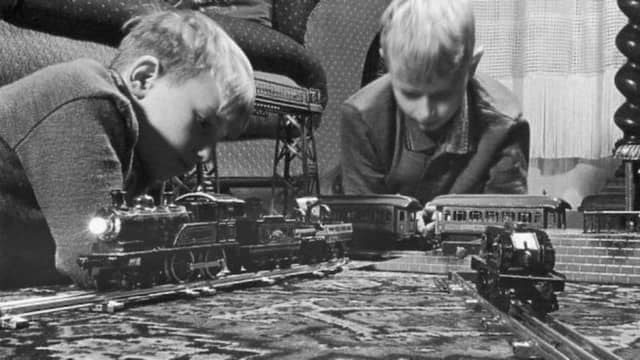

AS children all over the borough look forward to opening their presents next week, we take a stroll - or should that be a train journey - back through time into the British Newspaper Archives to see what the young people of 1950 might have expected to find under the tree. And in a copy of the now-defunct Ballymena Weekly Telegraph, we unearthed the tale of the thriving toy train factory located right here in Dunadry.
AS children all over the borough look forward to opening their presents next week, we take a stroll - or should that be a train journey - back through time into the British Newspaper Archives to see what the young people of 1950 might have expected to find under the tree.
And in a copy of the now-defunct Ballymena Weekly Telegraph, we unearthed the tale of the thriving toy train factory located right here in Dunadry.
Whilst we live in more enlightened times in which both girls and boys can be expected to enjoy playing with train sets, we hope our readers will forgive the slightly antiquated attitude of the original author, who explains: “The quiet County Antrim village of Dunadry, with its rover and bridge and low-roofed cottages imparting to it an old-world charm of its own, is served, according to the timetable, by only two trains a day - the ‘up’ and the ‘down’.
“But for five days a week, trains - not on the timetable - leave the village. They are toy trains, complete with lines and control boxes, bound for a toy firm’s main distribution factory in England.
“This Christmas, thousands of boys - and their fathers as well - in homes throughout Britain, will be handling the Dunadry-made little red coaches with their ‘London Transport’ crest.
“More than 200 workers in the Dunadry factory, some of whom travel almost 20 miles a day to the Dunadry ‘marshalling yards’ are the makers of all this fun.
“They work on more than a score of operations to make sure that there is a perfect ‘up-to-time’ running on the thousands of railway systems which will clutter up dining room and drawing room floors on Christmas Day.
“Dunadry cannot recall such activity as this. An old factory, once used for bleaching and dyeing, has been transformed.
“Instead of men busily working on lengths of cloth, there are young men and women, and some not so young, carrying out a variety of operations in the building of trains.
“The factory now houses smart looking assembly lines instead of vats of chemicals and beetling equipment.
“The old mill closed, and many thought it would never open again, but it did.
“Came the war, and a military unit took it over as a bakehouse. From it poured hundreds of loaves for Royal Artillery, Royal Engineers, Movement Control and many more units stationed in Ulster.
“The war over, the bakers and their ovens moved out and the mill was quiet again - until a cross-Channel firm saw possibilities in the factory building, and inquiry revealed that the district was in the centre of a good employment pocket.
“Large press and cutting machines were soon going in, and so were benches, paint spraying equipment, extra lighting points, electric motors and hundreds more items of machinery.
“The workers were soon trained, and not many months afterwards, the large cardboard cartons with hundreds of trains were being piled on trucks, ready for the quayside.
“This is a factory where every father becomes a boy again, and where the workers never feel that their job is tedious.
“Chief Inspector D. Lennox, the man who gives the trains their final run after they have passed through hundreds of hands, never tires, sending the trains away on their final trip before the despatch department takes over.
“If a train shows sings of running off the lines, or wavers or bumps over the permanent way, Mr Lennox will be ‘down on it’, for his eye is trained to pick out even the tiniest flaw.
“A family man himself, Mr Lennox knows the dismay a breakdown can give. He it is who holds the key to the success of the miniature railway systems which are to be taken over by an army of boys in the months ahead.
“To get to the beginning of the job at Dunadry, a visit must be paid to the ‘tooling up’ department - the place where the tools are made which will enable the workers to turn out the thousands of pieces of track and floors and couplings.
“On the ground floor of the main factory building, the press machines clatter on throughout the day, marking out and cutting the tinplate for the lines and the bodies.
“The heavy presses rise and fall and the girls keep a close eye on the components which pour from their machines.
“The guillotine cuts through the tinplate like a knife through butter, and the stock of floors or end-pieces for the carriages soon mounts up.
“Workers fit sides on floors along the assembly line, and soon the carriage begins to take shape.
“The carriages are plated in another department and soon switch to the assembly lines for the fitting of additional equipment.
“Pauline McNulty, of Dunadry, has the job of cutting up the transparent pieces which will act as windows.
“Further along, another girl fits the windows.
“Girls assembly wheels, and others, with equally nimble fingers, put in the couplings.
“There are girls who see that the body and the bogey fit perfectly, and others who prepare and affix the ‘LondonTransport’ transfer on the bright red bodies.
“On another bench, the die-cast motor is fitted, and at yet another, the transfer is being removed.
“When the painters, the platers, the window setters, the coupling fixers and the scores of others have completed their work, the trains are sent for their trial run.
“If all is in order, the despatch staff will be able to take over.
“The trains consist of one driving coach and two ‘trailling’ coaches, and in every way resemble London Transport electric trains.
“The new industry is yet another in the long list which does credit to Northern Ireland, and yet another in which Northern Ireland workers are proving that they possess notable dexterity of hand and eye and the capacity to turn out a product which can take its place with credit, in Britain’s shop window.”
In May 1946, it was explained how a new light engineering industry had been established at Dunadry, with the assistance of the Ulster Government.
The Northern Whig told how B.M.C. Metal Products, Ltd was located in the former premises of Cowans Dye Works, which went out of business in 1938.
“The building was requisitioned by the Army during the war, and was No. 1 bakery and afterwards store.
“The factory is engaged in pressed metal work, and has gone into production on a contract for lipstick cases.
“About 50 workers are at present employed and It is probable that there will be employment for 100 when the business develops.
“Various types of door locks are also to be manufactured, and the directors have plans for installing electro-plating plant an adjoining building which was formerly beetling mill.
“The firm had a factory in London, which the directors decided to close down and come to Ulster.”
A later edition told how the factory was officially opened by Prime Minister Sir Basil Brooke and the Minister of Commerce Sir Roland Nugent and that it aimed to ‘compete with Birmingham’.
The then-PM was welcomed by Mr. Alan McBride, chairman of the company, who, like three of the other five directors, was an Ulsterman.
“Mr. McBride left his father’s linen business in 1930 and went to London, where entered partnership with Mr. William Connery to make tools for the type of industry which he now controls.
“Not long afterwards the present company was formed in London, but, due the attractive facilities offered in Ulster, shifted lock, stock and barrel to Dunadry.
“Reference to these facilities was made by Mr McBridge in an informal speech of welcome to the Prime Minister, when he expressed the gratitude of his company for all the assistance they had received from the government and the Ministry of Commerce.
“The factory, he said, would at first concentrate on the production of builders’ hardware, but in the near future, when they would substantially increase the number of employees, they hoped to succeed in their ‘tough job of trying take on an industry which has previously centred around Birmingham’.
“There was every chance, he said, of making the pressed metal industry permanent and competing a successful scale with England.
“Among the ‘luxury’ articles, such as lipstick holders, flapjacks, etc., that the firm will manufacture when the demand for the production of necessities has eased, will he an ornamental table cigarette lighter, the first to use an electric filament in conjunction with wick.
“Patented by an ex-Serviceman, the prototype is made from a small shell case and has the cardinal virtue of providing a foolproof instantaneous light.
“Others present at the christening included Mr. Herbert Quin, M.P., Secretary of the Company, Messrs. A McVicker, O.H.S Quincy, L. C. Bromley, J. Erskine, director; Mr. Hugh Minford, M.P., and Mr. Alfred Arnold, of the Ministry of Commerce.
“The electrical installations at the factory were carried out Messrs. D. L. McFerran, electrical contractors, Carlisle Circus.”
One former resident of Dunadry had plenty of tales to tell about the former industrual powerhouse. Jack Agnew spent an idyllic childhood there, before later moving to Antrim, as he explained in an interview with the Antrim Guardian several years ago.
Aged seven, Jack and his family ‘flitted’ to the village in 1940 from the nearby Ballybentragh Road, when Dunadry was just a ‘front street’ and a ‘back street’. Now, the area is developing rapidly and Belfast commuters are being attracted to the many housing developments springing up in the rural beauty spot.
The Bleach Green only exists now as the name of a housing development.
The house in which Jack lived, immortalised in a 1906 portrait which Jack treasures, is located roughly where the reception of the Dunadry Hotel now sits.
There, he enjoyed a carefree time with his four siblings and can still name every family who lived in the area. Like many small villages, Dunadry was touched by the war, and Jack and his neighbours had a front row seat.
People collected their newspapers, metal railings were taken off the fronts of houses to be melted down for munitions and gas masks were fitted at the local gospel hall - which used to be a blacksmith’s.
“I can remember the news coming on the wireless and the adults talking about how Britain was now at war with Germany,” said Jack.
“I can remember the invasion of Poland.”
Jack recalled the stir caused in the village when strangers from foreign parts arrived.
“The British soldiers came first in about 1940, they were staying in Clady and the Bleach Green,” he reflected.
“My father had a Citroen Big 15 which could hold about eight people. It had a gear stick on the dash and bench seats, so you could have three in the front, three in the back and there were two small seats at the rear.
“There was Fox’s, which was a wee roadside pub where Ellie May’s is now, but the soldiers always wanted to go to Ballyclare on a Saturday night for a feed of drink or go to the Town Hall for a dance.”
As a child fascinated by engines and machinery, Jack loved to look at the Bren gun carriers and armoured vehicles, while Spitfires and Hurricanes often flew overhead. He also loved to watch his own father tinker with the Leyland lorry on which he delivered coal.
He adds: “There was a British soldier called Harold with auburn hair, I remember him being about six foot to me, but maybe that was because I was small.
“I remember my mother doing his hair, he would sit in a chair and she would put rollers in it like a woman.
“We all thought he was a cissy but he must have thought he looked good!”
Times were tough for local families during those years.
“There was no light, no streetlights.” said Jack.
“There was a turbine at the factory and a generator which ran off the race from the Six Mile Water, which sometimes gave electricity but it was only a 20 watt bulb so it wasn’t very bright and sometimes the turbine would stop. We had lamps as well.
“During the blackout there were masks to go over the headlamps of vehicles, even though they were not very bright in the first place, they were only six volts.
“One night my mother was putting my sisters to bed and didn't think to cover up the skylight above the room. The local policeman Bob Kane and his associate knocked on the front door and my mother was summonsed and fined ten bob, even though his mate wanted to let her go. He wasn’t very popular after that.
“Nobody had a television. If you were lucky you had a wireless with a wet battery that needed to be charged.
“I remember Lord Haw Haw and his propaganda transmissions from Germany, when he praised all the things that the Germans were doing. But the English were doing the same thing back!
“To entertain ourselves, we played rounders, the girls played hopscotch, and in Dunadry there were plenty of places to play hide and seek, I used to go to the railway halt and they used to let me watch and help them.”
Later would come the American soldiers in 1942 and 1943.
“They brought candy and cigarettes, I can remember the reek of the cigarettes as my father smoked them.
“The Americans were mostly at Langford Lodge where their aircraft were based. One of them crashed near the ‘corkscrew road’ which is now known as the Burnside Road. All the children went to look at the crash site.
“They had Dodge vehicles which I liked to look at.”
While Jack was more interested in lorries, bikes and cars than the railway, we wonder if any local children ever took delivery of those shiny bright red toy trains that Christmas in 1950!