

Heritage group launches book detailing the research into those who were buried at historic Cranfield graveyard
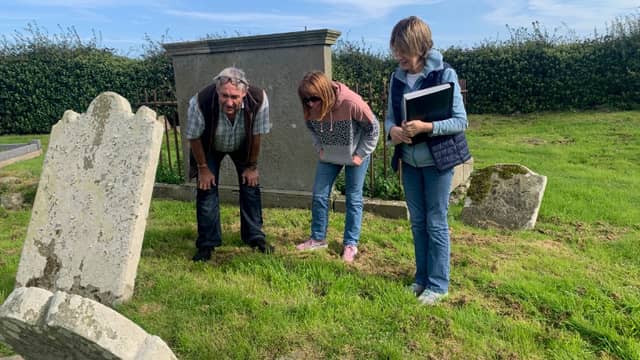

JUST over a year ago, the Antrim Guardian told readers that Creggan Local Heritage Group was planning to publish a comprehensive account of gravestone inscriptions from Cranfield Church. And now, this Thursday, the book will be officially launched at Creggan Primary School.
JUST over a year ago, the Antrim Guardian told readers that Creggan Local Heritage Group was planning to publish a comprehensive account of gravestone inscriptions from Cranfield Church.
And now, this Thursday, the book will be officially launched at Creggan Primary School.
Many gravestones from all traditions relating to families past and present from Creggan, Randalstown and surrounding areas can be found in the churchyard.
The heritage group also had access to a unique set of registration rolls from the school which date back to the 1860s which supplement the book, entitled “Graveyard inscriptions from the Ancient Graveyard of Cranfield and Genealogical Material from Local Townlands”.
Present day pupils also worked with the group and got a chance to look through the roll books, dating from 1850s to the 1920s.
Interestingly, the rolls contain the child’s name, the date they were enrolled, the townland they hailed from and the occupation of their father.
The children had fun searching through the books, finding great grandparents, grandparents, uncles and aunts.
Other historical details have been derived from parish records, civil records, Griffith’s Survey and Tithe Applotment Books, which recorded the tithes paid to the Church of Ireland.
Research by the Ulster Heritage Foundation was also utilised.
Patrick McAteer of the Heritage Group said that the book took several years to pull together and that the group learned lots of interesting facts about their local area.
He added that one of the most enjoyable parts of the book creation involved deciphering inscriptions of over 100 graves at Cranfield.
The team spoke to families and referred to local historic records.
Mr McAteer said: “We were concerned that many of the grave inscriptions at Cranfield would be lost over time. A lot of the official heritage bodies consider that old gravestones falling over, fading or cracking is just part of the vernacular and should be allowed to happen.
“Obviously with some of them being hundreds of years old, there are no family members left remaining to tend to them.
“There are approximately 100 legible headstones in the graveyard at present but many will soon be indecipherable.
“In noting the grave inscriptions, it gave us an opportunity to celebrate their part in our local story.”
He said that there are around 100 graves in the churchyard, some from as far back as the 1700s.
“Many graves from 1700-1800's have mortality symbols - we can see that the gravestone in Cranfield of the family ‘Hannon’ has one such symbol as a skull and crossbones and the words ‘memento mori’ - or ‘remember you must die’.
“Since death was an everyday part of this generation’s life, it makes sense that emblems of mortality made their way onto tombstones to remind people of the brevity of life..
“It is thought this particular symbol is meant to be a reminder to all who passed by the graveyard that death was inevitable and life was short, which we can still take meaning from in today's busy life.”
Mr McAteer said that the type of stone used, ground conditions and wind direction were all factors in how well some gravestones wore in comparison to others.
“Interestingly, some of the 1700s graves have worn better than those in the 1800s.
“And people are still being buried here, if the family has a plot and there is enough room, so there is such a wide variation in styles over the centuries.
“You can also see when a family had money, the grave can be quite grand, sometimes the trend was for railings, sometimes it was a statue. Many people buried here would have had wooden crosses, which are now lost to time.
“Traditionally the north end of a graveyard would be the place were very young children and babies were buried and here and in other areas, there are no headstones, so that bears out.
“We had thought about ground surveys and scans in the past, but we are conscious that it is still a graveyard in use, and we want to be respectful of all the families who are using this place.
“Deciphering the gravestones was just a matter of getting a good day with good light to start with.
“As we went along we got used to the various writing styles which were associated with different eras, there was lots of ‘here lieth’ and in some cases a wife was given her maiden name.”
He said that working through the rolls was also interesting.
“The occupations of the fathers was fascinating to look through, there were lots of farmers and fishermen and labourers, there were also blacksmiths and even a railway gauger.”
As well as getting schoolkids involved, copies of the book will also be donated to Antrim and Newtownabbey Borough Council, which Mr McAteer said has been ‘very helpful’ and to local churches of all denominations, to assist people researching their ancestry.
The council also supported the cost of the publication with a £1,000 grant.
Patrick said he is looking forward to getting a copy of the book in his hand and thinks it will be an important community resource.
“Lots of people are interested in genealogy these days, there was huge interest from the young school pupils and there was very little written down about this area that people could access.
“People say the internet is great, but if a page isn’t paid for or maintained, even that information can disappear, so this will be a very good source of history and knowledge for everyone.”
The whole area is a hidden historical gem.
Before the opening of Creggan National School in the 1840s, which was replaced in the 1940s, before the current school was built in the 2000s, there was Creeve School was funded by the Kildare Place Society, Dublin, and the London Hibernian Society.
These were Protestant charitable organisations who funded education for the poor. The school is mentioned as being in existence as far back as 1829.
The master of the school was Hugh McDonnell, thought to be the person who wrote a treatise in Irish on native flora and fauna.
An excerpt from the Ordnance Survey of Ireland on the Parish of Cranfield from 1830-1838, from the Ordnance Survey Memoirs of Ireland Vol 19 says this of the school: “Creve, master Hugh McDonnell, Roman Catholic, pay school, annual income 8 pounds, schoolhouse stone and lime, cost 35 to 40 pounds, number of pupils by the Protestant return: 15 Presbyterian, five Protestants of other denominations, 65 Roman Catholics, 44 males, 42 females;
By the Roman Catholic return: 17 Prebyterians, two Protestants of other denominations, 61 Roman Catholics, 42 males, 38 females, connected with Kildare Place Society and London Hibernian Society.”
Fittingly, the foundations of the school, which were uncovered during the construction of a community garden on rented waste ground, have been incorporated into the overall design.
The garden sits next to an imposing stone cross.
Termon crosses were common in Ireland from the arrival of St Patrick and Christianity in 432 AD until the time of the Protestant Reformation in the 16th Century. They mark land belonging to the church, in this case, the ancient church at Cranfield.
This cross marks the boundary of Cranfield townland and parish with the townland of Creeve.
Termon crosses, unlike the ornate stone high crosses found near some monasteries, were usually made of wood, and were replaced as a required throughout the ages. The stone version was installed in 1963.
The immediate predecessor of the present cross is now in Cranfield Church.
It was constructed by a local man, Charles Fergus, in 1911, and paid for by the prominent Belfast antiquarian FJ Biggar.
On down the road a bit is Cranfield itself.
The Holy Well dates from Pagan times, before it was blessed by the Christian St Olcan and once produced fine spring water and amber coloured crystals.
Pilgrimages were made to Cranfield annually between May Eve and 29 June.
The amber pebbles contained within the well are believed to have great healing powers bestowed by the saint, thought to protect women during childbirth, men from drowning and homes from fire and burglary.
In the last century emigrants to America believed that, if they swallowed a pebble, they would sail safely across the Atlantic Ocean. Also to this day, the healing tradition of attaching rags to the overhanging trees and bushes continues.
According to the custom, one must bathe the infected part of the body with a rag dipped in the well, pray and then tie the rag to a large overhanging tree. As the rag decays the affliction is supposed to disappear.
The church has been a pilgrimage site for centuries, with people going around it seven times before doing the same at the Holy Well.
A set of ancient steps can still be seen, as well as a path leading to the main road.
Queen’s University researchers have identified a much earlier potential site of worship, possibly pre or early Christian, which pre-dates the 13th century church, which currently represents an earthen banking, a hollowed out rock and ‘vallum’ or wall.
Antrim and Newtownabbey Borough Council also owns and maintains a jetty and slipway, which has been in a bad state of repair for years and is set to be replaced by summer 2024.
Patrick said he hopes that the current ‘hodge podge’ of interpretative signage can be improved.
Local boat owners are reported to be interested in returning and making Cranfield their permanent base.
There are also hopes that a touring vessel could also use the jetty as a launch point to ferry visitors into the Lough.
Lough Neagh Partnership has committed to building a bird watching hide just past the slipway, which Patrick said would be ‘an excellent fit’ and in keeping with the Heritage Group’s plans.
Also on the water’s edge is a custom made sculpture, designed by ceramics artist Diane McCormick.
Sitting on a concrete base, the one metre high cylindrical design has a top made from natural stone and will also be adorned with images of boats, maps, eels and pollan and an inscription that reads ‘In memory of the generations of families who fished from Cranfield and the north shore of Lough Neagh.’
Patrick hopes a sculpture or statue can be added beside the Holy Well too eventually.
The book will be launched in Creggan Primary School outside Randalstown at 7.30 on the 30th of November. It costs £15 and will be available at the Lock Keepers’ Cottage in Toome and Kearney’s Costcutter in Randalstown.