

Himalayan Hero David gives fascinating presentation at Greystone Library
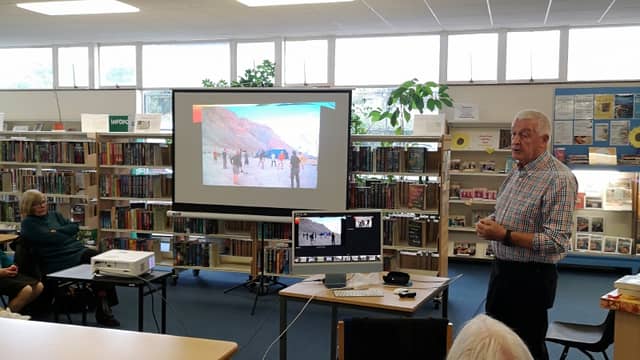

Greystone Library recently welcomed local adventurer David Burke for a fascinating talk about his remarkable rescue mission in the Himalayan Mountains. Fifteen years ago, David’s expedition with a group of young people turned into a race against time when devastating storms struck India and Pakistan in the summer of 2010. His quick thinking and bravery helped save lives as floodwaters swept through the region.
Greystone Library recently welcomed local adventurer David Burke for a fascinating talk about his remarkable rescue mission in the Himalayan Mountains.
Fifteen years ago, David’s expedition with a group of young people turned into a race against time when devastating storms struck India and Pakistan in the summer of 2010. His quick thinking and bravery helped save lives as floodwaters swept through the region.
There was an excellent turnout for the event, with plenty of laughter and moments of awe as David shared his inspiring and courageous story.
Former RAF man David Burke may have been 62 back in 2010, but the part-time explorer and mountaineer was far from over the hill.
The Brantwood Gardens man had worked with the British Schools Exploring Society for several years, leading expeditions for teenagers to far flung corners of the world - from the Norwegian ice fields to the rainforests of the Amazon.
With experience matched only by his boundless enthusiasm, he was just the man when the Society started putting together an ambitious voyage of discovery for young people from across the UK to a little-known part of the Indian Himalayas.
Assisted by kindred spirit Tom McCormick, from Saintfield, the mood was upbeat when they met up with their young charges, a team of scientists and the team doctor in Delhi on July 26.
Over the next five weeks they planned to explore an uncharted valley southeast of the Thanglesgo stockade in the high altitude Ladak region. Instead they discovered heroes within themselves during an altogether different adventure of a lifetime.
And to think it all started so well.
Following in the pad prints of the rare snow leopard, they set off after a one-day drive over the Khardun La Pass - said to be the world’s highest driveable road at over 18,000 feet - down into the bustling village of Hundar.
August 3rd brought with it an ominous hint of things to come when heavy rain fell, forcing the team to dig trenches to divert water from their camp site. With conditions deteriorating, they organised an around the clock watch to keep an eye on the rising water levels.
Oblivious to the fact that this was just the tip of the iceberg, they decided to take to the higher ground and become the first westerners to explore the mysterious valley, glaciers and peaks.
After crossing a series of treacherous rivers they downed rucksacks and set up base camp at 16,000 feet - roughly the same height as Mont Blanc.
For the next few days the younger people, under the watchful eye of their leaders, took part in exploratory climbs into this unknown territory on the roof of the world. Along the way they discovered tantalising evidence of the snow leopard, including the carcasses of large indigenous blue sheep, but no sign of the notoriously secretive beasts themselves - though David has no doubt that they were being watched by eyes unseen from the icy mountain passes.
Ten days in, as they prepared to scale the unnamed peak towering over their high base camp, the skies opened and the rains began in earnest. And the water just kept falling.
This was weather on an epic scale. The 16-mile cloud burst caused the River Indus, which flows from China to Pakistan, to break its banks. The filthy tide swept inland displacing millions of people and killing thousands in its path.
The relentless rains soon had a knock-on effect for the team stranded on the mountain side. The bridge at Hundar Dok had been washed away, so the rations they depended on were not coming. David, Tom and their team were totally isolated - and supplies were perilously low.
2000 people were unaccounted for and a humanitarian disaster was developing.
Small bridges to the north and south of the valley had been swept away too, so the team of young people was effectively marooned on an unexplored mountain miles from help.
Supplies were dwindling down to two eggs, some rice and some lentils.
Thankfully that was supplemented by a goat which the Sherpas slaughtered - by the time the famished group had eaten, all that remained was the feet.
But that goat helped kick-start a chain of events that brought a chink of hope to scores of people in their darkest hour.
Using satellite phones, David was advised of the unfolding flood disaster and told ‘in no uncertain terms to evacuate ASAP’.
With the bridges gone, they were advised to make their way along the valley to Hundar Dok where the villagers had erected a ramshackle bridge, which the group scrambled across.
Relief was replaced by reality , when they saw first-hand the plight of the people who had borne the brunt of the downpour.
People had lost absolutely everything, there was no fresh water and the thread of disease was looming.
Over the next two days the team dug new irrigation channels and a well to restore fresh water. They also carried tonnes of stones to make the repairs to the bridge more permanent. A medical clinic was set up too, and more than 30 people sought treatment.
David and his group helped out in the local school and the village elder presented them with traditional silk scarves as a token of gratitude.
News filtered through that a bridge at Satchan - perhaps their last escape route from the valley - was under threat, so they set off on a seven hour trek through the cloying mud. When they finally arrived it was still standing, but only just.
They eventually returned to Ley, which was struggling to come to terms with the loss of many lives.
The stench of raw sewage was over-powering, power was intermittent and there was no sign of any relief effort.
The weather remain unstable and the people were genuinely afraid that there was more to come. At the first sign of heavy rain or a distant rumble of thunder, they grabbed whatever meagre possessions they could and took to the hills.
But the group stayed to help again, donating medical supplies to the local hospital.
Eventually conditions improved enough for the team to return to Delhi and then back to the UK. Looking back, David believed the remarkable journey would shape the lives of those who took part.