

How an Antrim Guardian article helped American visitors go back to their roots
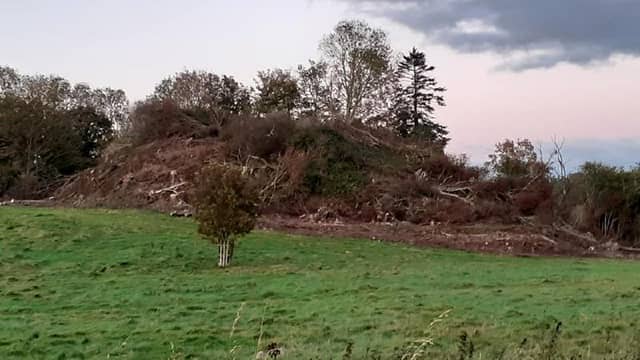

AN Antrim Guardian article has helped an American family trace their roots - and visit the site of a potential ancestral fort. The mother and daughter team behind the ‘Ewe and Ruthie’ blog, carry out research for the descendants the Flinn Family, in New Jersey, Ohio and beyond.
AN Antrim Guardian article has helped an American family trace their roots - and visit the site of a potential ancestral fort.
The mother and daughter team behind the ‘Ewe and Ruthie’ blog, carry out research for the descendants the Flinn Family, in New Jersey, Ohio and beyond.
The took to Facebook in recent weeks to say: “In a publishing of the Antrim Guardian, an article was written, by Stephen McCracken, ‘All is Revealed as Ancient Hill Fort Finally Sees the Light of Day’.
“In his article, and subsequent Facebook post, McCracken states: “A unique sight as you travel from Toome to Antrim.
“The O’Flynns castle revealed. This stood as one of the last barriers to the Norman conquest.”
“We were told that it would be hard to gain access to the private grounds.
“But after some modest blagging - we were given the go-ahead to visit.
“3,555miles later, we arrived at the lands of the current Lord O’Neill.
“After the driver picked us up, we were on our way! We arrived, and as our contact with the castle stated - the gate was open for us.
“First stop - the guard’s house to state our intentions, then a quick discussion with the lead admin, and we were off down a dirt road to search for a structure that we’d only seen on the Historic Environment Record of Northern Ireland’s online maps!
“And a special thank you to Dr Patrick Gleeson, Senior Lecturer in Early Medieval Archaeology, School of the Natural and Built Environment, Queen’s University Belfast, for sharing it with us.
“This is what a Flinn Hill Fort looks like!
“Is this our castle? Further research would need to be done. And by someone far more skilled than we are.
“But for now - Woo-Hoo!”
In another post, cataloguing their travels around the island they said: “We had a wonderful time in Ireland earlier this month.
“We had promised ourselves we wouldn’t plan this trip around genealogy. But here we are, on the grounds of Shane’s Castle, investigating an 11th century rath.
“A rath being a small fort, rumored to be the old stomping grounds of the Flinn ancestors.”
And the pair also stopped by at Antrim Lough Shore, adding: “A statue of mythological giant Finn McCool has been installed on the shores of Lough Neagh.
“The Protector of the Lough sculpture, which stands at eight metres tall and is illuminated at night, celebrates the lough, land, folklore and heritage.
“Specially commissioned by Antrim and Newtownabbey Borough Council, it has been erected in Antrim Lough Shore in a nod to the legend that the lough was created when Finn McCool scooped up a piece of earth to throw at his enemy in Scotland and missed.
“The hole left in the earth filled up with water and is known today as Lough Neagh, while the remains in the middle of the two regions is now known as the Isle of Man.”
Back in October 2020, Stephen McCracken told our readers: “Over the past few weeks, people travelling from Toome to Antrim or vice versa have been subject to a unique sight out their vehicle’s window.
“About three weeks ago, the Shane’s Castle estate cleared the foliage and trees from a hill, which all now can see is in fact an old Hill fort, which is in a brilliant condition.
“The site itself has been under foliage for the past 200 years of mapping.
“In an 1820s map, this is called ‘The Mount’ and a well is attached at the bottom of the south face.
“With one side leading down to the River Maine, it’s a formidably secure fortification, which would have given the residents an early warning of approaching boats.
“Maybe this site once saw the likes of the Vikings approaching in the 10th century.
“From the top, one would have a clear view over Lough Neagh.
“On the other side of the motorway is the Dunmore Bridge, which featured in the series Game of Thrones.
“The whole townland is called Dunmore, leading into Randalstown itself, now Shane’s Castle park.
“Dun More is the old Irish name for ‘the great fort’ and most likely was the original name for Randalstown.
“In 1667 the name Randalstown superseded from the name Ballydownmore in Dunmore (the Maine Water town is also used sporadically pre-1667).
“The change of the name of the town was occasioned by the marriage of Rose O’Neill of Shane’s Castle to Randal MacDonnell, the second Earl and first Marquis of Antrim, in whose honour the town was re-named Randalstown.
“The name of Dunmore changing to Randalstown is a more recent event, occurring in the mid 19th century.
“The Irish Townlands Project calls the mound ‘an old motte and bailey castle which stands just to the immediate south of Randalstown’.
“The name would suggest that this was an Irish native fort and was taken over and made into a motte and bailey Norman site.
“It also can be seen that the native Irish also built in the same style as the Norman model.
“The lack of archaeological evidence means we cannot draw any firm conclusions.
“The name Randalstown can be translated into Baile Raghnaill in gaelic.
“The 1830s ordinance survey memoirs have this to say: “About two miles to the west of Shane’s Castle, and in the demesne as it is at present, there stood within memory the ruins of an ancient building commonly known as Dunmore Castle, but of which not the slightest vestige now remains.
“It is more than 30 years since all trace of these ruins has been removed, and now except the name nothing further is remembered or known relating to them.
“It is situated on the summit of a very steep bank overhanging the River Maine, above which the summit of the fort is elevated 86 feet.
“It is situated on the right bank of the river, in Shane’s Castle Demesne, and about a fifth of a mile below the town of Randalstown.
“The central fort measures 40 by 50 feet.There are faint traces of a parapet which enclosed the summit.”
Mr McCracken said that by 1200 the O'Flynns were paying tax to the Normans in the ragman rolls.
He also noted that the fort was where the Anglo-Norman knight John de Courcy, who invaded Ulster in 1171, is thought to have been badly wounded.
De Courcy was to rule most of modern east Down and east Antrim for a quarter of a century. His two principal castles still stand today, Dundrum Castle, overlooking Murlough Bay, County Down, and Carrickfergus Castle.