

How fate stopped crooner king Bing taking the Road to Antrim

IN May 1942, legendary crooner Bing Crosby set about recording a certain Irving Berlin song for the soundtrack of his forthcoming film release, ‘Holiday Inn’. By then, he was at the very peak of his fame; often retroactively characterised as the world’s very first multimedia star thanks to his pioneering work in film, radio and recording, Crosby would ultimately achieve 396 hit singles over the course of his 50 year career - more than the Beatles and Elvis Presley combined. In 1939 alone, 24 of his songs charted on the hit parade.
IN May 1942, legendary crooner Bing Crosby set about recording a certain Irving Berlin song for the soundtrack of his forthcoming film release, ‘Holiday Inn’.
By then, he was at the very peak of his fame; often retroactively characterised as the world’s very first multimedia star thanks to his pioneering work in film, radio and recording, Crosby would ultimately achieve 396 hit singles over the course of his 50 year career - more than the Beatles and Elvis Presley combined. In 1939 alone, 24 of his songs charted on the hit parade.
Yet, even as Bing lent his distinctive warm baritone to Berlin’s homey evocations of glistening treetops and children listening for sleigh bells in the snow, few could have predicted the life the recording would go on to assume on its own. Such is the persisting popularity and seasonal ubiquity of ‘White Christmas’ that now, with the song set to soundtrack its eightieth festive period, it is difficult to conceive of a time when its familiar melody and sentimental themes were absent from the airwaves at Christmastime.
The bestselling single to date in history, it is estimated that ‘White Christmas’ has sold somewhere in the region of 50 million copies since its first release. As writers Dave Marsh and Steve Propes have observed, it ‘changed Christmas music forever, both by revealing the huge potential market for Christmas songs and by establishing the themes of home and nostalgia that would run through Christmas music evermore’.
The overwhelming, timeless success of ‘White Christmas’ has ensured Bing Crosby an enduring place within the wider pop cultural pantheon even today, forty-five years on from his death. Indeed, in a curious synthesis of old and new, last week saw Crosby’s estate confirm the introduction of a Bing Crosby themed ‘Winter Wonderland’ on virtual reality platform ‘The Metaverse’. Visitors to this digital space can immerse themselves in the aesthetics of a “classic Bing Crosby Christmas,” be it by making purchases at ‘Bing’s Sweater Shop’, enjoying Bing’s films amid the cosy ambience of the ‘Christmas Lounge’, or examining hitherto unreleased archive photographs at the ‘Bing Museum’.
Bing may have been larger-than-life celebrity beloved the whole world over, but in the late 1970s, few could profess to be as dedicated a fan as Antrim man Noel Mould.
A telephone engineer from Sussex Court, Mr Mould would go on to accumulate an enormous collection of over 1,000 Bing Crosby LPs.
“I never really set out to collect his records, but I began watching him on films and the whole thing snowballed from there,” he explained to the Antrim Guardian in 1977.
On one occasion, a fellow collector offered him £45 for one of his rarer albums - which, adjusted for inflation, would equate to a neat £330 today - this notwithstanding the fact that said record’s rarity and worth have no doubt multiplied dramatically over the last forty-five years.
“Most of his songs are full of nostalgia. As there’s nothing really to look forward to today, I looked backwards through Bing’s music,” Noel added.
“There is much more to it than the singing. He has great charisma. People like Frank Sinatra, but you can’t get close to him. Bing is just like the fellow next door.”
A member of the International Crosby Circle - a fan club devoted to celebrating Bing’s fifty-year career- Noel was even invited to meet the singer in-person and was relieved to find that his idol was “easy going and very approachable.”
“He has friends all over the world because he is so easy to speak to - he speaks to the lowest of the low and appreciates his followers,” he told the Antrim Guardian.
“He has been more than good to me.”
The local man enjoyed fairly frequent contact with his musical hero to the extent that, in July 1977, Noel set up an interview with Crosby on Downtown Radio during which he revealed that he would be interested in visiting Northern Ireland in the immediate future.
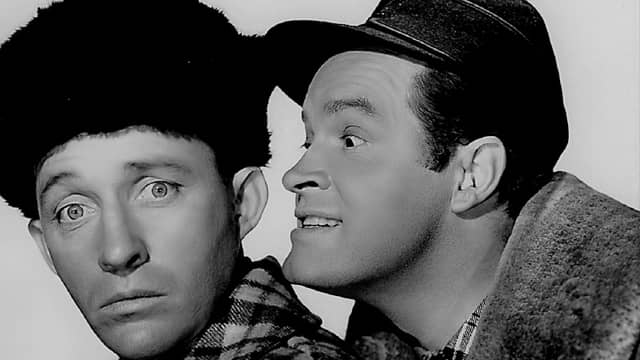
Were this visit were to come to fruition, however, it would not represent the first trip undertaken by the legendary American crooner to Northern Irish shores. Back in 1944, with the Second World War raging grimly on, Bing travelled to Ulster together with comedian Bob Hope - with whom he co-starred in the celebrated ‘Road’ films - to entertain U.S troops billeted at Langford Lodge near Crumlin.
A comedy of errors ensued at the end of the two stars’ tour of duty when the jeep carrying them to a waiting ferry at Larne broke down, leaving the famous twosome stranded in a dark country lane somewhere in County Antrim - much to the amazement of a local farmer who happened to be passing by. There they remained until an enterprising American army colonel arrived on the scene and hitched a ride to take the pair to the harbour.
However, despite Noel’s best efforts to secure Bing for a Northern Irish concert appearance in 1977, the performer’s busy schedule put paid to any such plans. Telephoning his hero, Mr Mould was disappointed to discover the “unfortunate news that he had been lined up for a charity concert in Brighton on the only date available at the King’s Hall - October 10th.”
Despite his advancing years, Bing Crosby’s timetable was as hectic in 1977 as it had been in any other year of his illustrious career. Having recovered from a ruptured back disc suffered earlier in the year at a 50th anniversary concert in California - during which he toppled 30 feet into an orchestra pit, leading to a month in hospital - September found the incorrigible performer embarking upon a concert tour of Britain that included a two-week residency at the London Palladium.
While in London, the multi-tasking musician found time to record a complete album of new material, ‘Seasons’, and film a Christmas television special that featured a duet with David Bowie on the festive standard ‘Peace on Earth/Little Drummer Boy.’ This duet, belatedly released as a single in 1982, has since gone on to join ‘White Christmas’ in the canon of classic Christmas songs.
Despite the setbacks encountered in booking Bing for a Northern Irish concert appearance, Noel remained confident that the iconic singer would make good on his promise to visit Ulster in the immediate future.
“Now Noel says there is a strong possibility that Bing will sing in Belfast in the spring,” the Antrim Guardian reporter excitedly divulges.
“It won’t be too long before Noel and Bing - ‘like those couple of swells’- will ‘walk down the avenue’ on that road to Belfast.”
The story was dated October 13th, 1977 - and tragically it was not to be.
That very same day, Bing Crosby flew alone to Spain to play golf and shoot partridge, in good spirits and seemingly good health. The following day, October 14th, found Bing at the La Moraleja golf course near Madrid where he partnered up with World Cup champion Manuel Piñero to compete against club president César de Zulueta and Valentín Barrios over 18 holes.
Upon the conclusion of the game, Bing and his party were walking back to their clubhouse when, suddenly, the 74-year-old singer silently dropped. He made no effort to break his fall, having apparently instantaneously died of a massive heart attack.
Speaking to the gathered press, Bing’s wife Kathryn announced with tears in her eyes that her husband ‘had a very good round. I’d like that to be said’.
Eyewitnesses recall the endearingly characteristic final words that prefaced the sudden death of Bing Crosby - the rags-to-riches everyman whose rich baritone raised spirits through the Depression and the Second World War all the way through the seismic cultural shifts of the post-war era: “That was a great game of golf, fellas. Let’s go have a Coca-Cola.”
Unbeknownst to Noel Mould and the world at large, the concert Bing gave at the Brighton Centre on October 10th - the date Noel had hoped to book the American singer to appear at the King’s Hall - was to be his final public concert appearance before his death.
Nonetheless, the local superfan left an unlikely mark within his favourite singer’s sprawling discography. Not long before Noel’s famous friend travelled to Spain for his final fateful game of golf, he would be influenced by the Antrim man to make some unorthodox recordings which would number as among his very last.
“Bing has recorded almost everything but poetry,” Noel said.
“When I put the point to him, he said he didn’t think it was a commercial proposition - but agreed to be taped.”
Mr Mould travelled to London’s CBS recording studios whilst Bing worked on the finishing touches of his very last LP, ‘Seasons’ and, on September 14, successfully recorded him reading five pieces aloud. These were to see a limited release for charitable purposes.
“His voice is so easy on the ear - indeed his speaking voice is music,” the local fan enthused.
When Bing Crosby’s ‘final chapter’ (as the posthumously released ‘Seasons’ album was publicised) was finally reissued in CD format in 2010, Noel’s vision was fulfilled and poetry readings, namely of ‘Lucy Gray’ and ‘If’, finally featured alongside the traditional style pop ballads that Bing was renowned for.
Writing in BING magazine in March 1978, Noel fondly recalled the recording sessions.
“On the completion of Seasons, Bing boomed through the speakers: ‘Let’s do the poetry…’ so I quickly joined him in the ‘box’ and we went over the selected poems so that Bing could make his choice. We were in business, as they say!
“The first to be recorded was a lovely piece called ‘Around the Corner’, quite short but poignant. As so many others have been, I was amazed that with no rehearsal worth talking about Bing read as if he knew it all his life. Next came a piece by Longfellow called ‘The Singers’ then Bing went on to do ‘If’ by Rudyard Kipling, ‘Lucy Gray’ by Wordsworth and lastly ‘The Slave’s Dream’ by Longfellow.
“A couple of slips occurred on this and they will need careful editing to correct - we had run out of studio time by then and there was no chance of recording it again.
“Still,” the Antrim man concluded with perceptible pride, “Bing had done it. Done me proud and I was, to say the least, tremendously grateful that he had taken the time to help a nobody like me.”