

Increase in Royal imagery in local parks leads to call for 'more equality in public places'
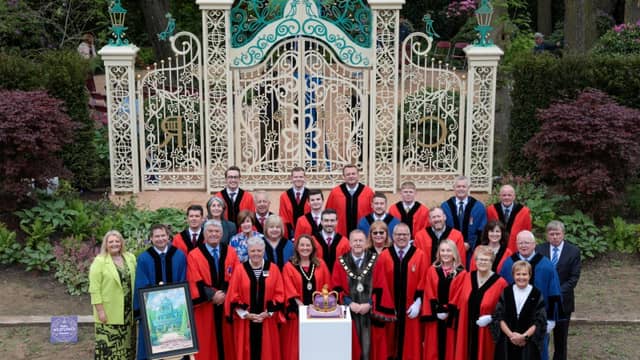

SINN Fein National chair and South Antrim MLA Declan Kearney has said that the increasing amount of Royal imagery in the borough’s public parks means that other cultures and traditions should also be reflected. In recent years, the Queen’s Platinum Jubilee Garden has been installed at Antrim Castle Gardens, along with a statue of the late Duke of Edinburgh, soon to be joined by a companion piece honouring the late Queen.
SINN Fein National chair and South Antrim MLA Declan Kearney has said that the increasing amount of Royal imagery in the borough’s public parks means that other cultures and traditions should also be reflected.
In recent years, the Queen’s Platinum Jubilee Garden has been installed at Antrim Castle Gardens, along with a statue of the late Duke of Edinburgh, soon to be joined by a companion piece honouring the late Queen.
In Hazelbank Park, another garden marking King Charles’ coronation has been built, while the venue will also host Armed Forces Day next year.
As part of a wide-ranging interview following the party’s historic results in local council elections in May, which can be read on page eight, Mr Kearney said that he welcomed investment in the public realm. He added that he understands the huge significance attached to the Royal family and the importance of marking major events like deaths, jubilees and coronations.
“We know that significant part of the local population have a great affinity to the Royal family and that needs to be respected.” he said
“We also now need to open conversations about other sections of the community and their traditions are reflected and respected and how we can invest in their culture as part of public realm work.
“Artwork in shared spaces needs to reflect and respect all key traditions within our community.”
Mr Kearney said he was particularly interested in permanently commemorating historic events like the Battle of Antrim, which happened 225 years ago and the associated Battle of Randalstown.
Meanwhile, fellow South Antrim, John Blair of Alliance said: “I am aware, fully mindful and respectful of the importance of marking of some key anniversaries and the significance of commemorating the deaths of both the late Queen and Duke of Edinburgh.
“These things had to be recognised, however I do feel there has to be some parity and equality in terms of what we do with our shared open spaces.” he said.
“In addition, the sectioning off of increasing amounts of our parks, where they are not always open and accessible to people, is a matter of concern to me.
“I have always and consistently been a believer that our parks should be as open and left as natural and accessible as possible and I am on record as such.”
Under Section 75 of the NI Act 1998, Antrim and Newtownabbey Borough Council was required to screen the policy concerning the permanent placement of a statue of HRH Duke of Edinburgh in Antrim Castle Gardens.
The screening process is designed to assess if there is any impact on the various categories identified in the Section 75 equality legislation.
Following a request to Council, a copy of the completed screening form has been provided, which makes clear that the policy was initiated after elected members brought forward a motion to council in April 2021.
The same screening form includes details on the development of a bursary scheme. The completed form acknowledges that the new policy would affect service users, or park visitors.
Although this policy was screened in 2021, it states: “In that last local government elections in 2014, unionist parties gathered more first preference votes than nationalist parties in terms of 63% unionist and 21% nationalist and 16% other.”
The form does not explain why updated information reflecting the results of the local government elections held in 2019 is not included.
Under the ‘religious belief’ and ‘political belief’ categories, the form states that these ‘are often linked in Northern Ireland and as the Royal Family are regarded differently by various sections of the community, elements of the policy may be undesirable to some members of the community’.
In both these categories, the impact of the policy has been described as ‘minor’.
If the impact had been assessed as being ‘major’ in one or more of the Section 75 categories, consideration should be given to subjecting the policy to a thorough equality impact assessment procedure.
The recommendation arising from the screening process concluded that there was no need to conduct an equality impact assessment as, ‘the policy is proportionate and in cases where minor risks have been identified the adverse consequences can be guarded against by community engagement. The sculpture and bursary under this policy are in addition to other memorials and funding programmes that already exist’.