

Inside Randox: the UK's secret weapon in the war on COVID
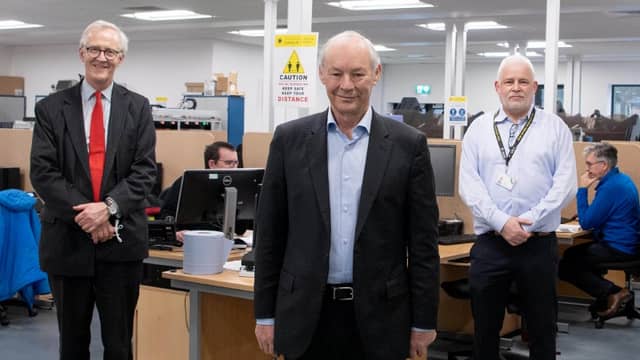

THE numbers involved are simply staggering. Just 12 months ago most knew little, and cared even less, about reports of a new respiratory disease that was spreading through Wuhan in China.
THE numbers involved are simply staggering.
Just 12 months ago most knew little, and cared even less, about reports of a new respiratory disease that was spreading through Wuhan in China.
What a difference a year makes.
Since then COVID-19 has marched around the globe. More than 96.2 million cases have been confirmed - and over 2.05 million have perished across 190 countries worldwide.
This has been a human tragedy on an unimaginable scale - but while the relentless spread has been terrifying, the scientific response has been equally awe-inspiring.
The UK’s fight back began in January when a local man chanced upon reports that the Chinese government had released the genome of the virus. He knew his dad would be interested - after all his father was Dr Peter Fitzgerald, Managing Director of Randox Laboratories.
He realised that time was of the essence and he immediately summoned his top team to Randox Science Park in Antrim.
From that moment on, the site of a former torpedo factory and base for the Royal Engineers by the shores of Lough Neagh became the front line of the war against COVID.
Randox had experience of tackling previous coronaviruses. That ‘gave them an edge’ and that early groundwork would prove key - but COVID was proving to be a very different beast.
Realising the potential scale of the threat posed they decided to throw everything at the hunt for a workable test, pivoting their efforts towards the real and present danger.
They were already a diagnostic company of global standing - after all they were responsible for five per cent of diagnostic tests worldwide before the pandemic.
In 2019 that involved a staggering four billion tests, exported to 145 countries around the globe. And 85 per cent of those were produced in Antrim.
This was already a diagnostic super-power, and one that had invested £335 million into its core in-house technology.
But COVID forced them to redouble their efforts. They were already one of the town’s biggest employers, with 1,400 staff on the books, but those numbers were quickly ramped up with an extra 800 scientists and engineers rapidly enlisted.
Over £68 million was also spent on new infrastructure - building new labs, designing new equipment, bringing 38-years of experience on the cutting edge to bear.
From its humble beginnings in a former chicken shed at his parent’s home on the Randox Road, Dr Peter Fitzgerald was guiding the UK’s largest diagnostics firm into unknown territory.
March brought the first breakthrough when the first accurate test was made. Initially they could deal with 150 tests a day, but by the summer that had risen to 20,000.
Now they can complete 100,000 and there is scope to ramp that up even further.
That contribution to the UK’s track and trace programme is beyond compare, and now samples are winging their way to Antrim from across the country.
By January 7 Randox had completed eight million tests. This week they are approaching nine.
“What we are doing is unparallelled. It simply hasn’t been done before,” said senior manager Mark Campbell.
“Within nine weeks we were completely operational, which was a huge challenge.”
Working practices have inevitably changed too. The relentless demands placed on them have seen Randox change from a nine to five Monday to Friday operation into a well-oiled machine that continues to turn over 24 hours a day seven days a week.
“This has been a real team effort - and we have a fantastic team.”
The team captain, of course, is Dr Fitzgerald. So is he proud to have helped steer the country away from brink?
“Pride? Not so much. Pride comes before a fall,” he said.
“However, I do think we have done very well, though there are always things we can do better.
“I think Randox has been quietly pleased to be involved. People wanted to get stuck in.
“We are actually very creative in our work. We identify problems and find solutions. That’s what we do.”
Despite the success, there has been some criticism of the company, with some media figures challenging their credentials. Many of those claims were, said the MD, ‘incorrect’.
“Oh, I do think we were targeted, but our response was to do better. The numbers don’t lie.
“Before COVID we felt we could help some people’s lives through science. COVID, of course, has raised that profile and drawn attention to the work we do.”
He has a special interest in the virus too - after all he contracted it back in March.
His children did too, but his wife did not.
And that’s a puzzle for Dr Fitzgerald. Why do some not get it, and why do some suffer much worse symptoms than others?
Intrigued, he revealed that Randox are working on a predictive test which will identify those most likely to suffer the worst ill-effects - another first, and another potential life-saver.
But with the vaccine rolling out apace, is COVID finally on the retreat? Alas there are no easy answers.
“The vaccine will make a difference, but I wouldn’t be too gung ho about it. It’s a very tricky virus.
“Looking further ahead, I hope that health improvements will come from this. The pandemic has certainly raised awareness of testing and the technology has moved on very fast.
“People will ultimately benefit from this.”
The battle goes on, but you can bet that Dr Fitzgerald will be scanning the horizon for future threats.