

INSIDE THE HOUSE OF THE DEAD
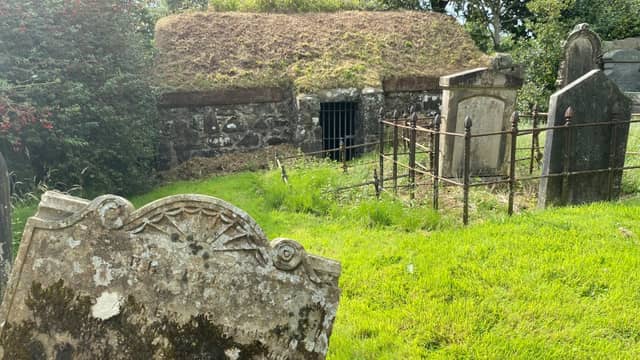

HAVE you ever considered spending a summer afternoon in the house of the dead? Well, I did - and I reckon it beats swatting away wasps while sipping a clinking glass of gin and tonic.
HAVE you ever considered spending a summer afternoon in the house of the dead?
Well, I did - and I reckon it beats swatting away wasps while sipping a clinking glass of gin and tonic.
But first, an admission.
For a newspaper man I’ve often been guilty of possessing a conspicuous lack of curiosity.
Over the years I have attempted to write with authority on a wide range of subjects, from historic local treasures like the holestone and Ram’s Island, to the old Quaker’s graveyard on the Belfast line and Crumlin Glen.
Have I ever set foot in any of them? No, of course I haven’t.
But recently I was struck by a quote from the late Queen. Asked why she continued with a punishing schedule of public engagements well into her 90s, she replied: ‘I have to be seen to be believed’.
Which got me to thinking.
A while back I did a piece on St John’s Church at Donegore - another of my many blindspots, though it is just 10 minutes away from my front door - and more particularly its efforts to protect its sleeping dead.
You see in a corner of the graveyard at the 17th century church stands a curious little building. They call it the ‘dead house’.
But it was not a vault to exult the passing of a person of social standing - it was a practical response to the scourge of the ‘Resurrection Men’.
They took to grave robbing to supply the growing interest in anatomy in the early 18th century.
Back then ‘subjects’ were supplied by the gallows principally - a rather productive source, given that petty offences were punishable by death in those days.
But as demand increased, a new profession was born.
Usually working in pairs, they made silent sorties to the graveyard in the dead of night, seeking newly-dug plots. Then they deployed a crowbar often sharpened to a point to facilitate the speedy opening of a coffin.
It was a lucrative business. In December 1808 a medical institution was offering the then princely sum of £5 for ‘good, fresh corpses’ - and upwards of £10 if they died of an obscure complaint.
Bizarrely, it was a greater crime to steal a shroud than a body. According to the law it was only a misdemeanour to steal a dead body, but it was a felony punishable by transportation to steal the clothing.
That sorry state of affairs was finally laid bare at the trial of Burke and Hare in 1828. They took ‘freshness’ to a whole new level, and began murdering their subjects. Consequently the matter was made the subject of statutory legislation and became governed by the Anatomy Acts of 1832 and 1871 which placed the supervision of schools of anatomy under the control of a Government Inspector.
In the meantime, however, there were the death houses where the dearly departed rested for five or six weeks until they were no longer of practical use of anatomists before being buried. Effectively it was a waiting room for eternal rest.
Most are now gone or have fallen into disrepair, but not the one at St John’s. It has weathered the last two centuries remarkably well - and last week I decided to see it for myself.
The sun blazed as I trundled up the hill and pulled up outside the sturdy church gates. There was not a soul around - well, none that I could see at any rate.
After admiring the rather lovely church itself, the first thing that strikes you is the vast walled off final resting place of Sir Samuel Ferguson, a scholar and poet who shuffled off this mortal coil in 1886.
One of his poems recorded a visit to Westminster Abbey, and it was curiously prophetic:
‘Amid the tombs of England's dead
I heard the Holy scriptures read...
Yet hold not lightly home, or yet
The graves in Donegore forget’.
Alas, many of the headstones have been blasted clean by the passage of time.
And there are so many graves - a veritable Tetris of love and loss.
Swinging past the church, in the far corner of the graveyard, there it was.
It was made of sturdy stone, the low roof covered in thick moss.
There were gaps on three of the four walls, no more than a slit that would allow the mourning families to ensure that the loved ones, lying on the clay floor, were still there.
The low doorway was blocked with a modern steel gate.
I assumed it was locked, but tried it anyway. And it opened.
I stepped inside and back in time. The floor was clear apart from a few shards of rotting wood. Leaning against the wall were the rusty old gates that had once barred entry.
And it was cold. Very cold. A good 10 degrees chillier than outside.
It was creepy too. In that small, dark space there was a sense of the sorrow, the death, the decay - and the extraordinary lengths people were prepared to go to defend their dead.
I didn’t stay in there long, but long enough.
So where next?
I’ve often been told that there is something magical about Cranfield on the shore of Lough Neagh near Randalstown.
Rags flutter from trees of hawthorn and hazel in the shadow of an ancient ruined church.
And then there is the holy well.
The waters drawn from Cranfield were, it is said, imbued with healing properties by St Olcan - a saint and holy man with links to the area.
Indeed, it is thought he was buried there with soil brought specially from Rome.
From time to time, the water deposits amber ‘stones’ which crystallise out on the sides of the well.
At the end of June the water rises bringing these treasures to the surface and over the edge where they may be gathered.
Back in 1837 Samuel Lewis, in his renowned Topographical Dictionary, said that many believed them to be ‘objects of good fortune’.
It was said that a house in which rested a mystical Cranfield stone would never be burned by fire, nor robbed by thieves. Many believed that a person who carried one of the gems could never be drowned. A woman possessing a stone would have a safe and painless delivery in childbirth.
I decided to investigate - and once again I was glad I did. Some may scoff at the powers of the waters or its amber treasure, but a visit to this gem will undoubtedly do your heart good.
The tree itself is quite a sight to behold. Rags, hundreds of them, flutter from the branches - many from people seeking a cure from whatever ails them. There is even a handy box of rags for travellers who forgot to bring their own.
There were names, rosaries and personal items too.
It was quiet, peaceful even, and it possessed an ethereal beauty all of its own.
Whereas the dead house is a symbol of heart-breaking loss, Cranfield represents hope. Both very different, but both very moving.
They share one thing, though. Both have been well looked after. There were no discarded beer cans, no ugly graffiti.
No, these important landmarks are respected, revered even.
And Her Majesty was right. Seeing is believing.