

Irish language programme examines why a woman was burned at the stake in Antrim
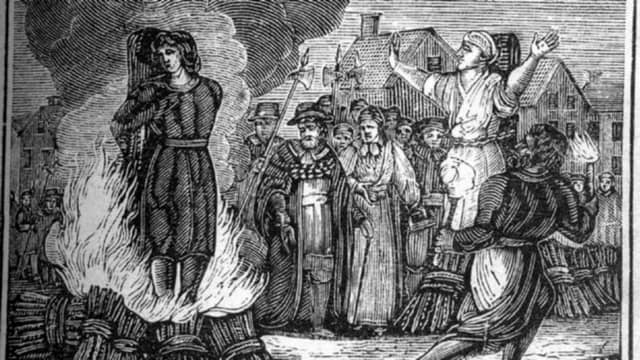

THE terrible fate that befell an Antrim woman who was accused of dabbling in the dark arts is the focus of a major new Irish language television series. TG4 series An Diabhal Inti -The Devil’s in Her - explores how and why thousands of people, mostly women, were accused of being in league with the devil and executed as ‘witches’.
THE terrible fate that befell an Antrim woman who was accused of dabbling in the dark arts is the focus of a major new Irish language television series.
TG4 series An Diabhal Inti -The Devil’s in Her - explores how and why thousands of people, mostly women, were accused of being in league with the devil and executed as ‘witches’.
Set against the backdrop of the great European witch hunts spanning two centuries and reaching across the Atlantic as far as America the six-part series offers a unique lens into the social, political and religious conditions that resulted in one of the greatest ‘otherings’ in human history.
Featuring the renowned actor Olwen Fouéré, dancer and choreographer Aoife McAtamney and introducing the young Ailbhe Drimbarean, this visually arresting series offers a dramatic and mesmerizing re-examination of the idea of woman as ‘witch’.
By exposing patriarchal views of women which combined with religious beliefs in the devil walking the earth, the series shows how accusations of witchcraft mostly targeted women, making the female body a site of demonic possession, with deadly consequences for the accused.
This week's episode looks back at the terrible consequences those beliefs had for a beggar woman in Antrim back in 1698.
Accused of witchcraft after giving a young girl a sorrel leaf in exchange for beer, she met her fate at the hands of a fearful mob.
This story tells of how fear and misinformation were spread through pamphlets and books on demonology and witchcraft.
George Sinclair in his early 18th century study of the supernatural - ‘Satan’s Invisible World’ - gave one such dubious account of what happened that fateful day.
He wrote that a 19-year-old local girl fell gravely ill after she was given a sorrel leaf by an ‘evil harridan’.
‘It was scarcely swallowed by her but she began to be tortured in the bowels, to tremble all over and even was convulsive and in time swooned away as dead’, said the scribe.
‘They sent for the Minister, who scarce had laid his hand upon her when she was turned by the demon in the most dreadful shapes.’
Alarming symptoms indeed, but then the already extraordinary case took yet another unexpected turn.
‘She began to rowl herself about, then to vomit needles, pins, hairs, feathers, bottoms of thread, pieces of glass, window nails, nails drawn out of a cart or coach wheel, an iron knife about a span long, eggs and fish scales’.
A lynch mob descended on the ‘hag’s hovel’ in Antrim and she was strangled. She was then burned at the stake just to make sure.
The series, tells the individual stories of the women who did not escape the horror of the witch hunts on the island of Ireland.
Others who perished include Florence Newton known as the ‘witch of Youghal’; Goody Glover, an Irish woman in Puritan Boston, hung on Boston commons; and the infamous mass trial of Islandmagee, where eight women and one man were accused of witchcraft and paid a high price.
The series also explores the reasons why the witch hunts did not affect Ireland in the same way as other European countries, and how paganism, goddess worship and beliefs in popular magic survived longer as a result.
The story of Mary Butters, the Carnmoney Witch in the North and Biddy Early, the wise woman of Clare, in later episodes offer other insights into how powerful women survived beyond the witch hunts in a patriarchal world.
Contributors such as Dr Andrew Sneddon, the leading expert on the Irish witch trials, Dr Mary McAuliffe, Claire Mitchell QC, Professor Julian Goodare all offer unique insights into the religious mindset that created the narrative and the conditions for the witch hunts.
The series is written and directed by Paula Kehoe, produced by Ashlene Aylward and edited by Jill Beardsworth for Lagan Media Productions. An Diabhal Inti is funded by TG4, BBC Gaeilge, Northern Ireland Screen's Irish Language Braodcast Fund and the BAI Sound and Vision Fund.
TG4 is available on Sky and Freeview, and all episodes can be watched via their on demand service.