

Killer will never be released - but did a local medic get away with it?
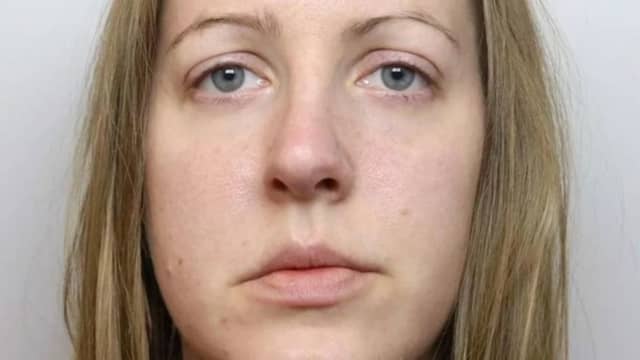

LUCY Letby is starting her new life behind bars this week - and the courts have ruled that she will never be released. The neonatal nurse, who was convicted of murdering seven babies, may appeal of course - but such is her notoriety, the chances of walking free seem remote.
LUCY Letby is starting her new life behind bars this week - and the courts have ruled that she will never be released.
The neonatal nurse, who was convicted of murdering seven babies, may appeal of course - but such is her notoriety, the chances of walking free seem remote.
Damned by her own hand as ‘evil’ in a scrawled note found in her home, the media has branded her a monster.
It’s not hard to see why. The 33-year-old has leapfrogged the likes of Rose West and Myra Hindley to become Britain’s most prolific child killer.
And these were babies. Vulnerable babies already fighting for their lives before entering Nurse Letby’s ‘care’.
The coverage has been relentless. Let her rot, scream the headlines. Bring back the noose.
Given the nature of her ghastly crimes, it is perhaps understandable.
But it’s worth considering just how complex the task faced by police and prosecutors was during that epic nine-month trial.
There were 22 counts for the jury to consider, and they only agreed on one of the murder charges - Baby O - by delivering a unanimous guilty verdict.
The other six murders were decided by majority verdict. Some were clearly not convinced.
There were 15 charges of attempted murder, and only two counts resulted in a unanimous guilty verdict.
Of the rest, six were guilty by majority. Six resulted in a hung jury. And two cases culminated in a not guilty verdict.
They are surprising figures but they underline the challenges of prosecuting ‘historic’ medical cases. The jury all agreed that they had a child killer before them. They agreed that she had tried to kill others. And they agreed that she played no part in others.
Letby may be safely behind bars, a convicted killer, but the gulf of opinion in the jury room shows that she could have got away with it.
Dr Death
Almost a quarter of a century has now passed since the arrest of Harold Shipman, the most prolific medical serial killer in history.
The sobriquet ‘Doctor Death’ was well-earned. Though he was convicted for the cold-hearted killing of 15 of his patients, he is now thought to have helped around 250 to their graves - before adding himself to the grim tally in January 2004 when he committed suicide in prison.
Few could believe that an otherwise unremarkable GP could murder his patients for financial gain, saving lives on one hand, and then ruthlessly taking them on the other.
Surely he is an aberration, a revolting one-off. Sadly not. Indeed, many criminologists now believe that he drew dark inspiration from a man born and raised in Randalstown.
Which may seem odd, since that man was convicted of killing precisely no-one.
Yet few innocent men make it all the way to the chamber of horrors - and fewer still are openly spoken of as Shipman’s murderous muse.
And few would go to the bother to book a post mortem for a patient who was still very much alive, let alone announce that another was at death’s door when all that apparently ailed her was a mild stomach ache. Before he injected them, of course.
Bodkin Adams
Dr John Bodkin Adams was such a man. He died 40 years ago an innocent man. Apart from the murders, that is. And there were many, many murders.
Even his most fervent supporters have been forced to concede that for a mild-mannered man, he certainly had a knack for losing his patients.
Down the years his international reputation as a serial killer has grown. There have been books and articles galore all pointing to the local man’s guilt.
Innocent until proven guilty be damned, it is now widely accepted that when the roly-poly Randalstown man finally breathed his last in July 1983 he had perhaps hundreds of deaths on his conscience. But then he was never big on conscience. From an early age excess was his thing, and he liked to indulge himself at every turn.
It must have come as a terrible surprise to his parents, who scraped a meagre existence as Plymouth Brethren. How could they have created a bloated, greedy monster apparently prepared to go to any depths to fund his extravagant lifestyle?
Yet somehow, here was a man who munched on violet creams by the case and who demanded a steady supply of cake in the operating room.
When he passed away at the grand old age of 83 he was a contented, not to mention very fat man - with a bank balance to match.
So how did this son of a Randalstown watch maker, and a fire and brimstone preacher to boot, manage to accumulate an estate worth over £400,000 after a lifetime of epic excess - and in the days when doctors were comfortably off, but certainly not earning the salaries enjoyed by medics today?
Adams studied at Coleraine Inst before going to Queen’s University in Belfast and while his academic career was far from distinguished, he finally graduated in 1921 without Honours.
After an unsuccessful stint as assistant houseman at Bristol Royal Infirmary, his career took another turn when he applied for a job as a GP in a Christian practice in Eastbourne.
If St Peter ever had a first class waiting room, Eastbourne would surely occupy one corner. It was a retirement haven for the wealthy and influential on the south coast of England and its residents were the very embodiment of the British establishment - aristocrats, retired ambassadors, generals, senior civil servants and rich industrialists.
Rich pickings indeed.
At first the nice young Dr Adams cycled to appointments. Thirty five years later when standing in the dock at the Old Bailey accused of murder, he was probably the richest GP in England. The bicycle clips were long gone, replaced by a series of chauffeur driven cars. He was particularly partial to a Rolls Royce. Or two.
Over the ensuing years, the self-confessed euthanasia enthusiast was found to be the beneficiary in no fewer than 132 of his patients’ wills.
In this cynical age, the pattern seems clear but back then there was an obstinate refusal to believe that the family doctor was anything other than a force for good.
The parallels with Shipman are also disturbingly vivid. Here we have a charmer using drugs to control patients, maintaining poor records; a man who would turn up unannounced to check up on patients, a man taken to pocketing precious knick-knacks, and ultimately a man who enjoyed the sense of power over life and death.
Yet in the early days the practice flourished, to such an extent that three extra medics were needed to help shoulder the workload. Dr Adams’s star was on the rise and there was no shortage of patients eager to meet him. As luck would have it, many of them were elderly. And rich.
In 1935 the good doctor received the first of his many ‘anonymous postcards’ - the phrase he later used to describe news of a bequest from a dearly departed friend. That year he inherited £7,385 from Mrs Matilda Whitton. It was a huge chunk from her £11,465 estate - the equivalent of almost half a million pounds today.
The will was contested, but was upheld by the courts. The template, it seems, had been set.
This heralded the start of a productive spell for the enterprising Ulster man. From this time onwards, the primary source of his wealth was not his fees, but the legacies left by the adoring old dears who had sadly died not long after the ever-obliging Dr Adams had helped them prepare a new will.
These wills routinely named Dr Adams sole executor and expressed a preference for cremation, even though he had signed the box on the cremation form declaring that he did not expect to gain from the death.
But gain he did. In the 10 years between 1946 and 1956 dozens of patients left him money generating an annual income of £3,600. In modern money he was trousering around £100,000 a year.
Such conspicuous wealth eventually set tongues a-wagging, and the police finally closed in on July 23 1956 when they received a call about a suspicious death. The caller was fading music hall star Leslie Hanson, who was deeply disturbed by the sudden decline of his friend Gertrude Hullett.
Adams was eventually arrested and said, after caution: “Murder? Can you prove it was murder? I don’t think you could prove murder. She was dying in any event.”
He did, however, accept he had been ‘easing the passing’.
How many others had he helped over the finishing line? Of the 310 death certificates he had issued over that period, Home Office pathologist Francis Camps reckoned at least 163 were ‘suspicious’.
Between 1946 and 1956, more than 160 of his patients died in suspicious circumstances. Of these, 132 left him money or items in their wills.
Among the contest cases was Amy Ware. Dr Adams had banned the 76-year-old’s family from seeing her, so they did not have the opportunity to bid farewell before she suddenly died in February 1950. The local man received £1,000 from her estate.
Nine months later Annabelle Kilgour died immediately after her Adams gave her an injection. He received £200 and a clock for his troubles.
In May 1952 Julia Bradnum had just returned from a brisk walk when the doctor called. “It will be over in three minutes” he was heard to say before brandishing his faithful syringe. His prediction was correct and he pocketed £661 from the will - which he had helped her pen the previous year.
In November of the same year he was treating Julia Thomas for depression following the death of her cat. After administering some ‘medication’ he left, telling a member of the lady’s staff that he had been promised her new typewriter. He took it with him, and she signed off at 3am the following morning.
Clara Miller passed away in February 1954. Adams was a regular visitor in the weeks leading up to her death, locking the door to meet with her for up to 20 minutes at a time. When a friend enquired why that was, the 87-year-old explained that he was ‘assisting her in personal matters’. She left him £1,275. He also submitted a bill for £700 for his services.
In May 1955 James Downs, brother-in-law of Amy Ware, died. He had lapsed into a 36-hour coma after Dr Adams’ final visit. The doctor inherited £1,000, as well as £216 for services rendered in those difficult final days.
In 1956 it was the turn of Gertrude Hullett. A nurse looked on in horror as the Ulsterman administered the final deadly dose and uttered the immortal line: “You do realise, doctor, that you have killed her?”
Public interest in the trial was intense. If Adams was found guilty he would hang. The final verdict, however, created a sensation.
He could well have stepped from the pages of an Agatha Christie novel, but he got away scot-free. He may have done it. Proving it was the problem.
One wonders if that would be the case with the cutting edge tools investigators have at their disposal today - the advancements that finally ended the reign of ‘Angel of Death’ Lucy Letby.