

Let there be light!
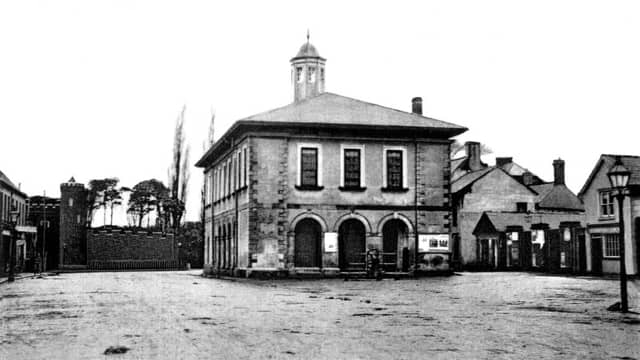

170 years ago the town of Antrim was finally looking to a brighter future. Gas lights had arrived. The dark age was officially over.
170 years ago the town of Antrim was finally looking to a brighter future.
Gas lights had arrived. The dark age was officially over.
It had been a remarkably quick turnaround too.
In October 1854 a Joint Stock Company was formed with the purpose of establishing gasworks in the town, and the 1,800 shares were sold locally for £1 each - with Lord Massereene digging particularly deep.
Within a year the project was complete, with William Vance from Antrim responsible for the masonry and Robert Stewart from Belfast, the elaborate lamps.
And on New Year’s Eve 1855, the great and the good gathered in the courthouse for a celebratory dinner.
The building was tastefully fitted up with evergreens for the occasion.
A large transparency representing the Massereene Arms, with the mottos ‘Per augusta ad augusta’ and ‘Long Live our Noble Chairman’, was unveiled.
It also bore a figure of Erin, with her right hand resting on a harp, beside which reclined a wolf hound, with her left on the horn of plenty. Above her were the words ‘Success to the trade, and prosperity to the town of Antrim’ and ‘Ireland - my country, my delight’.
In the background was a round tower and a railway train.
At the other end of the room was another tranparency, bearing the crest of the Hitchcock family emblazoned with the words ‘Success to the Antrim Gas Company’.
A fine chandelier had been suspended from the ceiling, and it ‘brilliantly illuminated the room’.
Lord Massereene chaired the meeting, resplendent in his uniform as Colinel of the Royal Antrim Artillery.
Before the food arrived he proposed a series of toasts - to the Queen, to Prince Albert, the Emperor of the French, the Lord Lieutenant, the army and the navy.
There then followed a toast to the popular nobleman himself, with John Hitchcock, chairman of Directors of the Gas Company, raising a glass to him.
“Whenever I have called upon him, either in private or in public, to do any act of kindness to an individual or to the town and country of which he is the proprietor, I have always found him respond graciously, willingly, delightedly,” he said.
Lord Massereene rose in thanks to loud applause. Antrim had been his home, he said, for 12 years - and he had seen many changes in that time.
At a time life outside the castle walls for many had been ‘very miserable and destitute of public spirit’. His great uncle, Lord Lough Neagh, had not helped matters as he was an absentee landlord - though he said his judgment had been impaired by a fall that left him with serious head injuries.
“My grandfather remembered the time when there was not a slated house in the whole of Antrim, and when travellers were obliged to get off their horses and lead them through the town lest they should fall - the streets being so rough - and break their knees, and the travellers fall and break their necks.
“My gradfather showed a very good example of industry and self-reliance to the inhabitants. So far as I am able to judge he spent £30,000 on the Castle of Antrim, in improving it.
“My father also improved the place very much by planting and otherwise.”
And he added that his relationship with the people was ‘excellent’.
“I remember on one occasion some person - who must have been a stranger - put up a placard calling a public meeting of the inhabitants to take into consideration ‘the daring invasion of their rights by Lord Massereene’ because I had erected a wooden paling a short distance from the garden wall.
“It brought forth a document the next day, signed by every householder, without exception, in Antrim repudiating it as insulting to them rather than to me.
“That shows the feelings entertained towards me by the inhabitants of Antrim and which I need scarcely assure you, I reciprocate.
“I do trust, and I am perfectly certain, that we shall always be as fond of each other as we are at this moment.”
After a sumptuous meal, prepared by Mr Walker of Bridge Street, the fine band of the Antrim Artillery entertained the crowd.
And outside, as the townsfolk prepared to welcome in 1856, the streets of Antrim twinkled.