

'Lost' underground chamber complex could become 'a tourism goldmine'

IN recent weeks, contractors employed by Antrim and Newtownabbey Borough Council held a public consultation on the future development of the Round Tower site Antrim, also known as the Steeple. Feedback will be used to formulate a plan to develop the home of one of Ireland’s best preserved monuments for the benefit of the community and to help boost inward tourism.
IN recent weeks, contractors employed by Antrim and Newtownabbey Borough Council held a public consultation on the future development of the Round Tower site Antrim, also known as the Steeple.
Feedback will be used to formulate a plan to develop the home of one of Ireland’s best preserved monuments for the benefit of the community and to help boost inward tourism.
I proposed that the decision-makers should take into consideration sites in the wider area to form a heritage trail. Within Antrim there is the Springfarm Rath, numerous holy wells and many great early Christian sites which would be perfect to link, to make a bigger draw for visitors.
Over the past few days a few local guides and historians visited a number of sites to gain a better understanding of what we have and are able to work with within a few miles of the town.
The first stop was the motte on Donegore Hill. Unfortunately large gates with ‘keep out’ signs prohibited our progress. This ancient monument, which includes a council information board, is now not accessible to anyone. We hope this is so that repairs can be made, rather than it being closed to visitors altogether.
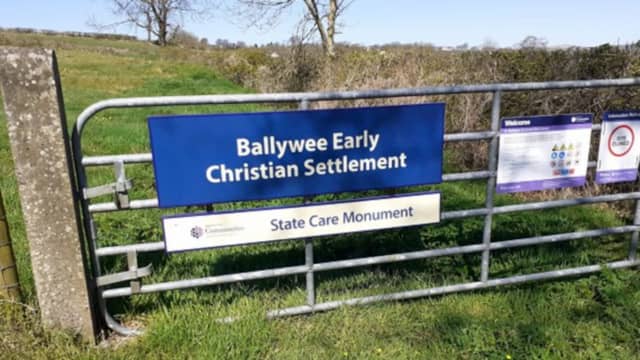
We then visited the ancient settlement of Ballywee, which is located behind Donegore Hill. This is a fascinating site which was completely excavated in the 1970s and again in the 90s. Ballywee is a complex of underground passageways and chambers, known as souterrains, which seems to be thousands of years old, dated to the early Christian era.
Within the many chambers, the cobbled floors are on view and there are many tunnels branching off into other chambers. It’s hard to fathom why it was built, how it was used and why this site hasn’t been properly utilised. Maybe these chambers were used to hide in during wars with other clans or even Viking raids?
Within the annals of Ulster, the whole area is mentioned when in 1137, Bishop Malachy O`Morgair, later St Malachy, insisted on separating dioceses of Down and Conneor, because he felt the people acted like Pagans and actually complained that he had ‘not been sent to men, but beasts’.
This suggests that maybe the early Christians of Ballywee had kept a lot of their old Pagan traditions - the site certainly radiates a sense of mysticism and intrigue.
By the time of the Ordnance Survey, the site isn’t mentioned as it was probably totally covered over and only remnants of building footings were on view.
If the Ballywee site was in the Republic of Ireland or in England, I’m sure it would include a heritage centre, the site would be under a roof and preserved.
Walking around it, I was reminded of a Roman site in Paphos in Cyprus, which is a huge draw to the town. This too, like Donegore Hill, is also inaccessible for tourists - we had to climb over two fences and across a farmer’s field, making sure we didn’t disturb any livestock.
It’s no wonder that this site is something of an unknown quantity, since it is hidden from the roadside.
This isn’t the only site of significant tourism value which is hard to access, just a couple of miles of Antrim town.
At least three perfectly preserved raths are visible at Dunore on the foot of Donegore hill, bordering the lough. Donegore includes ‘ore’, which usually in Irish means gold, or a gold mine.
This whole area could certainly become a goldmine for untapped tourism!