

Lough shock: experts were aware of algae threat more than 50-years-ago
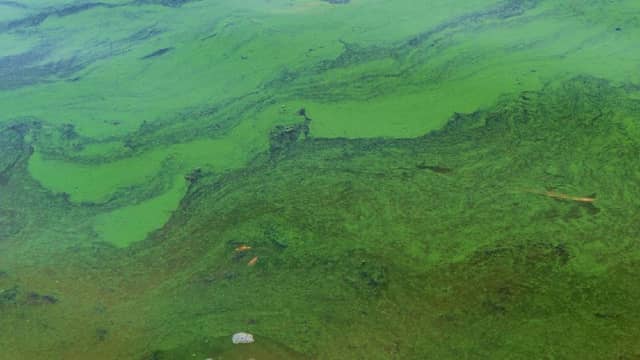

LOUGH Neagh is dying before our very eyes. What started as a hint of green here and there earlier in the summer has become a suffocating sludge that now poses an existential threat to the animals, birds and fish that call it their home.
LOUGH Neagh is dying before our very eyes.
What started as a hint of green here and there earlier in the summer has become a suffocating sludge that now poses an existential threat to the animals, birds and fish that call it their home.
In recent weeks several old-timers have shaken their heads in disbelief. This has never happened before - not in their day.
So what has suddenly gone so devastatingly wrong?
This week the Antrim Guardian can reveal that there was nothing sudden about it. For more than half a century experts have been warning about an impending environmental disaster on the lough.
They knew because it had happened before, in the hot summer of 1967.
In June of that year locals first spotted ‘a mysterious pollution’. The normally clear waters had taken on a ‘dirty green hue’. And it was spreading by the day...
Cyril Johnston admitted that he was growing increasingly alarmed.
“The water is a blue-green colour and as thick as soup, with lumps floating in it as big as your head and others fist sized,” he said.
“Cattle along the lough shore are refusing to drink the water and are nearly mad with thirst.
“Never since I was a boy do I remember such pollution.
“An American visitor has told me of how new cities built beside lakes in the US have, by effluents from their factories, turned the lakes into cess-pools.
“What has happened here to Lough Neagh makes you wonder what will happen when the new industries get going and start pouring waste products into the water...”
Another local resident, who declined to be named, shared those concerns.
“Filth and dirt are being poured into Lough Neagh - enough to kill a fish a foot and a half long.
“And this is the water that is being pumped out and given to people to drink?”
He added that many families had taken to drawing their own water from wells instead, though in the hot weather that supply was expected to dry within days.
All the while the slimy soup continued to spread. It was clear that action was needed to stop the rot.
By July 1967 it was confirmed that two government departments, the Ministries of Development and Agriculture, were joining forces to fight the algae - which they described as ‘the most serious ever’.
Kenneth Vickers, head of the Ministry of Agriculture’s Fisheries Branch, said it was a global problem caused by the increasing amount of nutrient salts - such as fertilisers - entering the water.
By September, exactly 56-years-ago, a new group was established to tackle the problem - the Lough Development Association.
Acting chair Phillip Bell told a public meeting in Antrim that while it was ‘difficult to identify a cause’ for the blooms, they were determined to ‘do something about it’.
“The situation is of national importance and requires immediate action,” said acting secretary Alec Greer.
There were nods of agreement across the hall, including Lord O’Neill who was there as chair of the River Bann Association.
By June 1971, Lough Neagh was making ripples at Westminster as Minister for Development Roy Bradford was grilled by MPs.
And his message was stark.
“We are faced with what might be termed an ecological timebomb,” he told a stunned chamber.
In response, he confirmed that the government had hastily set up the Freshwater Biological Investigation Unit to examine what had gone so wrong in the UK’s largest inland waterway.
Mr Bradford also explained that the enrichment of the lough was a ‘natural ageing process’ through which all lakes progress - though in Ulster that process had undoubtedly been accelerated by man.
Phosphorus was key to the growth of the algae, he said, and around 80 per cent of that came from industrial and domestic sewage.
Ian Paisley said the waterway was ‘one of the most valuable assets in Northern Ireland’ and he forcefully argued that the government should ‘take the lough over and be responsible for it’.
North Armagh MP Robert Mitchell said he was satisfied that the Ministry was ‘no longer complacent about the importance of Lough Neagh’ for water supply and industrial use. He also echoed calls for Westminster to take control of it so they could ‘deal efficiently and effectively with the problem’.
It is a call that still resonates today.
In reply, Mr Bradford said treatment centres would be in operation ‘within the next two to four years’ which would reduce the toxic tide by ‘about 50 per cent’.
Problem solved? Alas, no.
In September 1978 local people, academics, councillors and civil servants gathered at Greenmount in Antrim to discuss the pollution.
Dr Rick Battarbee, of University College in London, said that man had indeed been the driving force of change to a waterway that had remained largely unchanged in 4,000 years.
It had all began in the late 17th and 18th centuries with the agricultural activities of the Scottish and English settlers and the growth of the mills.
It accelerated rapidly in the early 20th century with the growth of toilets in the home which led to the direct disposal of sewage into streams and rivers - and into the lough.
All the while the enrichment increased steadily.
The introduction of synthetic washing powders, rich in phosphorus, in the late 1950s did not help matters - not did the extension of mains sewage after World War Two with the growth of new housing estates.
GJ Kennedy, of the Fisheries Research Laboratory, said the decomposition of the algae posed a serious threat to fish, as it stripped the water of oxygen.
“Although eels are very tolerant of low oxygen concentrations and are normally accepted as being a bottom dwelling species not adapted to swimming in the open water, they certainly could not survive some of he bottom conditions recently recorded in Lough Neagh,” he said.
And that was a real concern. At the time the local eel industry was worth some £800,000 a year - twice the value of the province’s salmon trade.
But by February 1980, despite pumping cash into addressing the issue, the problem was still considered ‘massive’.
Scientist Dr Roger Smith, director of the Freshwater Biological Investigations Unit, underlined how perilous that delicate ecosystem had become.
“It has been estimated that five warm days in which the wind speed drops below five knots would be enough to kill most life in the lake,” he said.
In other words, the sort of conditions that prevailed during the hot spell back in June.
With hindsight, it is perhaps a minor miracle that it has taken more than half a century for the algae to return with a vengeance.
Perhaps there is still time to pull it back from the brink once more.
But it will take a huge concerted effort - and with no Executive sitting in Stormont, there is no hand on the tiller at a time when the various departments should be galvanised into urgent action like never before.
In the meantime, the outlook is grim.
And Lough Neagh is dying.