

Making a killing from the 'Tardree murders'
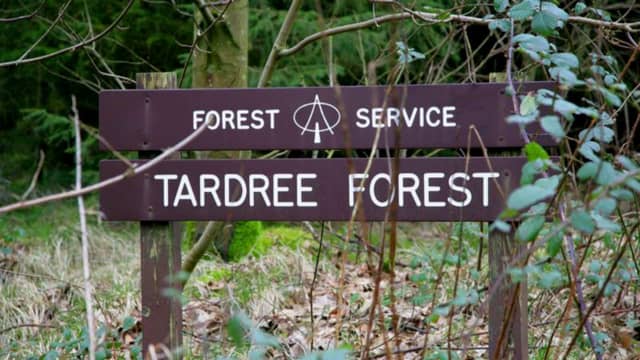

THE rain beat down balefully as the car snaked its way along the narrow country roads towards Tardree Forest. On board were five men, four burly types and another - shivering, head bowed - sandwiched in the back seat.
THE rain beat down balefully as the car snaked its way along the narrow country roads towards Tardree Forest.
On board were five men, four burly types and another - shivering, head bowed - sandwiched in the back seat.
No-one spoke.
The car eventually screeched to a halt and the four powerfully built men stepped out into the shadows, barking at their passenger to join them.
He had been assured that he was being taken to speak with the RUC, so why was he trudging through a forest in the dead of night?
He would bide his time.
They continued on, far off the beaten track until he could take it no more and bolted, sprinting into the autumnal gloom.
Then a glint of metal in the moonlight, as one of the gang of four calmly produced a handgun, took aim and fired.
The fleeing man stopped in an instant. It had all happened so quickly that his body seemed unable to register that he was already dead - an assassin’s bullet lodged in his brain.
And then he fell, out of sight, into a yawning hole in the ground.
By now his killers were at the pit, and they calmly began filling the make-shift grave with wet peat.
It was a brutal business, but business had been good. Together they had dispatched dozens in the same cold, clinical fashion. For them, death had become a fact of life.
The year was 1972 and the men who wiped the mud off their boots before getting back into their car and leaving that godless place were members of the SAS. Their victim was a Catholic, just another life snuffed out during a turbulent 12-month spell that ‘officially’ claimed 497 lives.
If this all sounds like an unpleasant scene from an ill-advised film, well, it very nearly was.
And it all started with the publication of a controversial book back in 1996. Indeed, more than a quarter of a century on the debate is still raging.
‘The Nemesis File’ was penned by ‘Paul Bruce’, and what made it remarkable was the fact that he claimed the story was true - and he should know, because he insisted he was there.
Acting under orders, he stated that the elite troops had carried out ‘perhaps 40 murders’ at the height of the Troubles. Bruce admitted he had personally shot ‘13 or 14 people in cold blood’.
If true, the allegations would rock Westminister to its core. But it was a big ‘if’.
The Ministry of Defence vociferously denied any ‘abduction and assassination operation’. Well, they would wouldn’t they?
But even Sinn Fein baulked at the suggestion. If so many young republicans had vanished, surely they would have known about it.
And, 50 years on, the alleged mass graves have yet to reveal their secrets.
But the books editor, John Blake, was standing by his man. And as former editor of the Sunday People and senior executive at the Daily Mirror, he knew something about telling and selling a story.
Since Tardree was front and centre in this gruesome tale, he was keen to speak to the Antrim Guardian to silence the doubters.
“Like a lot of people I was very sceptical when I read the first crude draft of the book, but the more myself and others have looked into it the more I have come to believe that Paul is telling the truth,” he said.
“It is an amazing, incredible and ultimately terrible story but a lot of people are beginning to take it seriously.
“The MOD might like to see Mr Bruce portrayed as a fantasist, but I feel that he has been very courageous in telling his story, the implications of which could be enormous.”
He added that Blake Publishing sought water tight assurances before going to press, and that is when the author produced his ‘ace card’ - a signed affidavit from another member of the murder gang supporting his version of events.
But then there was the question of the legal implications for Bruce himself.
“Our own solicitors advised that because of his candid admission that he had killed many of the young men in cold blood, he left himself open for prosecution. It didn’t worry him.
“He’s not after money or fame. He just feels that a dreadful wrong has been done and he believes it’s time everyone knew about it.
“He was an idealistic young soldier and he was exploited. It was a sordid, horrible affair.”
The story sparked considerable media interest, catching the eye of ‘Paul Bruce’ himself - who agreed to give the Antrim Guardian an exclusive interview to elaborate on why he decided to break cover after so many years.
Though he was reluctant to give his real name or service number to check his credentials, he insisted that his experiences in Northern Ireland had left his life in ruins, and him a broken man.
“Since I left the army in 1972 I haven’t been able to settle down. I started drinking. I drifted from job to job. I got married, but that too ended in disaster. It hasn’t been easy,” he said.
He gave up drinking in 1991 and began putting to paper the ‘terrible memories’ he maintained he had spent the previous 20 years trying to blot out.
“When I first started writing what eventually became this book it was very much for myself - a form of therapy if you like. I never intended to make any money out of it.
“When we decided to go ahead and publish the book I thought it would be a great relief, but it hasn’t really worked out that way. I’ve been thrust into the limelight and a lot of what I say has been denied.”
He argued that their covert operations went unnoticed because of the scale of the bloodshed back in ‘72.
“Northern Ireland seemed to be a war zone with daily reports of shootings and bombings. When we, the SAS, were called in we had a pretty good idea that the work would be dirty.
“When our mission was explained to us I felt physically sick. I was dumbfounded and it took a long time for it all to sink in.”
Soon, however, he claimed the four man team was clinically dispatching victims at a rate of up to two a week. And one by one they were led to massive burial pits - one at Tardree, the other between Dromore and Lurgan - and shot in the back of the head.
Mr Bruce insisted that the ‘executions’ never got any easier.
“Each murder was definitely more difficult than the last but at the moment of truth my training gave me the ability to switch off. I’m not a natural born killer.”
He added that any blame had to be shared with the team’s commanding officer, who rather conveniently ‘died in the Falklands’.
“We were acting under orders. We were told that the targets were IRA men and we were told what to do with them.
“You have to remember that if we had rebelled the same would have happened to us. I have no doubt about that. Once we had become involved we had dug a hole for ourselves that was impossible to get out of.”
And in a sense history was repeating itself. He had made some explosive claims - and it would be hard to dodge them with the press pack in hot pursuit.
“Once this has settled down, if it ever does, I dream to get away and live quietly.”
Some chance.
By the end of January, the police confirmed that detectives were looking into ‘The Nemesis File’.
“Certain allegations in this book are being investigated,” said an RUC spokesman.
“There does not appear to be a lot of evidence to back up the claims, but the investigation is ongoing and we have no further comment.”
Two officers flew over to London to interview John Blake - who clearly saw their intervention as further ‘proof’ that this story had legs.
“The police told me that one of the sites is very peaty which means that if any bodies are buried there they could be very well preserved,” he told reporters, hungry for a new angle.
By now the book was gathering momentum, as well as international attention. Three American publishers, said Blake, were embroiled in a bidding war. There were also negotiations with movie moguls keen to film this shattering ‘true story’.
He may have no interest in money but Paul Inman, the author’s real name, was suddenly raking it in - but at a cost.
After giving a series of interviews admitting his own role in the killings, each more grisly than the last, it was only a matter of time before the RUC took him at his word.
In August 1996 there was a dawn raid on his home in England. He was arrested under the Prevention of Terrorism Act and flown back to Belfast.
According to the RUC, he soon cracked under questioning and admitted that he had ‘made the whole thing up’.
The police confirmed that Mr Inman was never a member of the SAS, though he had served briefly in Northern Ireland in 1972 with the Royal Mechanical Engineers.
“We are satisfied that the allegations contained in the book are not true in fact or substance,” they said.
“The RUC consider the book a work of fiction and accordingly the investigation is now closed.”
This was echoed by the Ministry of Defence, who insisted the SAS were not serving in Northern Ireland at the time of the ‘killings’.
“We have said all we’re going to say about this matter,” they said in a terse statement.
Though almost universally discredited, it proved to be a huge money-spinner reportedly grossing £2 million in UK sales along by October of 1996. For critics, this was filthy lucre of the highest order.
Blake Publishing went from strength to strength, winning industry awards and adding ‘authors’ like Katie Price to their roster of talent.
But it did not all go their way. In 2003 they published ‘Dead Lucky’ which purported to have the scoop on the whereabouts of Lord Lucan. It later transpired that the man they identified in Goa was actually a folk singer named Barry Halpin. It sold 20,000 copies, but the remainder of the 80,000 print run had to be pulped.
Little is known about the whereabouts of Paul Inman or if he ever got that quiet life he craved. One things for certain, though. This author was never brought to book for murder or for sparking an expensive wild goose chase.