

MLAs speak out on flooding at Stormont
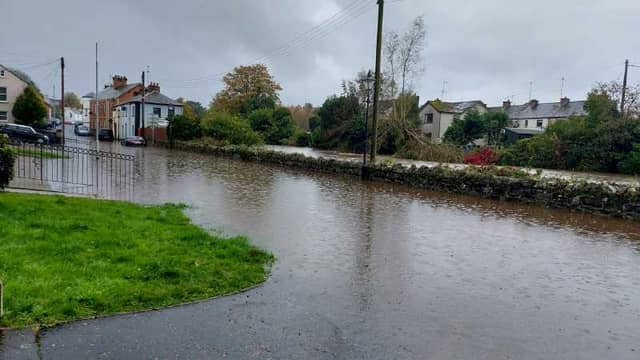

THE Northern Ireland Assembly has formally accepted a motion brought forward by South Antrim UUP MLA Steve Aiken regarding persistent flooding concerns along the Six Mile Water. The motion has been scheduled for debate tomorrow, 17 February, after the Antrim Guardian went to press.
THE Northern Ireland Assembly has formally accepted a motion brought forward by South Antrim UUP MLA Steve Aiken regarding persistent flooding concerns along the Six Mile Water.
The motion has been scheduled for debate tomorrow, 17 February, after the Antrim Guardian went to press.
Dr Aiken has repeatedly raised the issue within the Assembly, highlighting the severe and ongoing impact of flooding on communities in Antrim, Ballyclare, Muckamore, Dunadry and surrounding areas.
His motion calls for a coordinated, cross departmental effort to deliver long-term, sustainable solutions.
In recent years, the Six Mile Water corridor has experienced frequent and increasingly severe flooding events, placing homes, businesses, and critical infrastructure at risk.
Local residents’ groups have consistently voiced concerns about road closures, property damage and the lack of timely remedial action.
Speaking ahead of the debate, Dr Aiken emphasised the urgency of the issue, stating that communities ‘cannot continue to endure the anxiety and disruption caused by recurrent flooding’ and that government agencies must ‘work at pace to protect households and restore confidence’.
Alliance MLA John Blair said: “I am pleased that this important issue has been brought before the Assembly, and I want to thank my South Antrim colleague for securing the debate. This discussion is particularly timely given the recent – and, sadly in many areas, ongoing – flooding being experienced across my South Antrim constituency.
“I also want to thank the Infrastructure Minister for taking the time to visit South Antrim just a couple of weeks ago to witness first-hand the devastation caused by the flooding.
“As climate change accelerates, heavier and more frequent rainfall is becoming a regular feature of our weather. We have endured an exceptionally wet winter, and what were once ‘once in a decade’ events are now occurring with regularity.
“The recent devastation is yet another stark reminder of the long -overdue need for a comprehensive Flood Alleviation Scheme along the Six Mile Water and other locations in Antrim. It is deeply frustrating to be repeatedly contacted by distressed constituents while I and others have consistently pressed the Infrastructure Minister for mitigation measures.
“Ministers have indicated that there may be progress on an alleviation scheme by summer 2026. That work must proceed without delay, and I will continue to press for it both inside and outside this Chamber.
“My own frustration is nothing compared with that of those living with daily flood risk - people who fear for their safety, their families, and their homes and businesses every time heavy rain is forecast. I have seen that fear again at the end of January and the start of February particularly in Ballyclare, Dunadry, Glenavy and other communities across South Antrim, especially those in residential streets around Antrim Town where both fear and flooding have been a reality on so many occasions.
“The negative impact of continued development and associated run off along the banks of the Six Mile can no longer be questioned and this reality must form a central part of future strategy in both Planning and Infrastructure terms.
“Flooding along the Six Mile Water is not only a threat to homes, roads and businesses; it is also an environmental crisis. When the river bursts its banks, it carries sediment, agricultural run-off, nutrients and pollutants into the wider catchment, including Lough Neagh.
“Food events damage water quality, undermine biodiversity and further strain already fragile ecosystems. We have all seen the images of blue‑green algal blooms and the severe pressures on Lough Neagh.
“It is vital that the Infrastructure Minister rapidly brings forward robust flood alleviation plans for areas historically affected by flooding, so we won't be back here next autumn and winter making the same requests. Those residents who have faced repeated flooding can be assured that I will continue to raise this with the Infrastructure Minister and seek the detailed update she has promised on the flood alleviation scheme for the area.
“My constituents cannot wait for the next storm to find out whether lessons have been learned. I have raised this issue before, I raise it again this evening, and I will continue to do so until the people of South Antrim see the meaningful, climate-proofed action they deserve.”
DUP man Trevor Clarke added: “I welcome the debate on the Six Mile River. Anyone who was in or near the area on the day of the flooding a few weeks ago could not have failed to be shocked by the sheer scale of it.
“While development is necessary to allow families to build and buy new homes, we must also consider the impact on those already living in established communities. Existing homeowners should not bear the consequences of increased river swell and inadequate infrastructure.
“The Minister for Infrastructure has responsibility for Rivers and Roads. I am therefore calling on the Minister to carry out full and updated flood modelling to assess the cumulative impact of current housing approvals and to determine what, if any, additional capacity the river system can safely accommodate.
“Given the flooding that has already affected homes, it is essential that a clear mitigation and action plan is brought forward before any further housing developments are approved.
“Protecting existing residents must be the priority.”
His party colleague Pam Cameron said: “Flooding issues along the Six Mile River is not a new issue. It has been happening for years, affecting the same communities, the same homes and the same roads time and time again.
“This is not about freak weather events. It is repeated, predictable flooding, and residents are rightly asking why nothing has changed.
“Previous Ministers, including Sinn Féin Ministers, have visited these communities and seen the damage first-hand. Yet years on, people are still asking the same questions: where is the plan, what is being done, and when will this be fixed?
“I want to be clear: this is not a criticism of frontline staff within the Department for Infrastructure, who work hard and who Members regularly engage with constructively. The issue is leadership, direction and delivery at a strategic level.
“What communities see is a system that reacts after flooding happens, rather than preventing it. Visits take place. Reviews are carried out. But the flooding continues.
“Planning decisions are part of the problem. We continue to see development pressures without proper alignment with drainage capacity, flood risk management or road infrastructure, leaving communities downstream to deal with the consequences. But planning alone is not the excuse.
“The real issue is the absence of a clear, coordinated, catchment-wide flood prevention approach for the Six Mile River.
“My constituents are crying out for a solution. These are people whose homes have been flooded, whose possessions have been destroyed, and who live with constant anxiety every time heavy rain is forecast. That is unacceptable.
“So I ask the Minister to set out what immediate steps will be taken to deliver a coordinated flood prevention approach for communities along the Six Mile River, and when residents can expect to see real progress on the ground.”
Mr Aiken’s representative did not respond to a request for speaking notes ahead of the debate on Tuesday, while a representative for Sinn Fein MLA Declan Kearney said his notes would not be available at time of going to press.
Last Monday, the Infrastucture Minister Liz Kimmins responded to questions on the issue from Mr Blair and Mrs Cameron.
She said: “My Department’s Rivers directorate continues to progress a feasibility study to assess the river flood risk to properties in the Antrim area of potential significant flood risk. That work will identify whether there are any viable schemes to reduce the impacts of river flooding in the area, including at Riverside/Massereene Street, Meadowside, Muckamore and Dunadry.
“Ongoing work includes information gathering, progressing with updating the supporting hydrological analyses for the Sixmilewater river and early optioneering. It is anticipated that the feasibility study should be complete in summer 2026, as Members will be aware. Any opportunities to accelerate work on that study will be taken.
“In the immediate aftermath of the recent flooding, I visited Riverside, Antrim, where I met affected residents to listen to their concerns. Flooding of homes and businesses is absolutely devastating and distressing for those impacted, and, that day, I gave a commitment that we would do all that we can to manage it as best we can.
“Staff from Rivers and Roads teams also attended an urgent meeting with Riverside and Massereene Street residents last Wednesday. My understanding is that the session was constructive and robust. Officials provided an update on the Department’s immediate actions and longer-term plans for Antrim.
“I wish to advise that, as I said they would be when I visited two weeks ago, the operational protocols at Riverside were reviewed and updated with immediate effect to ensure strengthened operational readiness. Across the wider Antrim area, as co-chair of the regional community groups, we plan to convene a regional community resilience group (RCRG) meeting with multi-agency partners in the coming weeks.
“At that session, we will share the lessons learned from the recent flooding event. It is anticipated that that will also provide an opportunity to expand the group’s membership to include representatives from the areas most affected. The work of the RCRG helps to build resilience in communities. That is not my Department stepping away from its responsibilities; rather, it is an extra layer of support proposed for those impacted by flood events.”
Mr Blair asked if she would commit to a moratorium on major approvals in that area until a full drainage capacity study is complete.
Ms Kimmins said: “That issue was brought to my attention while I was on-site two weeks ago. While planning is the responsibility of the council, my Department is a statutory consultee as part of the process and looks at every application on its merit. That information is extremely important.
“As we look at climate change, climate change policy and how those things impact on planning, we will continually feed into that. I am happy to have a discussion with the Member if he has further questions on that. However, I recognise the concerns of the community there as well.
Returning to Mrs Cameron, who asked for a public or private meeting in Antrim between officials and residents to present an immediate action plan and realistic timeline for permanent solutions, the Minister said: “I will do my best to answer them. I have experience of flooding in my area, and I know how devastating it is.
“That is not to underestimate in any way the flooding in the Riverside area. I know that it is horrendous. The anxiety that comes in the aftermath is worse, because people anticipate the potential for flooding to happen every time that there is heavy rain. That is really important, and I factor that into everything that we do. That is why I asked officials to attend that most recent meeting, because it is important that we get ahead of it in the future. I appreciate the frustrations around capital schemes, because they take time.
“Where there is a possibility of speeding them up, we will absolutely do that. However, there are things that we can be doing in the interim.
“I laid out clearly to the residents whom I spoke to that day that there is a long-term plan. We will work through that at pace, but there are also things that we need to do in the interim. I spoke about how we reviewed the most recent operational response and upgraded it.
“We hope that we will be even more ready next time, because I recognise the concerns that came from the most recent occasion. Hopefully, we can build in an extra layer of support through the regional community resilience group. I am happy to meet with you to discuss that in the near future.”