

Murder most foul
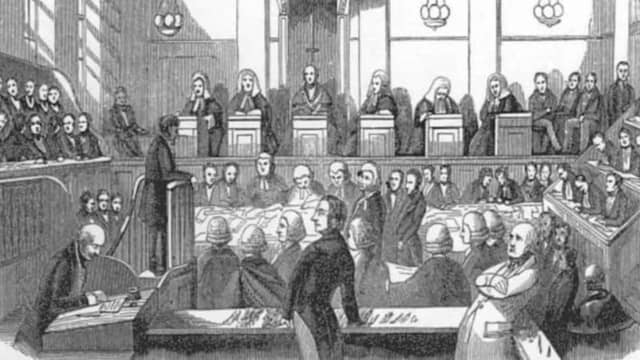

IT looked for all the world like an open and shut case. A well-regarded local woman was brutally murdered in October 1874 - and when the case finally came to court in March of the following year the people were baying for justice.
IT looked for all the world like an open and shut case.
A well-regarded local woman was brutally murdered in October 1874 - and when the case finally came to court in March of the following year the people were baying for justice.
The Belfast Weekly News was there that chilly spring morning almost 150-years-ago as, it seems, were practically the entire population of Templepatrick, Antrim, Doagh and Ballyclare.
‘As early as nine o’clock the gates were besieged by quite a crowd of persons, and every means short of force was utilised to gain an entrance within the coveted precincts’, noted the reporter.
‘The ingenious stratagems resorted to were really amusing to anyone unconcerned with the gravity of the occasion. Jurors, of course, on the production of their summonses were at once admitted, and proceeded with considerable alacrity to take possession of as good a seat as could be found.
‘The members, however, who figured not on the panel were vastly in the majority and it was against the devices of them that the bailiffs and constabulary had to be actively on the alert. Many boldly asserted their right to pass on the grounds that they were magistrates - indeed as many such presented themselves as would have given a resident justice for every street in the town’.
So what was the source of this intense public interest?
Widow Margaret Langtry had been murdered, and labourer William Bill stood accused of the heinous crime.
At 10 o’clock the accused was led into the dock and the five-strong prosecution team began the grim task of setting out the distressing ‘facts’ of the case.
By their own admission the case was ‘entirely circumstantial’, but they maintained that the facts combined painted a compelling picture of guilt.
Mother of three Margaret Langtry was ‘about 40 years of age’ and lived with her uncle David Bill, as his housekeeper. To complicate matters, Mr Bill was also the uncle of the accused. Indeed, the young man often visited his farm stead to work and stayed under his roof.
He would have known that his uncle kept his money in a chest in the loft. And that Ms Langtry kept the key. He would also be aware that uncle David was in the process of making up the rent for November and that he had asked his father for ‘£1 or £2’ to make up the amount, meaning that there was around £20 secreted away.
On the morning of October 30 1874 David Bill was in Belfast on business leaving his niece home alone. He returned back at some time between 9pm and 10pm when he noticed a bright light inside the property. Nervously, he ventured inside and saw ‘a bundle’ lying close to the fire. Thick clouds of smoke belched from it - and there were flames.
His shock turned to horror when he moved closer and saw his niece’s dead eyes gazing back at him.
“When I went into the kitchen I could scarcely stay on my feet,” he told the court.
“I was so horrified at what I saw. There was a bulk lying opposite the fire, about five or six feet long all ablaze and smoke and fire. I could not think what it was until I saw the countenance of Margaret Langtry.”
Realising she was beyond help, he raced to the loft and saw that the chest had been broken open with a hatchet, which lay beside it. Linen that had been stored in the box had been strewn around the room, but the would-be thief had failed to locate the cash - which had been wrapped in paper and cloth.
When he spotted the bundle of ‘notes and silver’ he scooped it up and put it in his pocket.
Back in the kitchen, there was ample evidence of the savagery that had exploded earlier that evening.
A pane of the back window had been broken, as were two or three in the front window opposite, The spot where the deceased lay was almost exactly between the two.
Blood had spattered on the walls and pooled on the floor. Slugs were found in the wall and the window frames and glass had been blown outside.
It was clear that a shot had been fired, striking the unfortunate widow on the head as she rested on a stool beside the fire. She had crumpled to the ground, her dress in the embers.
Worse still, the gun man had then entered the property through the window and as she lay there, her life ebbing away, he had battered her skull with the axle of a churn which was found lying on the floor nearby.
Upstairs her children slept, oblivious to their mother’s fate. They may not have stirred, but witnesses recalled hearing a shot coming from the Bill residence at around 8pm.
As police began combing for clues, some were baffled by the presence of small portions of a newspaper at the scene. Could this have been wadding from the gun? Could that smell on it be gun powder?
So police quickly established when and how the killing had taken place - but the burning question now was who was responsible?
The first port of call was David’s brother John, the father of the accused who also farmed land some three and a quarter miles away.
There were two roads for the traveller to choose, one towards Doagh and the other via Templepatrick - the latter of which was longer by roughly two miles.
But there was a quicker way, which the defendant had been in the habit of using. There was a ford crossing at the Sixmile, and from there walkers could follow the fields as the crow flies taking the journey time down to little more than half an hour.
When officers arrived at John Bill’s home, everyone was already in bed but during a cursory search of the property they found newspaper pages from the very same editions as those found in the murder house,
But what of a weapon? The prisoner in the dock had one in his room.
Concealed out of sight nearby were a pair of boots. And they were soaking wet. Indeed ‘the water was running out of them’. The trousers William had been wearing that night were wet too, as were his socks, and his waistcoat was damp.
Constable Gowan, who conducted the search, later recalled that incriminating visit.
“I saw the trousers and vest and coat in the room hanging on an old chair. The trousers were wet and were slobbered with mud round the legs.
“The boots I found behind a barrel. They were saturated with damp and there was water inside. The night was dry and there had been no rain for three or four days.
“The prisoner’s hands were black and dirty and he seemed to be perspiring and nervous.”
Enquiries revealed that the young man had been out that evening, and had not returned to the homestead until after 9pm.
There had been a sighting near Doagh at around 7pm by a 12-year-old mill worker. William Taggart said the man had something in his sleeve - something that projected into his hand.
But what about motive? Well, apparently there had been a fall out between the pair in recent days. The accused’s sister had died and was buried in Templepatrick on lands the murdered woman ‘claimed as her own’ and they had exchanged angry words.
Game, set and match. William Bill was arrested on the spot.
Yes, much of the evidence was circumstantial, but taken together it seemed pretty compelling - and if the jury agreed the local man would hang.
But even before the prosecution rested, tiny cracks began to open in the case - and some pieces simply did not fit.
Why, for example, would William smash open the chest with a hatchet when he would have known children slept nearby? And why would he not simply retrieve the key which he knew the victim always carried - and which was nestled in her pocket when she died?
Other things did not add up either. Take the socks, for example. Remember Constable Gawn had said they were sopping wet but under cross-examination by formidable defence lawyer Mr McMechan, he was forced to concede that it may have had nothing to do with the Sixmile.
They may have been, he admitted, merely ‘damp with perspiration’.
And then there was the evidence of young William Taggart, who claimed to have seen ‘a man with a gun’ on the night of the murder.
He told the court that he had seen him shortly after 6pm when he was waiting for his sister outside Doagh Post Office.
The man, who he recalled was wearing a grey coat and a hat, kept looking back at the youngster as he walked along the road.
Asked if he could see the man carrying what appeared to be carrying a gun in the court room, William said he could - pointing at the man in the dock.
But his testimony provided more questions than answers.
When pressed on the gun he conceded that he could ‘not say what it was he had in his hand’.
He also said that he remembered vividly the clinking of the man’s clogs on the road. Clogs? What about those incriminating boots?
Then there is the question of how he picked the prisoner from an identity line up at Templepatrick police station days after the murder.
“I have no doubt that the prisoner is the man I saw in Doagh. I am quite sure of it. I was not always sure of it...” he said in a faltering voice.
He also conceded that he had changed his mind about the hat and the colour of the coat. He added that he recognised him by his clothes and not his face in the barracks.
And now?
“I know him by his face too,” he replied.
Of course he would. If he had been coached by the police in the first place.
The prosecution case over, day two of the trial belonged to the redoubtable Mr McMechan. From the outset he maintained that an innocent man was facing the gallows - and that powerful forces were conspiring against him.
“I urge the jury to restore this young man to liberty, to his labour, to the family from whose bosom in the dead hour of night he was torn on the mere notion of a single policeman,” he said.
That officer was William Gowan, a man he accused of leading the prosecution ‘from motives in his own mind’. Furthermore, the lawyer believed that he had deliberately ‘suppressed nine tenths of what he knew to be true’ to achieve that.
The damning newspaper evidence was a good case in point. The paper had been used to wrap cheese by the murdered woman, and she gave it to the defendant’s parents following the ‘heavy bereavement’ of the recent death in the family. That is why, he said, that the pages matched - because they were from the very same paper.
He also speculated why the police, if they were so confident that Bill had waded across the Sixmile to slay the widow, why did they not conduct a search in the area that night?
The answer, he opined, was that the officers believed they had their man and they began to shape the evidence to support that.
“Constables and police officers are immediately on alert and with professional zeal examine every circumstance which can lead to establish not his innocence but his guilt.
“Presuming him guilty from the first, they are apt to consider his acquittal as a tacit reflection on their discrimination or skill and with something like the feeling of a keen sportsman they determine if possible to bag their game.”
Accordingly, simple question that could produce unwanted answers were simply not asked.
Where was the prisoner that night, for example?
Roseanna Bill, his mother, said the police never asked her. She was still mourning the loss of her daughter and had not been eating. William asked if there was anything that would change her mind and she said she was very partial to stewed rabbit - so he had set out to find one.
Armed with his trusty snare, he headed for Ballyvoy Wood where he caught one. On his way back he passed the window of Sarah Barr, who lived four miles from the scene of the murder, and they chatted briefly. She recalled in court that it was 8pm - the very time that a shot rang out at the Bill house.
And what of the boots? Could there be another explanation?
They had in fact been borrowed that afternoon by William’s sister Mary who had been mucking out the pigs. She told the court that it was ‘very dirty work’ and before she returned the boots she had to clean them inside and out.
When she returned them she noticed that her brother’s gun was lying on the bed.
Long before the police arrived, she wished her mother a good night as she stirred a fresh bowl of rabbit soup over the fire.
Roseanna Bill also remembered the attitude of the local constabulary as they descended on her humble home.
“The police searched the house and abused it very badly. There is a man (pointing at the sub-inspector) and I don’t say he is a bad man, but he jeered and taunted at me,” she said.
Day three saw the long-awaited verdict - and Mr McMechan said it should have implications far beyond the courtroom.
“An Act of Parliament should be passed without delay to forbid a police constable to dare, without a Magistrate’s sanction, to invade a peaceable, slumbering place,” he said.
The jury retired at 5.15pm and were back just three years later - with a verdict of not guilty.
A woman had died a terrible death - but an innocent man had been saved from the gallows.