

'Name and shame litterbugs' says environmental campaigner

THE Six Mile Water Trust has said that while the river appears to be getting cleaner, more needs to be done to help avert disasters like the blue-green algae plague which struck Lough Neagh last summer. The organisation spoke out after it emerged that 100% of river stretches in Northern Ireland failed to meet ‘good’ overall status.
THE Six Mile Water Trust has said that while the river appears to be getting cleaner, more needs to be done to help avert disasters like the blue-green algae plague which struck Lough Neagh last summer.
The organisation spoke out after it emerged that 100% of river stretches in Northern Ireland failed to meet ‘good’ overall status.
Last week the Rivers Trust released its 2024 edition of the State of Our Rivers report, providing a comprehensive analysis of the health of rivers across Northern Ireland, Ireland, and Britain.
The new report features a case study of the causes and potential solutions to the blue-green algae pollution crisis of last year, which caused vast toxic algal blooms in Lough Neagh and is forecast to return this summer.
Jim Gregg of the Six Mile Water Trust said that it’s not too late to make big environmental improvements.
“As a Rivers Trust we are fully aware of the state of not only the Six Mile Water but all rivers throughout the UK and Ireland.” he said.
“The primary source of pollution is from sewage plants that continue to discharge into adjacent water ways. You only have to listen to the news and hear how bad it is in the UK .
“The Six Mile Water Trust can only give our experience on the Six Mile catchment, having been monitoring pollution since 2009 using various means, citizen science like invertebrate monitoring gives a very good indication of background levels.
“In fairness to NI Water, significant improvements have been made to Ballyclare Waste Water Treatment plant and Muckamore and Ballynure waste water pumping stations.
Other upgrades have included improving storage and telemetry and backup pumps.
“It is of concern however, that the local planning authorities disregard NI Water as a major consultee when they advise of significant pollution risk to the Six Mile Water on certain planning applications.
“It is clear that the environment has been neglected by government allowing outdated infrastructure to be continually overloaded and hence the outcome we see being highlighted today.
“Is it too late? No it is not.
“The Six Mile catchment has seen improvements in fifteen of its’ eighteen monitoring sites over a ten year period using kick sampling and reporting identified sources of pollution.
“Recent information received indicated that the Six Mile Water is the fifth largest contributor of Phosphorous of the eight main rivers feeding annually into Lough Neagh.
“However the Six Mile is the only river that has shown a decline in phosphorus levels each year since 2012 to 2022. This reduction, whilst monitoring phosphorus, is also relative to other pollutants nitrates and other enrichment sources such as agriculture and storm water drainage improvements.
“The Belmont Road development is an example, whereby a major move away from hard engineered storm water drainage to a sustainable urban drainage system (SUDS) utilizing open ponds, swale, wetland as containment with a controlled discharge of much cleaner storm water.
“Other major key performance indicators (KPI’s) include the increase in otters, fish, kingfishers, dippers and aquatic plants such as ‘ranunculus fluitans’ a rare water crowfoot, restricted to the Six Mile Water.
“However we are never far away from a major incident.
“In September 2023 we had a massive fish kill in Ballynure where we lost more than 1,400 trout in one incident of pollution which is still under investigation.
“The Trust are currently working on a document in relation to the Six Mile Water catchment pollution sources and what has and can be done to improve water quality.”
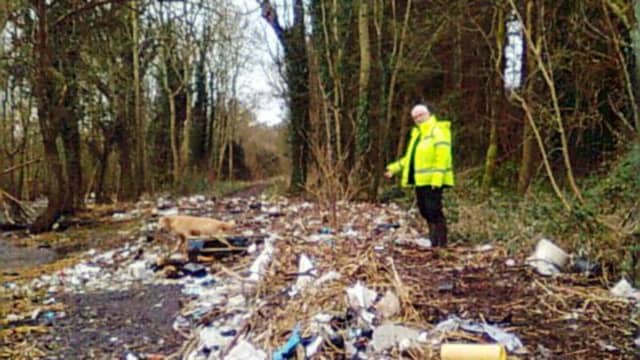
In recent weeks the SMWT, working in conjunction with Antrim and Ballynure Angling Clubs removed approximately 270 large bags of litter from the banks of the Six Mile Water in their annual clean-up, taking place since 2016.
Jim said: “On average 30 bags have been removed year after year along with shopping trolleys, bicycles, building materials, and river blockages.
“All a public eyesore, flood risk, and environmental pollution. It is disappointing that we have not seen a reduction, meaning that we are not addressing the underlying problem.
“Whilst the Angling Clubs and Trust do their best, we need fundamental change and that means a change to legislation from those charged with that responsibility for the protection of our environment.”
The Trust wants to see more information in the Highway Code regarding littering from a vehicle, making such guidance part of a driving written test and heavy penalty points, car seizure, and fines for littering from a vehicle.
It has also called on the council to introduce specific litter wardens with targeted patrols, ti increase public awareness and publicise the names of those issued with fines and fixed penalty notices.
The Trust has also called for specific awareness classes on environmental subjects.