

New Zealand High Commissioner visits Glenavy
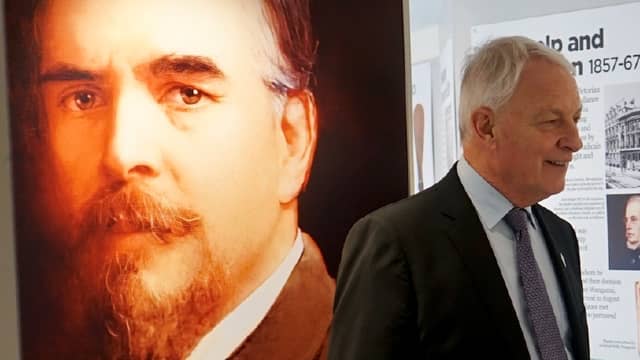

NEW Zealand High Commissioner to the UK, His Excellency The Hon Phil Goff, was a guest of the Ulster New Zealand Trust at The Ballance House in Glenavy during a busy visit to Northern Ireland. Appointed earlier this year to head the NZ diplomatic mission in London, Phil Goff is a former leader of the Labour Party in the Wellington Parliament, who served as a minister in several key posts and later as Mayor of the capital city.
NEW Zealand High Commissioner to the UK, His Excellency The Hon Phil Goff, was a guest of the Ulster New Zealand Trust at The Ballance House in Glenavy during a busy visit to Northern Ireland.
Appointed earlier this year to head the NZ diplomatic mission in London, Phil Goff is a former leader of the Labour Party in the Wellington Parliament, who served as a minister in several key posts and later as Mayor of the capital city.
Accompanied by First Secretary Kate Swan, the High Commissioner toured the home farm of New Zealand Premier John Ballance. Now an event and exhibition centre outside Glenavy that promotes family and business links between Ulster and New Zealand.
It was a visit that gave Phil Goff special pleasure, as the New Zealand Parliament in Wellington only has two statues of former Prime Ministers outside it and one of them is of John Ballance.
John Ballance was the 14th Premier of New Zealand at the end of the 19th century. The Ballance House, his birthplace, is now run as an historic attraction.
Born and schooled in Glenavy, he moved to New Zealand in 1866 and was the founder of the Liberal Party, the country's first organised political party and was instrumental in gaining women the vote.
Having been welcomed by UNZT Executive Chair Freddie Hall The High Commissioner took a guided tour of the Trust’s new exhibition with Director Brian Mackey.
Having himself left home and school at 16 to make his own way in the world NZ High Commissioner Phil Goff greatly enjoyed visiting the home of John Ballance, who left aged 14 to make his fortune.
The eldest son of Samuel Ballance, a tenant farmer, and Mary McNiece, Ballance was born on 27 March 1839 in Glenavy.
He was educated at a national school, then apprenticed to an ironmonger in Belfast. He later became a clerk in a wholesale ironmonger's house in Birmingham, where he married.
Ballance was highly interested in literature, and was a voracious reader.
He also became interested in politics, mostly due to the influence of his parents – his father was active in conservative circles, while his mother was a liberal. It was from his mother that Ballance gained many of the ideas he was later to promote. Having witnessed religious rioting when in Belfast, he became committed to the principle of secularism.
In 1866, Ballance and his wife migrated to New Zealand, intending to start in business as a small jeweller.
After settling in Wanganui, however, he took an opportunity to found a newspaper, The Wanganui Herald.
He became the editor, and remained chief owner for the rest of his life.
During the fighting with the Maori chief Titokowaru in 1867, Ballance was involved in the raising of a volunteer cavalry troop, in which he received a commission - which was later removed because of Herald articles criticising the management of the campaign.
Despite this, he was awarded the New Zealand Medal.
Following the conflict, Ballance’s status in Wanganui grew. He was respected for his management of the Herald, particularly his forthright and direct approach to reporting. He became increasingly involved in the affairs of the town, establishing a number of societies and associations, including a chess club.
In 1868 his wife Fanny died of illness, aged only 24 and two years later, he married Ellen Anderson, daughter of a Wellington architect.
He entered the New Zealand Parliament in 1875 as an Independent and eventually joined the Liberal Party in 1890.
Throughout his political career, he held various ministerial positions, including Minister of Customs, Minister of Education, and Colonial Treasurer. Ballance was an advocate for the abolition of provinces, and free education. He also introduced progressive land and income taxes during his time as Premier.
In his role as Minister of Lands he encouraged intensive settlement of rural areas, but also strongly supported the rights of the indigenous peoples to retain the land they still held. He reduced military presence in areas where strong tensions existed, and made an attempt to familiarise himself with Maori language and culture.
In 1890 Ballance led a loose coalition of liberal politicians to victory in the general election.
In 1893, at the height of his success and popularity, he died in Wellington of an intestinal disease after a major surgical operation and was the first New Zealand Prime Minister to die in office.
A statue was erected to his memory in front of Parliament House, Wellington, in front of what is now the parliamentary library and in Moutoa Gardens in Wanganui.