

Nutts Corner woman battles back from tragedy to help others through their grief

AFTER the death of her husband Hunter in 2010, just 14 weeks after being diagnosed with cancer, in 2019 Eleanor Abbot decided to embark on a charity walk to raise funds for the Northern Ireland Hospice. Hunter (63), a director of Spring & Airbrake in Nutts Corner, was released from hospital having undergone radiotherapy in the middle of May 2010, before sadly passing away on June 26.
AFTER the death of her husband Hunter in 2010, just 14 weeks after being diagnosed with cancer, in 2019 Eleanor Abbot decided to embark on a charity walk to raise funds for the Northern Ireland Hospice.
Hunter (63), a director of Spring & Airbrake in Nutts Corner, was released from hospital having undergone radiotherapy in the middle of May 2010, before sadly passing away on June 26.
Eleanor saw first hand the remarkable work carried out by the Hospice and wanted to give something back.
It was just days after her daughter Judith had given birth to her second son in July almost four years ago and the family was elated - but Eleanor was not to know she was going home to yet more tragedy.
“It was supposed to be a ten mile walk and it turned into 14 miles and all I wanted was to get into the bath,” Eleanor told the Antrim Guardian.
She looked through the glass doors to her lounge and noted that her son Gareth must have been watching TV on the sofa.
“I spoke in to him and there was no response, so I went in and looked,” explained Eleanor.
“I knew he was dead, he was already going cold, but your adrenaline takes over. I rang the emergency services and started CPR.
“I still felt I had to do something.
“The police were there first, and then the ambulance service.
“The paramedics just told me to stop and estimated he had been gone for two to three hours.
“I knew myself, but it was automatic.”
Eleanor’s first job was to tell Judith, who lived beside her Mum and brother, that Gareth was gone, as she nursed her new baby.
The following days were a blur and Eleanor says she can remember little detail.
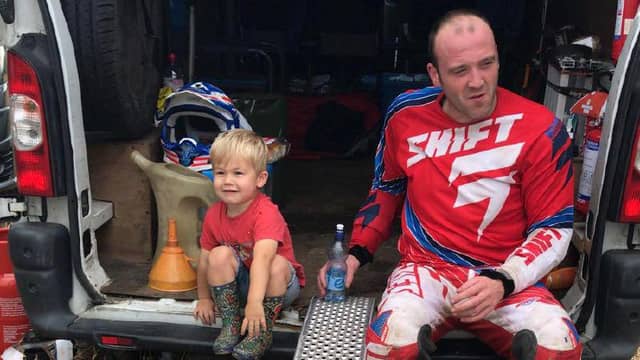
Gareth was a strapping six foot man, who was well known in the motorcycling fraternity.
Up to 800 people attended his funeral, such was his popularity.
“So many people came to celebrate his life and offer their condolences,” she said.
“Part of my mind became closed off as a coping mechanism and there is a lot I cannot remember about those days, although the names of his friends rolled off my tongue,” said Eleanor.
Gareth, always smiling, always helping others and a hero to his sister and oldest nephew, who still fondly remembers his ‘Uncle G’ was just 36-years-old when he died.
Once the visitors and cards stopped coming, Eleanor had to begin her life again and try and put the pieces of the puzzle of her son’s sudden death together.
“There wasn’t an ounce of spare fat on him, he was fit and healthy,” said Eleanor.
“The coroner said there was absolutely nothing wrong with him, I had talked myself into thinking that he had taken a heart attack or a brain tumour, but no, his heart just stopped beating, they could find nothing wrong at all.
“We had that mother and son relationship, he lived with me and we pretty much had the same thoughts on everything.
“I am only glad that Hunter was not here to see it as I don’t think he could have coped with Gareth going before him.
“The grief hits you like an avalanche, you don’t see it coming and it covers you like a blanket, and you try and get yourself out of it, if you can, but sometimes you don’t know how.”
With her young, fit, healthy son dying suddenly, Eleanor found there was little solace in talking to others who had undergone their own - but very different - bereavements.
“When someone says they lost their husband - as I did - from illness, or their granny died after living a long and full life - it is not the same, it doesn’t even come close to the shock and the feelings of emptiness.”
Not knowing where to turn, Eleanor logged onto the internet and came across CRY.
The charity aims to prevent young sudden cardiac deaths through awareness, screening, research, and supporting affected families.
“I gave them a call and suddenly I was speaking to people who knew what I was going through,” said Eleanor.
“They really helped me through some very bad days.”
Eleanor learned about ADS, which stands for Sudden Arrhythmic Death Syndrome.
In the past it has also been called Sudden Adult Death Syndrome or Sudden Death Syndrome but, because it affects infants and children too, the term Sudden Arrhythmic Death Syndrome is now used.
It describes the likely cause of sudden death in someone when a post-mortem examination has not shown any other potential cause of death, where structural heart disease and coronary disease or ‘hardening of the arteries’ have not been seen, or are not considered sufficient to cause sudden death.
Several conditions have been shown to cause SADS.
These are usually electrical problems – problems with pump systems found in the walls of cells in the heart which are meant to pump salts in and out of the cell.
It is not possible to find these at post-mortem, unless genetic tests are performed, which is not yet part of standard practice.
All services provided by CRY Ireland are free.
CRY uses some funding to raise awareness for SADS through various media campaigns.
Representatives from CRY also hold information meetings, which often involve travelling to schools, colleges, sports clubs, businesses and community groups to speak about this.
The majority of the funds raised for CRY go into the Centre for Cardiovascular Risk in Younger Persons in Tallaght.
To date, over 5,500 individuals have been seen at the centre.
If the cause of death is known to be a hereditary problem, such as some forms of cardiomyopathies, or heart muscle diseases, many causes of SADS, Marfan’s disease, then immediate family are screened as a precaution.
This usually means the parents, brothers and sisters, and if appropriate the children of the deceased should be checked for evidence of the same condition.
Or, where the cause of death is uncertain, relatives can also be screened for any clues as to possible causes of death, such as the electrical conditions lonq QT syndrome or Brugada syndrome.
Eleanor, Judith and Gareth’s nephews have all undergone screening as a precaution.
And Eleanor, true to previous form of wanting to give back to the people and charities which have supported her family in the past, has now herself become a telephone counsellor for CRY.
“They knew exactly what I was going through and what my grief was, so I decided to help others who were going through the same thing.” she said.
“There is no comparison. You really have to walk in our shoes to understand.
“It is estimated that between 60 and 80 young people under 35 die from these conditions every year in Ireland.
“It has nothing to do with how fit and health you are, indeed some cases involve very sporty young men dropping dead on football pitches.”
As well as raising awareness of CRY, the family also held a fundraising event at Massereene Golf Club on December 10 2022, which would have been Gareth’s 40th birthday, for the NI Childrens’ Hospice.
“The Hospice really helped Hunter,” said Eleanor.
“When my husband came home he was only nursed for five and a half weeks before he passed, but the Hospice were wonderful.
“The Macmillan nurses who came to him were just fabulous
“And Gareth loved children, he would light up around them and all children loved him, so we decided to raise money for a cause close to our heart,” said Eleanor.
“All of his friends from motorcycling supported it and we managed to raise a fantastic £16,000.”
Eleanor said she is thankful of the support of her friends and family following the tragedies she has undergone.
“I look after my grandsons a couple of times a week and they definitely keep me on my toes!” she said.
“Without them and Judith, I don’t know where I would be. We were a very close family, the four of us, and to lose Hunter and Gareth in such a short space of time hit us very hard.
“Gareth is still a part of the boys’ lives, we talk about him often, he is still their Uncle G.”
Eleanor exudes a quiet and dignified strength despite everything she has been through.
“The way I look at it, is that outside my door is a big hole,” she explained.
“It is always there. I can negotiate around it or fall into it.
“It will never be filled in, but I think it is better to negotiate around it.
“I know, for example, if I am feeling low today, tomorrow is another day, I will feel better after a night’s sleep, so I just bury my head under the blanket.
“You never get over it, it never gets easier, you just learn to live with it, you never get over the sense of emptiness, but you just have to take each day at a time.
“CRY have just been unbelievably supportive and I needed to give myself an objective.
“I don’t want our loss to be in vain and some good has to come out of all of this, so I think it is important for me to publicise the work of CRY and also to say that death and how we deal with it should not be taboo, it is something we need to talk about and discuss and see how we can help and support each other through this process.”
Eleanor and Judith will hand over the £16,000 raised for the NI Childrens Hospice next week.
For more information on CRY, please log on to www.cry.ie