

Pioneering suicide intervention scheme developed in Antrim aims to save lives

A PIONEERING project aimed at helping people spot the signs of suicidal thoughts in friends, family and loved ones has been developed in Antrim. The Connections programme is run by Fresh Minds Education, founded by Aine and Adam Wallace and which has a premises at Antrim Enterprise Centre in Greystone.
A PIONEERING project aimed at helping people spot the signs of suicidal thoughts in friends, family and loved ones has been developed in Antrim.
The Connections programme is run by Fresh Minds Education, founded by Aine and Adam Wallace and which has a premises at Antrim Enterprise Centre in Greystone.
Fresh Minds addresses the emotional health and well-being needs of children and adults through harnessing the power of creativity and uses innovative, evidence based, and trauma informed mental health and resilience training to parents, teachers and children and offers resources for use home and in the community.
All their work is based on the AMBER approach - which stands for Anchor, Move, Breathe, Express and Relax, developed here in Antrim by Aine.
Supported by the Public Health Agency, the Connections scheme has a number of facets and helps people gain the confidence and skills to assist people experiencing emotional distress and or suicide.
It also helps participants to develop a greater understanding of emotional health, mental health and suicide prevention and to help improve the resilience of local groups, workplaces and communities.
Various elements of Connections are now well established in all the Health and Social Care Trust Areas in Northern Ireland.
Early adopters include EA FLARE team, Extern, Health & Social Care Trusts and the Public Health Agency NI and by March 2020, 300 sessions were delivered province wide in Northern Ireland.
In the first year of the pandemic, the charity Fresh Minds Education devoted itself entirely to translating this curriculum for online engagement and it reached 1,500 individuals online in its first year alone.
There has also been a specific focus on working with veterans in a post-conflict society.
The Connections programme is based on ‘connection, humanity and hope - created in the context of trauma growth and focusing on bringing about attitudinal change, positive behavioural change, hope and healing.
Fresh Minds’ suicide prevention and intervention curriculum has been used by the Public Health Agency to assist them in meeting the unmet need for easily accessible training that inspires help seeking and saves lives locally.
The focus for the next phase of this work is to establish Connections Link Life Suicide Awareness & Prevention Training through a team of facilitators who are able to cascade this curriculum locally.
The organisation offers ‘Training of Trainers’ to individuals, organisations and businesses who want to proactively save more lives.
The T4T scheme was funded by Fresh Minds and Eilish Craig and Kiri McLaughlin were the two senior facilitators who trained 16 new trainers on how to develop LifeLink skills .
Eilish is a counsellor and Suicide Prevention Lead at Fresh Minds. She explained how the latest stage of the programme involved participants from all over Northern Ireland, who have spoken about their own experiences with suicide and suicidal thoughts.
These include a bereaved wife, young people from North Belfast who have overcome mental health struggles and the brother of DJ Stephen Clements, who took his own life early in 2020.
Their experiences take the form of a PowerPoint presentation and videos which are used in an educational setting for participants and can be tailored to the individual group.
It is hoped that those groups can then apply what they have learned in their own situations.
Eilish said that it is important to distinguish between mental health and ill-health, and to try and remove some of the stigma and taboo nature which still surrounds suicide in Northern Ireland.
“Language is very important and we do not want to shame anyone,” she said.
“We live in a post-conflict society and young people are still having to deal with trauma that has been passed down through the generations.
“Words like ‘commit’ are no longer used - suicide has been decriminalised since the 1960s. People don’t ‘top themselves’, people with mental ill-health are not ‘crazy’ or ‘nutters’ or ‘melters’.
“We are also experiencing the hangover of religion, when people who died by suicide were buried in unconsecrated ground and their families were shunned.”
As part of the programme, factors that lead to poor mental health, emotional distress and suicide are discussed, as well as the role of mental health and emotions in relation to suicide prevention.
Some people can be impacted by trauma and life events, relationship breakdowns, bereavements and particularly in young people, clusters of suicides in their community.
The role of self-care and well-being in improving mental health and preventing suicide is also touched upon, and the effects of substances including drugs and alcohol.
A study highlighted by The Samaritans has highlighted that the risk of suicide is eight times greater if the person has consumed alcohol.
And with young brains often not fully developing until the mid 20s, research also shows that younger people do not realise the permanency of their actions, which can lead to rash and impulsive behaviours.
Previous spates of suicides among young people have revealed that there is a certain glamourisation of the tributes and warm words.
“Some young people have such little self worth that they think ‘at least when I am dead, people will say nice things about me’, which is really tragic,” said Eilish.
“I think someone said it in the wake of all the tributes to Sinead O’Connor after she died - you have to tell people how much you think of them when they are alive.”
Eilish said that people need to start viewing mental health and physical health in the same way.
“Of course the two things are connected, the brain is an organ in your body the same as any other and we would not think twice about going to the doctors or seeking help with a physical ailment, so there should be no shame in seeking help for mental ill-health.
“There is loads of research to show that what happens in the body can have an impact on the mind, and vice versa. Just think of all the people who experience stomach problems linked to anxiety. Everything is connected - literally, through the nervous system.”
She said that some participants in the scheme have reported success with medications, while others have struggled.
“There is no right or wrong way to deal with mental ill-health, it is what works best for the individual.
“Things like diet, sleeping patterns and exercise levels can all have an impact on how we are feeling.”
Eilish also said that there are various stereotypes attached to people who may be feeling suicidal which are not borne out in real life.
“One of our participants spoke about being surrounded by friends in the park on a warm summer’s day and feeling like he couldn’t go on.
“He wasn’t alone or isolated or sitting in a dark room - he just felt how he felt at that moment, and thankfully sought help.”
Similarly, she said that on the outside, people like Mr Clements were living dream lifestyles, but no one knew what was going on behind closed doors.
Eilish said that when people talked about suicidal ideation, they should be taken seriously.
“It’s often said that silence kills and that it is better that people talk about it than don’t talk about it, and if they threaten to harm themselves, then they should be taken seriously, no matter how many times they say it. Reaching out and reaching in are both equally important.”
She said that other warning signs could be giving away possessions or profession affection to loved ones in a way that is out of character, effectively ‘saying goodbye’.
Part of the course deals with the impact on those left behind in the aftermath of a suicide.
“Research has shown that the people directly impacted by one suicide can stretch into the hundreds,” she said.
“One lady talked about a man who worked in a shop opposite where her husband used to wait for his lift to work.
“Every morning the man in the shop would raise the shutters and wave and chat to her husband, it became a daily ritual.
“When the man found out her husband had died, he was devastated and the impact of not seeing him every morning where he had been for so many years was very upsetting.
“But again, people should feel no shame, either in talking about their suicidal feelings or those who have been bereaved by suicide, it is nobody’s fault and it is entirely the decision of the individual if they choose to take their own life.
“The whole point of the programme is to teach people the tools to recognise where they may be able to intervene and to me, it is no different than any other type of lifesaving training.
“For years there have been anti-smoking campaigns, safety warnings about the water, advertising about too much alcohol consumption.
“In the case where suicide is a preventable death, we should have the knowledge and tools to be able to try and help if we can.”
Eilish said that a lot of people experiencing suicidal tendencies talk about ‘unbelongingness’ and ‘burdensomeness’.
“People can get so consumed by how bad they are feeling that they feel they don’t belong - like that young man in the park, even though he was surrounded by people - and that their pain is so large that they feel it is too much to share with others.
“We as friends, loved ones and supporters need to be able to show that we are there and we are listening and we can help - just being there and listening and even acknowledging that the other person is struggling can be enough of an intervention sometimes.
“Brené Brown talks about the difference between empathy and sympathy and how ‘toxic positivity’ can be harmful.”
“It can be as simple as suggesting a walk in the Castle Gardens to get close to nature, to get off the computer or just to make someone a cup of tea or a supportive text to let them know we are thinking of them. Just that you have noticed.
The programme also signposts people to agencies like Lifeline and The Samaritans and recommends support agencies for the bereaved and for friends and family supporting people through suicidal thoughts - because they need assistance, too.
“Sometimes as people shared their experiences, they felt guilt at now knowing the signs that someone intended to take their own life, that they did not know before, and thought that maybe they could have done more - but as Maya Angelou said, ‘when you know better, do better’.
“All our participants want to help other people, that’s why they took part - to help stop other people going through what they have.”
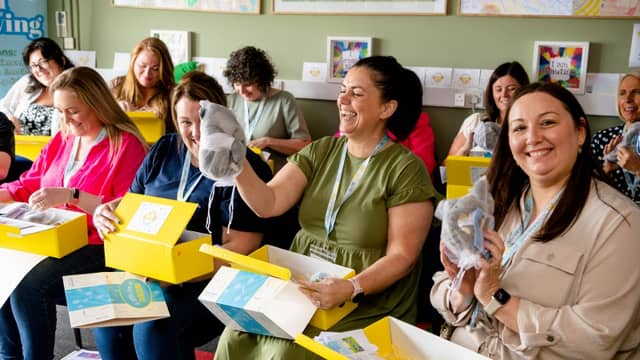
As part of the teaching, a mascot called Nellie the Elephant is involved - the ‘elephant in the room’.
Suicide is a big and complex topic that can be perceived to cause great sadness, hurt, pain, embarrassment, argumentative or is simply taboo.
Holding ‘Nellie’ helps people speak about mental health and suicide and the stigma that surrounds both.
Other tactics include talking about the Path of Life and the ‘boxes’ an individual has - which can either be used to store ‘crystals’ - the enjoyable things in life, or the ‘rocks’ of struggle and worry.
With 21 per cent of the population of Northern Ireland experiencing a mental health problem - around a fifth, Fresh Minds now aims to deliver 21 sessions of the Connections Programme between September 10 - World Suicide Prevention Day - and October10, World Mental Health Day.
If you or your organisation is interested in facilitating the scheme, contact [email protected] or call 028 9402 2242