

Plans to revamp Cranfield site as part of Lough Neagh tourist trail are explored
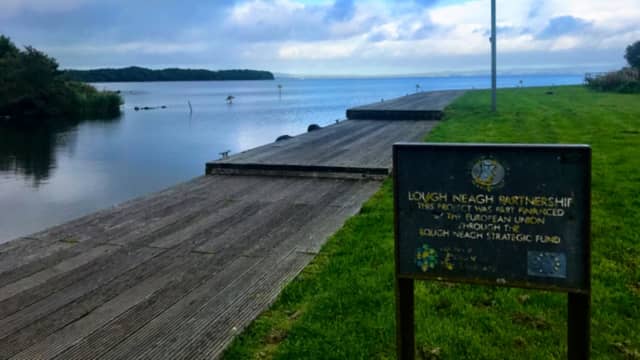

UP to £165,000 could be spent on replacing a neglected jetty and slipway at the historic Cranfield site outside Randalstown. Antrim and Newtownabbey Borough Council owns and maintains a small park, jetty and slipway as well as the Holy Well in Cranfield on the shore of Lough Neagh at Churchtown Point.
UP to £165,000 could be spent on replacing a neglected jetty and slipway at the historic Cranfield site outside Randalstown.
Antrim and Newtownabbey Borough Council owns and maintains a small park, jetty and slipway as well as the Holy Well in Cranfield on the shore of Lough Neagh at Churchtown Point.
There is also the ruins of a 13th century Church (St Olcans) including a graveyard at this location.
It has been reported that the site is gaining popularity with open water swimmers and that a boat company is also interested in offering tours from the beauty spot.
A report due before the monthly meeting of Antrim Borough Council this week said that, following reports of deterioration and concerns regarding health and safety a structural condition report of the jetty and slipway was undertaken in June 2019.
The report identified that deck boards on the jetty have deteriorated and are cracking.
Corrosion has been identified throughout the jetty structure.
The slipway neighbouring the jetty is cracked in multiple locations across its width.
This has created hazardous voids.
The report said that paving in the vicinity of the slipway is generally in good condition, but some repair is needed, especially where the paving meets the slipway.
For health and safety reasons, as a temporary measure, the jetty has been closed off to the public with fencing and ‘Danger Keep Out’ signage in place.
However the report said that the fencing is continually being removed by persistent users of the jetty ‘who fail to acknowledge that the existing structure should not be accessed’.
The slipway is separate from the jetty and is still in operation but there is a health and safety risk associated with its continued use, in terms of ‘slips and trips’.
The report has also proposed health and safety provisions could also be implemented at the Cranfield site, including steps attached to the jetty for easy entry and exit to the water.
Council officers have engaged with local stakeholder groups to determine current levels of need for the jetty.
Until such times as the fencing was erected, approximately six boats used Cranfield Jetty permanently.
Over the past five years the boat owners experienced some vandalism to their vessels and decided to no-longer berth at Cranfield.
The nearest alterative mooring points are at Toome Canal and Antrim Lough Shore Park with each providing small jetties where boats can moor for the day.
Additionally, Lough Neagh Partnership’s Lough Neagh Management Strategy identifies five strategically important local recreational areas on the Lough.
They are Churchtown Point/Cranfield, Gawleys Gate, Randalstown Forest, Sandy Bay and Washingbay.
A study completed by the Department for Culture, Arts and Leisure (DCAL) (Inland Waterways) completed in October 2014 identified these sites as primarily providing recreational opportunities for local communities.
The same report also identified six regional recreational areas with the capacity to attract day visitors from further afield: Ballyronan, The Battery, Lough Shore Park, Maghery, Oxford Island (including Kinnego Marina), and Toome Canal.
The DCAL study noted a disparity across all sites regarding the quality of provision and access and made recommendations for the improvement and enhancement of infrastructure.
The report said that work on the NI Tourism Strategy to the period 2030 has been suspended due to COVID-19 but it is expected that Lough Neagh will feature as a key opportunity for product development appealing to regional and national visitors in the shorter-term.
Local boat owners are reported to be interested in returning and making Cranfield their permanent base.
No active fishermen are able to use the jetty due to its current condition but around 12 boats still use the slipway to gain entry in and out of the Lough.
A private pleasure craft owner has expressed interest in using Cranfield Jetty and slipway as they have recently invested in a new business titled ’Lough Neagh Tours by Land and Water’ which they were hoping would in-part operate from Cranfield.
The report said that they have a relatively small craft which will provide ticketed tours over the Spring and Summer months.
Lough Neagh Rescue also uses Cranfield jetty on a regular basis for all types of training and in case of emergency the jetty is used as a primary and secondary landing emergency facility.
It is also included as part of a HM Coastguard emergency procedure for aircraft landings on the Lough.
There has also been an increase in usage by swimmers.
A local group from Ballyronan use Cranfield for weekly open water swimming sessions.
The report said that their numbers have been steadily increasing along with swimmers going out on their own.
There has also been an increase in water sport activities and visitors to the shoreline for local exercise.
Council officers have considered a number of options for the jetty.
The first is for the complete removal of the jetty is estimated at £27,000.
It was said that the absence of the jetty would ‘significantly detract from the site’ as a local recreational area and restrict opportunity to develop Lough Neagh as a tourism product and economic stimulus.
The second option was for the replacement of the jetty and slipway which includes enhancements to provide best practice water safety provisions at £165,000.
The third option is for more permanent fencing to restrict access to the jetty at an estimated cost of £5,000.
This option is not a longer term solution, said the report, and would need investigated further for practical engineering solutions.
Also, given the persistent removal of the current temporary fencing it was predicted that any permanent fencing will also be damaged to facilitate access.
The report concluded that, given the strategic tourism significance and local importance of access to the water ‘a full replacement of the jetty and repair of the slipway is to be considered the most satisfactory option for the longer-term’.
The estimated cost of full replacement and repair is £165,000.