

Randalstown woman insists 'young people need to learn about Northern Ireland's past'
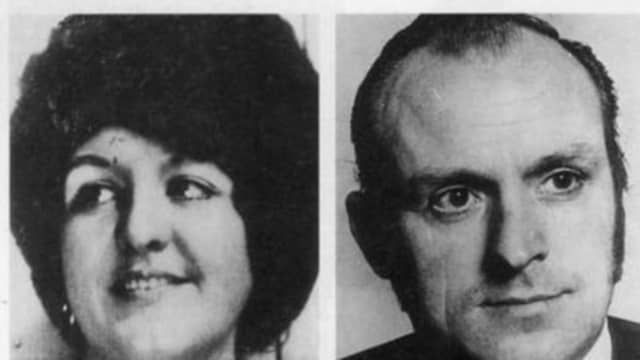

A RANDALSTOWN woman whose uncle was murdered by loyalists has spoken out at an event to mark European Victim’s Day at Stormont. Victims and families of those who were killed by terrorists gathered to mark the remembrance event.
A RANDALSTOWN woman whose uncle was murdered by loyalists has spoken out at an event to mark European Victim’s Day at Stormont.
Victims and families of those who were killed by terrorists gathered to mark the remembrance event.
The senate chamber was full to capacity on Tuesday as it paused for European Day of Remembrance for Victims of Terrorism.
Many of those who attended were directly impacted by loyalist and republican violence.
Mairead Burke was born in Londonderry and grew up in England before moving back to Northern Ireland.
She came to Antrim in 1975 to work at Muckamore Abbey Hospital and moved to Randalstown in 1992.
Like many families, Mairead’s was touched by the Troubles - with her uncle killed in one of the most horrific murders of the conflict.
Speaking to the Antrim Guardian several years ago, she said: “I started a scrapbook in the early days and gave up after the first year, it was unbelievable,” she said.
On June 25 1973, Mairead’s uncle, Stormont Senator Paddy Wilson, General Secretary and founder of the SDLP, had been drinking in a Belfast bar with a Protestant friend, Irene Andrews and another colleague.
He offered her a lift back to her home on the Crumlin Road and they drove away from the pub at about 11.30pm in Wilson’s red mini, before they were ambushed and repeatedly stabbed to death by the UFF in a brutal attack at a quarry on the outskirts of the city.
He was stabbed 32 times while Ms Andrews was stabbed 19 times.
“That changed our lives,” said Mairead.
“My father was never the same again.
“He bought a big Doberman as a guard dog, he was obsessive about locking and bolting doors.
“He was nervous about going out in public, especially things like weddings and funerals.
“I took my grandson on a tour of City Hall in Belfast recently and when my uncle Paddy was killed, they started a book of condolences for members who had died, and I was able to show him his great-uncle’s name and his story.”
Mairead, who was involved in the local District Policing Partnership for eight years said after this week’s event at Stormont that if young people did not learn from the past, it would never end.
The grief does not stop at the graveside for families, she added.
“It has a ripple effect throughout other generations, it certainly had a ripple effect on our family,” said Ms Burke.
At the event, families were able to talk about how the death of their loved ones had affected them.
Paddy’s son Paul’s video message was played in the chamber where his father once stood, and Mairead niece was also in the room.
She said: “We did get justice, but I think it’s important, there can’t be closure until you get justice, and I feel for the families that can’t get it and probably, some of them never will get justice.”
The European Remembrance Day for Victims of Terrorism was established following the 2004 Madrid bombings.
Paul Wilson said: “Years later I was asked to contribute to a commemoration plaque in Stormont.
“I came up with three words I thought he stood for. Equality, tolerance and respect.”
Mr Wilson then built on his understanding of respect in Northern Ireland today.
“Sadly, the respect for survivors and victims of the Troubles has been washed away,” he said.
“We see paintings and murals depicting cold-blooded murderers. Where is the respect for each other? For your neighbour? Where is the respect for those who died and the families who are left?”
At the event, family members were able to share how the death of their loved ones as a result of terrorist attacks had affected them and their families.
Mary Hornsey is the mother of Paul Maxwell, who was 15 when he was killed alongside Lord Mountbatten in an IRA attack in Sligo.
Also contributing was Tanya Williams-Powell, the granddaughter of Thomas Niedermayer, who was kidnapped and later killed by the IRA in 1973.
In the years following his death Miss Williams-Powell's grandmother, aunt, mother and father would all go on to take their own lives.
“That is the legacy, the multi-generational trauma that’s been caused by the decision to kidnap Thomas,” Miss Williams-Powell said.
Civic buildings were due to light up red for Troubles’ victims and survivors at the weekend.
South East Fermanagh Foundation (SEFF) made the request of all 11 NI councils as well as Dail Eireann, Dublin, and the Palace of Westminster, London.
Sinn Fein had previously blocked requests for the building’s illumination for terror victims, but it’s understood the application was given the go ahead as the republican party no longer has a representative on the Assembly Commission.
Speaking after the event at Stormont, host Jim Allister said: “This event was a welcome corrective to the attempt to airbrush victims from the record and a reminder of what innocent people suffered. At a time when an aspiring First Minister claims that there was “no alterative” to such actions the need to mark victims’ day has never been greater.”
He thanked Tanya Williams-Powell, Mary Hornsey and Paul Wilson for their contributions and Kenny Donaldson and SEFF for their help in making the event a success.
Mr Donaldson said: “It is important particularly at this time that victims/survivors are acknowledged, almost 25 years on since the signing of the Belfast Agreement, victims/survivors remain a constituency whose needs have not been delivered upon.”
Mairead Burke said that while the event was heavily attended by unionist representatives, she was upset that no one from the SDLP, her uncle’s party, had been at the event.
She said she had contacted the party for an explanation.
In 1996 there was controversy when John White, the man convicted of the killings of Paddy Wilson and Irene Andrews was invited to a Downing Street reception.
He spent two decades in prison for the murders.
Former SDLP leader, Gerry Fitt, was horrified and said that White ‘murdered my best friend in a very cold blooded, brutal and sadistic way’.
Paul Wilson told the Belfast Telegraph that the sight of his father’s killer on the steps of 10 Downing Street filled him with despair.
“When I look at his face, I think about the screams of pain he must have listened to when he was mutilating my father.
“I just cannot understand how he can live with himself. The screams must haunt him, mustn’t they?”
John White expressed disappointment at Lord Fitt’s comments.
“I’m slightly surprised that he should have personalised it in this way. He’s somebody I admired as a very good and courageous politician. But I think it’s absolutely wrong for him and others to be critical of the involvement in the peace process of people like myself.
“We’re trying to change the sort of society that we live in here. But if individuals are not allowed to change, then there’s no hope of change in society.”
In the years before his 1978 conviction for the murders, his responsibility for the crime was an open secret among a large inner circle of police, journalists and activists in the Northern Ireland.
An article in the Irish Times said that he talked ‘generally and dispassionately’ about the 1973 murders, admitting the difficulty of ‘retrospective analysis’.
“What led me to do the things I did was a profound hatred at what was being done to our community.” he said.
“It was our way of saying don’t you touch our community or this is what we'll do to yours. But it’s wrong to get into that now. There were some things done worse than what I did.”
The article continued: “About the special brutality of the Wilson/Andrews murders, he has nothing to say, except ‘There’s no doubt it was brutal’. He is not troubled about anything he has ever done. ‘Not at all. No.’