

Reliving the truly horrible Hallowe'ens of yesteryear!

IT’S a funny old thing, but I don’t believe in ghosts - yet you still wouldn’t find me dead in a graveyard after dark. Which makes me doubt myself. If I’m pretty confident that spectral hands are unlikely to shoot from an occupied plot to grab ankles and drag me to oblivion, why should I care?
IT’S a funny old thing, but I don’t believe in ghosts - yet you still wouldn’t find me dead in a graveyard after dark.
Which makes me doubt myself. If I’m pretty confident that spectral hands are unlikely to shoot from an occupied plot to grab ankles and drag me to oblivion, why should I care?
This time of year only makes things worse. I appreciate it that it is very much by design, but Hallowe’en is creepy.
There’s something deeply unsettling about the whole thing. My head knows that there is nothing to fear from the knee-high ghostie collecting ‘candy’ door-to-door, but my heart apparently thinks otherwise.
It’s wrong and I’ll be glad when it’s all over - and the supermarket shelves are once again free of all the spooky tat.
Yes, it’s big business, but looking back through the archives there is a sense that some of the ‘simple pleasures’ have been lost along the way.
These were the days when the turnip was still king - a time when no-one had even clamped eyes on a pumpkin.
Youngsters still sang that Hallowe’en was coming and informed all and sundry that the goose was indeed getting fat, before asking for a penny - though, failing that, a ha’penny would do.
Can you image the look on a 10-year-old’s face today if you proudly presented them with a penny?
Back in 1933 Elizabeth McVeigh gave an account of her October 31 celebrations. And it was a very different beast to what local parents will be planning for their little horrors 90 years on!
She reckoned that of all the festivals throughout the year, Hallowe’en ‘affords the greatest attraction’. After hearing what she got up to, I’ll allow the reader to be the judge of that!
Back then it was commonly known as ‘Snap-apple Night’. And there was feasting too, but the centrepiece was the barmbrack, a traditional sweetened bread dotted with raisins. There was often a few extra ingredients for All Hallows’ Eve - but more on that later.
‘The evening opened with a short sing song and during intervals crackers were pulled and sweets and nuts distributed’, wrote Liz.
‘Each member wore a paper hat and a black silk mask. Streamers and balloons added to the gaiety of the scene. The joyous uproar was soon interrupted by the announcement of tea.
‘During the repast, general topics of the day were discussed.
‘The most exciting part of the meal was the sharing of the barmbrack. Speculation was rife to know who should be the possessor of the ring, stick, bean, pea and rag’.
Ah yes, the secret and potentially molar smashing secret ingredients. But what did they symbolise?
‘The ring predicts early marriage, the bean signifies riches, the stick is regarded as the omen of death, the pea is a sign of poverty and rag foretells of marriage to a tailor’.
How nice. Who could resist a nice slab of cake while you contemplate your imminent demise?
Then onto more familiar territory. The games.
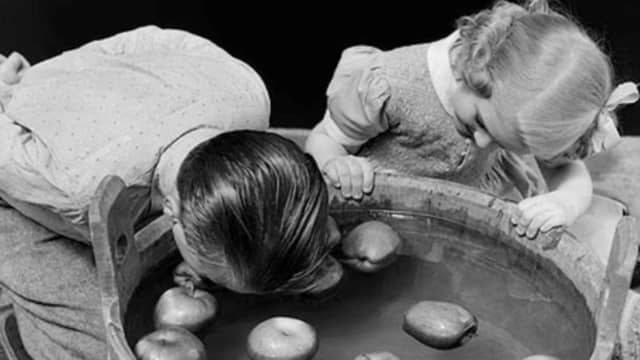
‘A bath containing water was procured and a few dozen apples put into it. In one of the apples a coin was inserted and one of the guests and blindfolded with his hand thrust into the bath.
‘The ‘snap-apple’ was then suspended and a coin similarly inserted’.
Hilarity ensued, as long as dental disaster was avoided.
They then retired to the parlour where there was Irish dancing accompanied by some handy Uilleann pipes.
‘After the departure of the guests I sat up with my parents discussing the glorious night we had just spent in the company of our esteemed friends. Secretly I wondered if providence would bestow on us another happy Hallowe’en as enjoyable as the one just terminated’.
How very genteel. And not a sparkler or toffee apple in sight. More Downton Abbey than downtown Antrim.
But change was in the air and within six years the world was plunged back into war.
But even that could not stop Hallowe’en, even if it did colour the proceedings somewhat.
A reporter calling himself John O’ the North popped into one local party back in 1941 and it proved to be a rowdier affair.
‘The children’s Uncle George, who is home on leave at present, was also invited and he has expressed the opinion that on the whole Dunkirk was probably rather less exacting’, he wrote.
‘When George and I arrived the party was already in full swing and our entrance was greeted to ear-piercing cheers which I had to admit, with a certain amount of jealousy, were at least 99 per cent intended for Uncle George - and probably indeed 99.5 per cent if the matter was more closely probed.
‘Considerable disappointment was expressed that George was not in uniform, but the combination of a knowledge of child psychology, second sight and the price of officers’ uniforms had driven George to the conclusion that an old suit of civvies was the correct garb for a Hallowe’en Children’s Party.
‘While the children clambered all over him and pulled at him with sticky fingers wanting to know all about how many of the enemy he had killed from time to time and - their soft little innocent blue eyes shining with excitement - whether he had bumped them off with a bayonet or blown them to bits with a big gun.
‘I stood quietly to one side almost unnoticed with a slightly mysterious smile on my face, trying to convey the impression that if, instead of giving so much attention to Uncle George, they would only ask me a few questions about the last war, then they would hear something worthwhile...’
Introductions over, it was time for the party. Cue ‘children shouting and eating and ducking for apples and pushing each other and squabbling the way children do’.
Uncle George, apparently a member of the Magic Circle, tried to call things down with some conjuring tricks. It soon descended into a food fight - but that’s another story!
But by 1943 the mood seemed to have darkened, with one local reporter bemoaning the fact that it had been a very ‘changed Hallowe’en’.
‘No other festival seems to have suffered more from the impact of the war than Hallowe’en, one of childhood’s happiest celebrations.
‘Last weekend saw no feast of oranges, nuts, pears, apples and pastry delicacies. Nor was there any fireworks or barmbrack galore.
‘Householders were not troubled by the sudden crackling of squibs pushed under the door or through a keyhole.
‘Even the dressing games were severely restricted. The ‘old clothes’ so necessary for such games are too valuable nowadays to be used like that’.
But like a greedy trick or treater, it would be back.
By 1950 it was being reported that it had returned with a vengeance with the return of the nightly banger blitz - even though fireworks cost four times more than they did pre-war.
Some of the old games so beloved by naughty youngsters were enjoying something of a renaissance.
‘It’s Hallowe’en and the youngsters are making the most of it’, penned one scribe that year.
‘I suppose there must be a bit of the youngster left in the oldest of us because we can still get a kick out of watching small boys setting of squibs and rockets and jumping jennies.
‘That is so long as they are set off behind somebody else.
‘For it strikes us as ‘awfully funny’ when a jumping jenny is dropped at the heels of some crusty old fellow and we see him take a ‘lep’ in the air and then set off in pursuit of his tormentors calling down maledictions on their heads’.
Supply was still an issue, but squibs, rockets, pinwheels and jumping jennies were still flying off the shelves.
‘So too are the other members of the fireworks family, although some have acquired fancy names like ‘busters’ and ‘rousers’ and even an atomic title or two - but they are still the old favourites in disguise.
‘There was a new name added to the list the other day when a countryman requested the man behind the counter to give him a ‘bag o’ dunderers’. And having been handed his ‘bag o’ dunderers’ he departed remarking ‘Ah hope they’ll be guid yins’.
‘On the other hand a lady who evidently disliked the ‘dundering’ variety requested selection of the ‘ones that go poop’.
Takes all sorts, I suppose!
Sales of ‘false faces’ were through the roof too, following the arrival of the first plastic masks - though some of the racial stereotypes which were apparently popular 73-years-ago would probably attract the attention of the local constabulary today.
The reporter went on to explain the ‘rules’ of some of the Hallowe’en games that were taking local streets by storm at the time.
‘I notice that the ‘childer’ haven’t forgotten the outdoor ones, especially that ancient favourite beloved of boys since our primitive forefathers first put doors of wood on their caves.
‘I refer, of course, to the game which is loosely known as ‘Knock the Door’.
‘My own front door has suffered from this knocking - and even kicking - in its time and the bell at the moment is out for the count so I speak from experience.
‘Nevertheless, boys will be boys. It has been so from the beginning of time and long may it continue because what sort of world would it be at all if there were no boys to knock other people’s doors and ring other people’s bells and keep the jolly spirit of Hallowe’en alive’
Other variants included ‘Follow the Leader’ and ‘the Wee White Horse’.
The former saw the youngsters line up in single file and follow the ‘Tom Sawyer of the gang’. When he selected a door to rap, they all had to follow in turn - until the inevitable happened.
‘Speed was the essence of success in this game, otherwise retribution came swiftly for those at the tail-end with the infuriated man of the house emerging suddenly, armed perhaps with a walking stick, just as one was in the act of grasping the knocker’.
The ‘wee white horse’ ended in a similar way.
‘This was the game by which every small boy was initiated into the Ancient and Honourable Order of Door-knockers’.
‘Green horn’ duly selected, he was told that he could play with them and be the horse. In reality, he was more a lamb to the slaughter.
His new found ‘pals’ fashioned a pair of reins from rope and then ran him hither and thither to a chorus of cluckings and ‘gee-ups’ before announcing they were taking him to the black smith.
The ‘smithy’ was usually the most irascible citizen in the neighbourhood, and the horse was securely tied to his doorknob. The gang then battered the door.
‘Then the gang fled to cover, callously ignoring the terrified bleatings of their victim to watch with keen appreciation the interview between the wee white horse and the angry blacksmith’.
Writing in 1981Gerald Rafferty feared that the Hallowe’en he had loved as a child was dead and buried.
‘This is Hallowe’en night, but would you know it? I would venture that in another decade or so the very name of Hallowe’en will be forgotten.
‘The whole thing has been wearing very thin for the last 10 or so years. We might still crack a few nuts tonight and maybe treat ourselves to an apple tart. But that’s about the size of it.
‘The real spirit has gone out of Hallowe’en and I’m not just thinking about the spirits that are believed by some to roam the earth tonight.
‘Hallowe’ens gone by bring a whiff of nostalgia - especially during the thirties and forties. It was a day eagerly awaited.
‘The big dumpling was prepared in the pot and served liberally and you went to bed as full as the proverbial fitch.
‘In the country, Hallowe’en pranks were annual events such as taking off a neighbour’s garden gate or taking a wheel off a cart or even taking the cart and leaving it away down the road or else in the middle of a field. Most of this was taken in good spirits by the victims.
‘Ducking in a basin of water for a Kid’s Eye, trying to bite an apple suspended from the ceiling, dressing up like Tam the Divil and scaring the life out of poor folk.
‘Years ago the country towns were like the Maragu Mor before Christmas, Everybody went to town that day. It was a custom. Some got drunk, some came home laden with bags of nuts, apples and oranges and then sat down to eat the dumpling.
‘But tonight, if you go out and about through the countryside you will see little signs of Hallowe’en. It’s great pity.
‘We should hold onto the old customs for once you let them go, they will never return’.
And he’s right. In many ways Hallowe’en today is a plastic parody of what it once was. A horrible shadow of its former self.
Don’t get me wrong, it still gives me the creeps, but then it’s supposed to. And I for one would certainly mourn its passing.