

Return of the Crumlin Meteorite

AFTER 120 long years the Crumlin Meteorite is back on Ulster soil this week - though this time it did not arrive with a bang. It had already travelled more than a hundred million miles when it heralded its arrival at 10.30am on the morning of September 13 1902.
AFTER 120 long years the Crumlin Meteorite is back on Ulster soil this week - though this time it did not arrive with a bang.
It had already travelled more than a hundred million miles when it heralded its arrival at 10.30am on the morning of September 13 1902.
First, it was the noise. People living as far afield as Antrim heard ‘an explosion’. Some locals initially thought the boiler had blown at Crumlin mill.
WJ Adams heard it too. He was gathering apples from a tree on the edge of a cornfield at Crosshill and he later admitted he was ‘shaken’ by the loud bang in the sky above him - and that was only heightened when he heard the thud of a heavy object striking the ground less than 20 yards from where he stood.
He spun around and spotted a tell-tale cloud of dust rising from the ground.
Adams rushed towards it and observed a hole in the ground, belching a ‘sulphurous odour’.
After retrieving a spade he starting digging and within 15 minutes he had extracted a ‘dense black stone’.
It had buried itself a foot and a half in the soil, and would probably been deeper still but for the fact that its journey was blocked by an even larger stone.
It was still hot when he reached it, and it remained warm to the touch for over an hour.
The object tipped the scales at nine pounds, five and a half ounces. It was seven and a half inches long, six and a half wide and three and a half deep.
Unbeknownst to the local man, the weird piece of rock coated in black dust was billions of years old and had travelled from the far reaches of space.
Word soon spread, however. Soon Professor Lazarus Fletcher, from the Mineral Department of the British Museum, was in Northern Ireland to examine the find - and he wanted it for his collection.
He paid ‘a high figure’ for the meteorite, the price boosted by the fact that they knew exactly when it had crashed down.
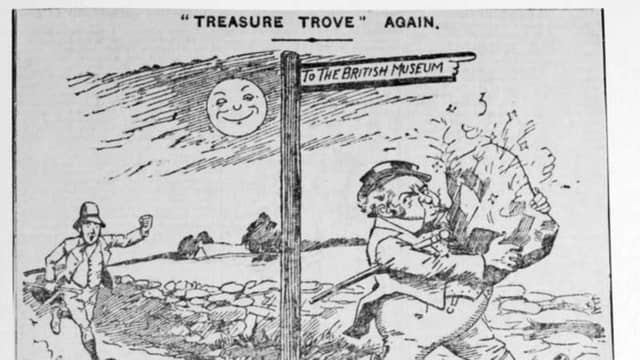
Within two weeks it had pride of place in the London collection - to the consternation of some.
“‘Anything I sees I fancies, and anything I fancies I collars’ that is the legend which should be inscribed in letters of flame over the portals of the British Museum for it accurately describes the grabbing propensity of that institution,” roared the Dublin Evening Mail.
“All that we know about this fascinating visitor is that it was dug up by a man who witnessed its arrival, and that it has now found a place in the collection of meteoric stone in the Central Hall of the South Kensington building.
“This is a prosaic close to an exciting life, but after all the meteorite is in good company for it’s only one of some 450 similar stones now on display there.”
The scribe noted that the Mueum had also got its hands on much ‘Celtic gold’.
“When will the argument be opened in the lawsuit which will decide their future ownership?”
Ultimately that never happened, and the return of the meteorite this week was on amicable terms.
Dr Mike Simms, from the Ulster Museum, said much had been learned over the last 120 years.
“It will have come from what’s called the asteroid belt, which is an area of debris between the orbit of Mars and Jupiter,” he said.
“You’re talking about a couple of hundred million kilometres, something like that, it’s a long way.”
Dr Simms added that science had long since resolved the mystery of the ‘explosion’.
“When it first hit the atmosphere it was going at 30,000 miles an hour so that’s a sonic boom basically.
“It’s fantastic that we’ve worked with the Natural History Museum to bring it back to Northern Ireland so the people of Northern Ireland can actually see one of their own meteorites.
“It’s come back home to its earthly home I should say, rather than its home in outer space.”
But the visit will be fleeting. This is a loan, not a gift. Like a fireball blazing across the night sky, blink and you will miss it.
The Crumlin meteorite is expected to stay on display at the Ulster Museum for the next three years and then it will be on its travels again.
While many Guardian readers will recall the story of the remarkable day in 1902, how many have heard about the remarkable coincidence surrounding it?
The meteorite landed on the exact spot that had been marked as the site of a monument to General Pakenham, who fell at the Battle of Alam.
It was never built, however, following a ‘dispute’ among its promoters.
The pole marking the spot, 20-yards from the apple tree at Crosshill, had only been removed by Mr Walker, the landowner, days before the ‘space rock’ fell.
What are the chances of that?