

Royal visit to mark a century since oldest active reserve Squadron was formed at RAF Aldergrove
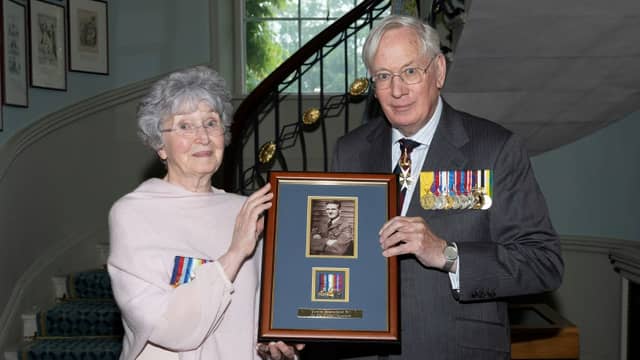

THE 502 (Ulster) Squadron, the oldest active reserve force in the RAF, was formed in Aldergrove in 1925. The 100th anniversary was celebrated last week with a Royal evening at Hillsborough Castle.
THE 502 (Ulster) Squadron, the oldest active reserve force in the RAF, was formed in Aldergrove in 1925.
The 100th anniversary was celebrated last week with a Royal evening at Hillsborough Castle.
His Royal Highness The Duke of Gloucester KG GCVO joined current Squadron personnel, families, and the families of some of the Squadron’s Second World War veterans to mark the occasion.
His Royal Highness was present in his capacity as Air Commodore-in-Chief of the Royal Auxiliary Air Force.
The evening saw the Squadron presented with a Roll of Honour bearing the names of all 174 Squadron members who died in service.
The Roll had been curated in the late 1940s but was only recently rediscovered. Two of the names on the list were represented by family members.
Warrant Officer Matthew Fahey’s niece and Warrant Officer Stanley Beaton’s daughter joined the evening. Both men died in February 1944 when their Halifax was downed by anti-aircraft fire from a German U-Boat in the Bay of Biscay. The daughters of twin pilots, Flight Lieutenants John and Peter Davenport were also present.
The Squadron’s continuity drill team marked the evening’s close with a precision display for the assembled guests.
Officer Commanding 502 Squadron, Wing Commander Steve McCleery, said it was an important milestone.
“502 (Ulster) Squadron’s motto is ‘I Fear Nothing’ and, in the 100 years since our formation, our personnel have lived up to that adage time and time again,” he said.
“From the 1920s spare-time pilots who drove the growth of aviation in Northern Ireland, to the U-Boat hunters of the Second World War, and the fast jet pioneers of the 1950s, 502 never failed to put itself at the front of the fight.
“In marking this anniversary, we honour their commitment and zeal, as we aim to continue their legacy.”
The Squadron was the first Special Reserve – units formed close to engineering hubs – squadron and was later amalgamated into the Auxiliary Air Force as the UK prepared for war.
A key part of ceremonial events, including the 1932 opening of Stormont’s Parliament Buildings by the future Edward VIII, the Squadron became known locally as ‘The Ulster Squadron’.
Deputy Commandant General, Royal Auxiliary Air Force, Air Commodore Gavin Hellard, said they had always punched above their weight.
“Northern Irish reservists are strongly represented across the Armed Forces, where they continue to make an above-sized contribution to the defence of the United Kingdom, drawing on a long tradition of service.
“502’s reservists are especially renowned for their professionalism and dedication, working alongside Regulars on exercises and operations all over the world.”
The Squadron served under Coastal Command throughout the war, flying the Anson, Whitley and Halifax. Initially based at Aldergrove, they moved to Limavady in late 1940, where they became the first Squadron to land using Air-to-Surface Radar. With Binevenagh mountain making landing at Limavady extremely dangerous, the innovation eventually saved countless lives.
A change of tactics saw the Squadron moved to Cornwall, from where they began proficient U-Boat hunters. The first Squadron credited with destroying a U-Boat through the use of radar, they gained an extraordinary reputation for innovation. They became the first Squadron to use flares to attack a U-Boat at night and the first to deploy the mighty 600lb anti-submarine bomb against a U-Boat.
502 Squadron Air and Space Operations reservist, Corporal Victoria Noble, said they were proud of their distinguished history.
“Everyone who joins our Squadron quickly comes to realise that we walk on the shoulders of those who wore the same Red Hand crest, and who gave their lives in defence of the United Kingdom.
“It remains important to commemorate them, and to celebrate the Squadron’s many achievements, as we enter our second century.”
The Squadron – who scored the most U-Boat kills of any of the Reserve Squadrons serving in Coastal Command – was disbanded at Stornoway in 1945.
With the reactivation of the Auxiliary Air Force, No. 502 was reformed on 10 May 1946, again at RAF Aldergrove, but now as a light bomber squadron, equipped with de Havilland Mosquito B.25 from July 1946. In December night fighter de Havilland Mosquitoe replaced the bomber variant, but in June 1948 the units of the by now Royal Auxiliary Air Force all converted to the day fighter role, 502 receiving Supermarine Spitfire F.22 fighter aircraft for the purpose. Jet conversion began in January 1951 with the arrival of de Havilland Vampire FB.5, which were supplemented by the FB.9 variant in July 1954.
Itt operated from Aldergrove for until 1957 when the RAuxAF’s fighter units were stood down.
502 was reborn as general service support squadron in 2013, again at Aldergrove Flying Station, and its reservists – recruited from across Northern Ireland and the Republic of Ireland - serve in variety of roles, at home, and abroad ‘to support current and future worldwide commitments’.
In 2019, a new standard was awarded to the squadron as the old one awarded in 1939 and was ‘worn out’.