

Save Our Swifts - or lose the sound of the summer forever
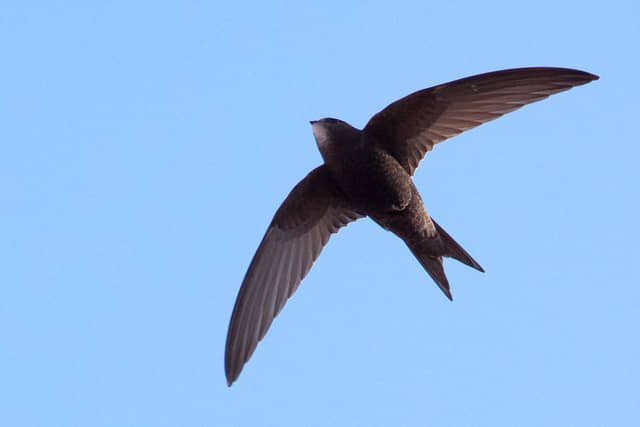

SWIFT migration is now well under way.
They are the last to arrive and often the first to leave. Their stay in Northern Ireland is just 100 to 110 days.
Sadly they have suffered a huge decline in the last 20 years. The numbers returning are declining much too quickly.
A lot can be done to help but sadly it isn’t.
We are in a biodiversity crisis right now.
It has been reported in my life time of almost 66 years that 38 million birds have disappeared from our towns and countryside. That is one in every five birds now lost.
Climate change, habitat degradation and loss are the main factors for this shocking decline.
Even at this late stage something can still be done to reverse the situation - but the time for talking is gone and urgent action is needed.
We can still save some of our urban nesting birds.
The once ubiquitous house sparrow and the now not so common common swift have both suffered a -60%+ decline. The swift is now -66%.
Both are suffering annual declines which means one day they will be gone except for those using nest boxes.
The swift may be reduced to those that are truly nesting wild around the coasts of Northern Ireland such as at Larrybane.
The swift is thought to be declining annually by around 4%.
Sound of the summer Growing up the swift was the sound of summer with their high pitched scree-ree call along all the streets in Antrim. The same would have been in every town across Northern Ireland.
In Antrim the hot spot was Massereene Hospital. Like all poor houses across Northern Ireland they had huge numbers of nesting swifts.
One of my longest memories was when attending Antrim Primary School. The air above the hospital the full of swifts. There were probably 100 plus nests.
Massereene, Lisnaskea, Coleraine, Enniskillen and Waveney hospitals are now demolished. Roe Valley and Lagan Valley hospitals were reroofed many years ago and before swift conservation was a thing. They closed all access for the swifts.
Today there are just a small number of nesting swifts coming back to Antrim. Fourteen pairs of swifts had their nest sites destroyed by someone filling the nest holes with yellow expanding foam. A hall in the area lost all 36 pairs of swifts when uPVC fascia and soffits were put up. There may be a light at the end of the tunnel in this case. I hear they may want them back again.
What has gone so wrong here?
Swift Conservation Groups throughout the UK and Ireland have evidence that much of the steep decline is due to redevelopments, new building methods, new building regulations and uPVC soffits and fascias.
This has led to a situation where are no longer sufficient gaps, air flow gaps, crevices and spaces within man-made structures and buildings to allow these birds to nest within the eaves of houses.
Fitting uPVC soffits and fascia during the months of May, June, July and early August can literally be a killer unless the existing structures are thoroughly checked out for nesting swifts before fitting.
The swift in many cases don’t leave their nests when threatened. Rather they retreat deeper into the nest cavity and cower there resulting in them getting sealed in unless the house holder and fitter is aware of their presence.
From 2021 to present, and continuing, the Housing Executive is refitting hundreds of homes across the borough.
When contacted they said no birds were harmed yet they are not doing breeding bird surveys before carrying out the work.
The results of that work was clearly evident in an Antrim swift colony where nesting pairs jumped from seven pairs to 15 pairs from one year to the next.
That is unheard of unless there is a catastrophic event in the area and that was the Housing Executive refurbishing houses.
Ideally the Housing Executive should be putting up nest boxes in every housing estate. They announced in 2022 that they had partnered with idverde and the RSPB to install boxes to protect red-listed species.
These projects often utilize swift call devices to encourage colonization and focus on increasing available housing for swifts, which are clean, low-maintenance birds that prefer colonial nesting.
The Executive said it was aiming to transform 400 acres of grassland across the estate into wildflower meadows, supporting species such as bees.
Sadly that didn’t happen.
Ironically, It is so easy to remedy the decline in these birds.
Cavities, cavities, cavities So what is this easy step? Cavities, cavities and more cavities.
The answer is the addition of swift bricks, now called, universal bird nesting bricks, in every new house or extension being built and new builds in every town.
They are now called universal bird bricks because they allow sparrows, swifts, sand martins, house martins, tits and even bumble bees to nest inside. The entrance hole is small and keeps out starlings. Sadly, there is a steep decline in this species also.
Across England and Ireland councils are doing something to help stop the decline of these not so common birds.
Fulbourn housing estate in Cambridgeshire has 300 nest bricks. Edgecombe flats has 90 nest boxes. An RSPB survey showed residents were very happy with the nest boxes and presence of nesting birds - after all the distinctive swift call is the sound of the summer.
The Duchy of Cornwall is behind the universal nest brick project. For the last seven years nest boxes for hole nesters have gone in to every new build. The total number of bricks is an amazing 741 with many already occupied by birds.
Brighton and Hove Council have new planning laws requiring developers to install bricks for swifts into all new buildings taller than five meters.
Hackney Council has new rules requiring new build projects to include swift bricks.
In the London Borough of Islington, bricks are to be added to all new builds and extensions.
Examples of swift brick victories include redevelopments of housing estates, such as the Windmill Estate in South Cambridgeshire where more than 250 swift bricks have been installed since 2009.
Barratt Developments has installed more than 4,000 swift bricks in new housing developments since 2016 – with plans for 7,000 more.
There are at least 68 local authority and neighbourhood plans with wording for nest box or swift brick provision, yet here in Northern Ireland there is a terrible resistance.
The Northern Ireland Swift Group are rarely contacted for advice on swifts and swift bricks. However in April 2022 five building companies here in Northern Ireland contacted us about universal nest bricks. Hats off to Lowry Construction and McBride Construction to name just two of them.
A nest brick can cost as little as £35. Compare that to the £100,000+ price for a house. Three nest bricks per gable adds just £100 to the cost of a house.
Closer to home there is a lot being done for swifts and it’s all down to an amazing council.
Mayo County Council is at the forefront in Ireland, as a whole, when it comes to swift conservation. They are now insisting on swift bricks in every new build.
The swift population is up 23% and that’s because 263 plus nest bricks have been put up across the county. If every council did the same it would be truly amazing.
Back to home where Antrim and Newtownabbey Council wrote a swift action plan. It states that developers should note that the Swift was given ‘Bird of our Borough’ status by the Council in May 2015.
Ideally what we, the Northern Ireland Swift Group, would like to see is something like if you want your planning permission you must do something for biodiversity.
We would like to see one, two or maybe three swift bricks on every suitable gable. Something that would be perfect would be a block or brick built swift tower in every housing estate or every school being built. Bricks could be built in to the walls and site sites created in the attic.
Sticking with Bird of the Borough I was shocked and saddened to find out that in the years since creating the title to find out the council hasn’t done anything for the swift.
Meanwhile I have made and given away hundreds of swift nest boxes.
Over the last few years the Northern Ireland Swift Group and many locals have been campaigning to save what could be Doagh’s last swift colony. The site is Ballyhamage House in Doagh.
All of its outbuildings where swifts nest are being redeveloped into housing of some sort. After a breeding bird survey carried out by NISG it was estimated that there were 15+ pairs of swifts.
This is a very important site for swifts and for Doagh. We contacted council many times requesting that an official breeding bird survey be carried out. All nest sites should be marked, retained and enhanced by creating more.
All we need is a space the size of shoe box for all pairs of swifts. We offered to help and show what was needed. Sadly the offer was not taken up.
Like so many other colonies across Northern Ireland it will be lost forever. Assuming every other nest site in Doagh is occupied we just don’t know where 30 swifts relocate to.
The Red List The swift and many other birds have just been added to the updated red list. Red is the highest conservation priority with species needing urgent action.
What needs to be done? It should be requirement that in order to get planning permission every suitable new build across Northern Ireland has to include bird bricks.
A few years ago I wrote to all councils in Northern Ireland asking for them to ask builders to include at least one bird brick in each gable of each new house being built. They didn’t reply.
I followed up with an email with the same information. I’m still waiting for 10 councils to reply. The council that did reply emailed a reply saying ‘there is no law saying we have to request nest bricks in every new build so we will not be asking builders to add them’.
Swifts and swift bricks have been discussed in Parliament where it was decided local councils should be asking for swift bricks to be added to all new builds. To my mind it’s very simple You want planning permission? You need to show you are committed to stopping this biodiversity crisis and built in bird bricks!
Some councils in England are already committed to helping, including Brighton and Hove, Cambridge, the Royal Borough of Kingston Upon Thames, Lake District National Planning Authority, the London Borough of Merton, Plymouth and South West Devon, Exeter, the London Borough of Bromley, the London Borough of Lambeth, the London Borough of Wandsworth, Wiltshire, Mole Valley Surrey, Dartmoor, Broxbourne, the London Borough of Bexley, King’s Lynn and West Norfolk.
Over the Irish Sea to Scotland we heard about some absolutely amazing news this year. As of January 2026, Scotland has become the first UK nation to legally require swift bricks in new housing development. How good is that?
The really good news is across the borough we now have people in Antrim, Doagh, Ballynure, Ballyboley, Rathmore, Toome, Crumlin, Glenavy and more doing their bit for swift conservation.
Two churches and soon to be two schools are now involved.
It is fantastic to have Robin Swann MP getting behind swift conservation. I really hope he can succeed where many of us have failed.
After reading his letter I brought two nest boxes to his office for him to see. One was a universal bird brick that is built in to a wall that’s being built. The other is for fitting externally to a building.
We, the Northern Ireland Swift Group, hope businesses and schools would contact us about doing something for swift conservation.
However not every building is suitable but we will assess it. It would be amazing to have a nest box project in Antrim town centre.
There are many suitable buildings especially Danske Bank which has good deep eaves to keep nest boxes dry.
They are very easy to accommodate and are very rewarding to watch.
They definitely don’t create the mess most people think they do. They recycle chick droppings.
A final thought.
I’ve said this many times before - those who care have no power, those with power don’t care.
To find out more about swifts and get involved contact www.northernirelandswifts.com Northern Ireland Swift Group on Facebook Crumlin and Glenavy on Facebook