

So why did Danny Kinahan walk away from a job that meant so much to him?
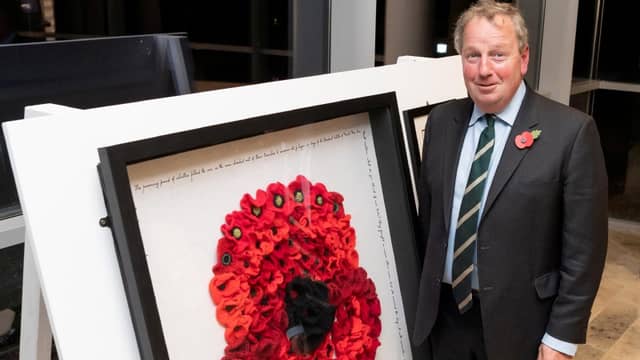

SO what drove Danny Kinahan to resign as Northern Ireland’s first Veterans’ Commissioner? After all, seldom was a man and a job better matched.
SO what drove Danny Kinahan to resign as Northern Ireland’s first Veterans’ Commissioner?
After all, seldom was a man and a job better matched.
As a former army officer, and as a public servant at council, Assembly and Westminster level, his credentials seemed impeccable from day one.
Yet now, four years on, it is all over - even though he was re-appointed for another term just last year.
So what has changed? Well, the government for one.
Last year Mr Kinahan gave a ‘guarded welcome’ to the Conservatives’ controversial Act to deal with the legacy of the Troubles because of the ‘lopsided’ number of prosecutions against former members of the armed forces.
Since Labour came to power it has committed to repealing and replacing those same laws.
Whether that was the only battleground remains to be seen - but following ‘an open and frank conversation’ with Secretary of State Hilary Benn, the local man ‘sadly concluded’ that he could no longer provide the independent voice that veterans require.
It is all so different from the early days of his tenure when he embarked on a whistlestop tour of duty across the province meeting service personnel with stories to tell.
It was the same hands on, face-to-face approach that served him well on the political front lines.
But many agreed that the UUP’s loss was certainly a gain for the army of veterans in Northern Ireland.
It is a subject he is passionate about. He followed in the footsteps of many of his family and joined the forces from university. A commissioned officer, he served with UN Peacekeepers in Cyprus, with the ‘old guard’ at Windsor, the Falklands and with the Black Watch on the mean streets of Belfast.
There are tens and thousands of veterans in Northern Ireland and while for the vast majority the transition back to civilian life has been seamless, some have struggled.
And these are the sort of people Danny Kinahan wanted to help.
“There’s a big job ahead, no doubt about that, but I feel it is a privilege to do it,” he told the Guardian four-years-ago.
“These are people who laid their lives on the line to protect the way of life we hold so dear. We owe them in the same way we owe our NHS.
“I have had the honour of meeting people who served in the army, the RAF and the Royal Navy and they have shared their experiences of how their lives changed after their service ended.
“And while it’s true that most have gone on to live happy, productive lives - some have fallen through the cracks.
“Post Traumatic Stress is a real issue. Many of these people witnessed some appalling things - violent deaths and the awful aftermath.
“I spoke with one man who spent three days piling bodies onto lorries.
“That sort of thing is obviously going to take a toll. Even the most mentally strong people can suffer if those memories are triggered.
“I want to reach out and help these people.
“When I was still MP I brought the Armed Forces Minister over to meet some of our veterans and I know that one of them has since taken his own life. It’s a problem that will not simply go away.”
The job, as he saw it, was to ‘ help join up the dots’.
And it was not just PTSD he planned to address head on.
He also planned to deal effectively with issues ranging from mental health and housing, to employment and legacy trials.
He also wanted to challenge perceptions that those issues only arise in one part of the community.
“This is not about unionism or nationalism - it’s about helping people from right across our society. It impacts on all religions and nationalities.
“I’m not here to wind anyone up or battle with people. I’m genuinely here to help everyone.
“At the centenary of the Somme I was struck by the cross-community nature of the people taking part in the commemorations. People signed up out of a sense of duty.
“That’s why there are so many veterans in this part of the world. Whole families enlisted, my own included. The forces are in our blood. It’s in us.”
The notion of the ‘fighting Irish’?
“No, the notion of selfless service. That’s a different thing altogether.”
As remits go, the Commissioner’s role was undoubtedly challenging. But Mr Kinahan was determined to succeed.
“Throughout my political career I always had a very strong sense of what’s right and what’s wrong,” he explained.
“I will always stand against injustice when I see it. Some of the things I have seen written about our armed forces are just wrong and I want the demonisation to end.
“There is already support out there, but my role is to make it all work. This is not an easy job, but I feel very lucky to be doing it. It is an honour.”
He added: “Before leaving politics I did my utmost to help people. Now that chapter is closed I will be able to focus on our veterans.
“I can’t imagine a more rewarding job.”
And now it’s all over, sparking a flood of tributes.
Among them was one from the chairman of Antrim Royal British Legion, Alderman Paul Michael, who said he was ‘deeply disappointed’ at the news.
He was, said the Independent rep, ‘a champion of veterans who worked tirelessly for all’.
The hunt for his successor is now underway. The successful applicant will know they have big shoes to fill.