

Spies in the skies - exploring archive photos from the time when local airfields were a target for the Nazis!
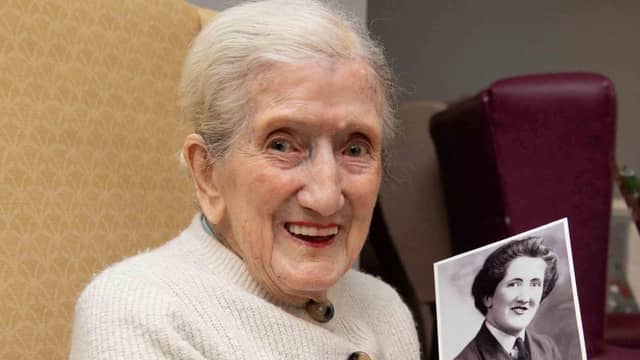

WHILE the Antrim Guardian has often told of the wartime exploits of local hero Lil Tweedale, who worked for the Coastal Command and helped load and unload the films used for aerial reconnaissance of enemy targets, it’s not often discussed how we here in the borough were also being watched. Lil, who recently turned 100, played a vital role in the conflict by assisting the RAF’s Photographic Reconnaissance Unit.
WHILE the Antrim Guardian has often told of the wartime exploits of local hero Lil Tweedale, who worked for the Coastal Command and helped load and unload the films used for aerial reconnaissance of enemy targets, it’s not often discussed how we here in the borough were also being watched.
Lil, who recently turned 100, played a vital role in the conflict by assisting the RAF’s Photographic Reconnaissance Unit.
Ironically, despite Antrim’s close ties with the RAF, Lil never served at RAF Aldergrove.
“I tried to joined the The Women's Auxiliary Air Force (WAAF) when 1 was 16 but was not allowed,” she said.
“When the war broke out, I knew that when Britain was in trouble, I wanted to help.
“Back in those days, women couldn’t have a trade, you had to be a batwoman or go into clerical work. I looked after officers, I polished their shoes and shined their buttons and brought them cups of tea.But I knew I wanted to do more.
“Once we were allowed to have a trade, because I was always interested in pictures and photography, I applied to be a photographer.
“It wasn’t just taking photographs, we had to mix our own chemicals and do all the development work.
“It was hard work. The cameras now are tiny, people even have cameras on their phones, but these were big box cameras on tripods.
“I travelled all over England and Scotland and different camps and I was also in London at the time of the Blitz. There was no such thing as Heathrow or Stansted, you flew into Croydon in a Dakota.”
As war started to escalate, Lil found that her talents were required by the RAF Aerial Reconnaissance Unit.
“My jobs included loading and unloading films for the cameras. I would bring the magazines to the planes and take out the used and load new ones. Other planes would flying over cities like Berlin or Frankfurt.
“There were about 50 to 100 on every film and once they were developed and dried I had to title each one with numbers. Then they went off and people would use them to identify bombing targets. I didn’t really know what I was looking at.”
Speaking further about her role, she said: “I was stationed at Killybegs, at Lough Erne. The Coastal Command. I was where the Catalinas and Sunderlands were.
“We used to have to go and put the magazines into the cameras in the planes.
“I couldn’t imagine it now. But we had to go out in dinghies in all weathers and climb into the Sunderlands and Catalinas, to put the magazines in the camera.
“It was exciting. We enjoyed it, but in the Air Force or the Army everybody’s a team. You work as a team, and if the Sergeant told you to do something you do it. Not like the young ones today, they’d tell you to do it yourself!
“We could be called out at 3 o’clock in the morning. We were on the alert all the time during the war. I was in until 1946, when the war was over. And you knew exactly, you could arrange something next week. But during the war you were, you had to be ready, to go at any time you were called, to go on duty at any time.
“But I enjoyed it. We did enjoy every day. And the companionship and everything was marvellous.”
But while the British were keeping an eye on Germany, the Luftwaffe also had local targets in their sights - and planned to have Nazi jackboots marching into our towns and villages.
We have delved into the American National Archives’ Catalog, which has published ‘Target Dossiers Pertaining to the British Isles, 1938–1945’.
The National Archives Cartographic Branch holds approximately 1.2 million aerial photographs taken by the German Luftwaffe during World War II.
Commonly referred to as GX prints, these photographs showed scores of British military targets, including RAF Aldergrove - exactly where Belfast International Airport is now sited - and Langford Lodge, taken in 1941.
Aldergrove officially opened in May 1918 but was virtually unused until May 1925, when it became a fully operational flying Station.
The Station was renamed RAF Aldergrove in January 1936, operating as an important Coastal Command Station throughout World War Two.
On 20 September 2009 the Royal Air Force Ensign was lowered and the Joint Helicopter Flag raised. Joint Helicopter Command Flying Station Aldergrove is now home to squadrons of the Army Air Corps and the equipment of 38 Engineer Regiment; approximately 75 RAF personnel remain stationed at Aldergrove.
RAF Langford Lodge is a former Royal Air Force station near Belfast, Northern Ireland. Today the airfield is owned by RLC (UK) a subsidiary of RLC Engineering Group which is headquartered in the Isle of Man.
Langford Lodge is located on the eastern shores of Lough Neagh and close to RAF Aldergrove/Belfast International Airport and the former RAF Nutts Corner. The site was also known as No. 20 Satellite Landing Ground. Opened in 1942, the base was an air depot for the United States Army Air Forces, as such thousands of aircraft were processed on their way to active service in Britain, North Africa, the Mediterranean and mainland Europe.
Langford Lodge was a target in Operation Grün (Or ‘Operation Green’ - a plan to target Ireland ), a second front to Operation Sea Lion, which was the planned Nazi invasion of Britain.
German paratroopers were to capture Langford Lodge, Aldergrove and Nutts Corner while RAF Long Kesh, Lisburn was to be destroyed. The full briefing package for Operation Green runs to five volumes, each devoted to a particular area of military interest.
This includes a 75-page booklet titled ‘Militärgeographische Angaben über Irland’ (Military Geographical data on Ireland).
The document described the frontier, size, historical background, industry, transport infrastructure, vegetation, climate, and weather of the island. It also included seventeen pages of detailed sketches of 233 cities, towns, and villages.
120 photos accompanied the booklet; annexes contained street maps of twenty-five cities and towns, including street names and addresses of garage owners. A second print of the plan in October 1941 added 332 photographs of the Irish countryside and coastline, mostly tourist photos, which were used to reference highly accurate Ordnance Survey maps.
There were also details on spring tides, geological formations and possible routes German troops could take off projected invasion beaches.
And that’s not the only link that Aldergrove had to the Nazis - none other than Hitler’s right hand man had the airfield in his sights.
In one of the Second World War’s most bizarre episodes, Deputy Führer Rudolf Hess staged a one-man trip to Britain in a Messerschmitt Bf 110 modified, to his own specifications, for long range flight.
On the evening of May 10th 1941 a pair of RAF Hurricane fighter planes were dispatched from the Aldergrove airfield.
Their Czech pilots, Captains Vaclav Bauman Leopold Srom, had been scrambled to intercept the lone German aircraft that had just flown past Glasgow - yet, ‘under no condition’ their orders stipulated, were they to ‘shoot at it’.
With Germany set to launch its invasion of the Soviet Union, Hess was concerned about the prospect of waging total war on two fronts. As such, his intended objective was simple - to broker a peace deal with Britain.
At the very least, a peace deal would mean that Germany could unleash its full concentrated military might upon the Eastern Front and, in the best-case scenario, Britain might be persuaded to fight against Stalin on Germany’s side.
As his twin-engine plane hummed over Scotland, further south the Luftwaffe was wreaking havoc on London.
Hess, experiencing difficulties in navigating in the night, overshot and reached the far side of the Scottish coast. He turned his plane around again to attempt a second landing in the vicinity of Glasgow, whereupon Bauman and Srom, lacking the fuel to engage in a long-range pursuit, were ordered to ‘stop action and return’ their Hurricanes back to Aldergrove.
The rest is history. Hess, running low on fuel himself, brought his Messerschmitt into a steep climb before bailing out, descending by parachute into the countryside not far from Floors Farm, Eaglesham.
There, he was discovered by a ploughman named David McClean who summoned the local Home Guard unit. Hess was placed into custody, and sat out the rest of the war - and, indeed, his life - in prison.
Adolf Hitler was incensed. Suspecting treason, he contacted Benito Mussolini to assure him that Germany had no desire to seek a separate peace with Britain, dissolving the position of deputy Führer for good measure.
German news outlets were advised to depict Hess as a deluded rogue madman and Hitler secretly ordered for him to be shot on sight if ever he returned to Germany.
However, the background to Rudolf Hess’ bid for peace - not to mention the circumstances surrounding his death - remain shrouded in mystery, fuelling a number of conspiracy theories.
That Hess arrived during the final and heaviest night of the Blitz indicates that he hoped the raid could be utilised as a bargaining chip - a grim show of force to coerce British officials to the negotiating table.
Mere days later, the RAF temporarily agreed to pause their reprisal raids against German cities, and, accordingly, the Germans halted their own airborne onslaught. While this pact was welcomed by the war-weary people of both countries, it only fuelled speculation that the two nations had struck a ‘secret armistice’.
Furthermore, the peculiar orders issued to Captains Bauman and Srom of Aldergrove airfield point towards Hess’ arrival as an event expected in advance.
Their instructions to hold their fire seemingly reveals that Hess planned his mission so meticulously that he had already agreed the details of a contingency plan with the RAF.
After all, even though a lone aircraft would have been unlikely to cause much damage by itself, why would a pair of fighter pilots be ordered to avoid combat with a German light bomber at the height of the Blitz if not for the fact they were intended to escort it to a pre-planned landing zone?
The most glaring proof of this theory is Rudolf Hess’ own navigational map. Whilst Dungavel House, the residency of the Duke of Hamilton, was Hess’ intended destination, Aldergrove airfield was clearly marked on his map as a possible secondary landing site.
In 1946, Hess was moved to Spandau Prison, a converted fortress in West Berlin, where he served the rest of his life sentence.
Jointly administered by the United States, Britain, France, and the Soviet Union, Spandau was initially home to seven Nazi prisoners, but, by 1966, Hess was the prison’s only remaining inmate, his fellow Nazi captives either having been released or died by that time.
Hess himself, however, had his freedom blocked by a Soviet veto, and so he remained in Spandau at a cost of over $1 million per year until he apparently took his own life in 1987.