

Stand and deliver! Your money or your life
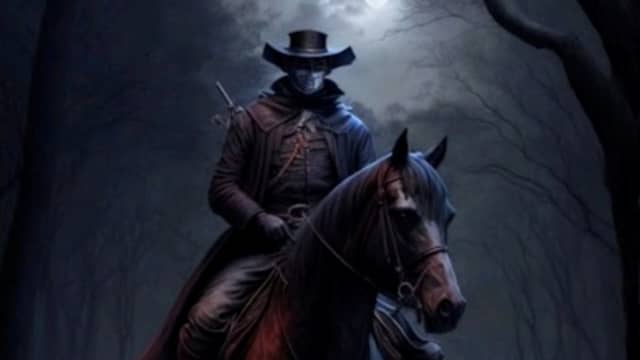

DID one of Ireland’s most infamous highwaymen enjoy a comfortable retirement in Antrim? A gallop through the archives suggests that Ireland’s answer to Dick Turpin may have indeed lived off the proceeds of a life of crime in this very parish.
DID one of Ireland’s most infamous highwaymen enjoy a comfortable retirement in Antrim?
A gallop through the archives suggests that Ireland’s answer to Dick Turpin may have indeed lived off the proceeds of a life of crime in this very parish.
Ah, Dick Turpin. That’s a name that conjures up quite the image.
He was a gentleman thief, relieving rich pickings off undeserving aristocrats. Men grudgingly admired him. Women swooned. He was a heart-breaking, money making man of action.
Romantic tosh, of course.
No, in truth Richard Turpin was a poacher, a burglar, a horse thief and a killer - a thoroughly unpleasant individual who thoroughly deserved his date with the hangman in April 1739.
The legend of the dashing and heroic anti hero came much later, but in fairness it has stuck.
But did you know that he had invited his cousin Benjamin to join the family business - and for a time he was encouraging passing carriages across Ulster to stand and deliver?
The year was 1730 and Dick was lying low after accidentally killing one of his accomplices. He heard that young Benjamin was down on his luck, scraping a meagre existence over the Irish Sea.
So he sent his highwayman’s kit his way - probably glad to get it off his hands as the local constabulary closed in on him.
And apparently Benjamin cut an impressive figure on his steed - but he was never going to climb the same lofty heights as his cuz.
His vision was poor and he suffered from crossed eyes.
He also had a speech impediment. Indeed, it was said that by the time he managed to utter the highwayman’s famous phrase, his intended victims were a few furlongs along the road.
His criminal career ended after he caught a severe chill after waiting for three days on a mail coach. Shivering violently, he made his way to the nearest town seeking medicine.
Unfortunately for him, the entrances to the clinic and the local constabulary were adjoining doors and he picked the wrong one - and he was promptly arrested where he stood in Dick Turpin’s finery.
Unlike his cousin, however, so inept was he that he did not hang and was instead ‘transported’ to the Americas. Incidentally, one of his descendents was Ben Turpin, who became an actor. And he too had crossed eyes. Google him if you don’t believe me!
But some 50 years before the Turpins plied their trade, a trio of highwaymen had wreaked terror along the highways and byways of Ireland.
And they were the real McCoy.
Well mounted, armed with swords, carbines and pistols, the Brennan boys moved from county to county on the hunt for the most affluent travellers.
In desperation, some merchants decided to travel together on horseback to evade the gang - but more often than not, they were one step ahead and still managed to confiscate anything of value.
No traveller was safe and their notoriety quickly spread.
A handsome reward was posted for the capture of the Brennans - and the authorities cared little if they were found ‘dead or alive’.
The writing was literally on the wall, so the gang upped sticks and moved their operation to England, where it was business as usual.
Another hefty bounty was put on their heads, but it meant very little as ‘no person’ had ever seen their faces during one of their raids. They were invisible men.
But their luck was running out.
The turning point came when they decided to rob three merchants of £100 in gold. By chance, their victims were Ulster men - Alexander Marshall and Joseph Hamilton, from Lisburn, and Joseph Thompson, from Antrim town.
And while they were detained by the Brennans, they spied them peeling off the masks to share the spoils.
They saw them again, sitting bold as brass in an inn in Chester a short time later, seemingly on excellent terms with the other customers.
The local garrison commander was alerted and the inn was surrounded and the outlaws captured.
But the Brennans only spent two days behind bars in Chester jail. They overpowered the jailer, stole his keys and made their escape.
Soon they were back in Ireland, their infamy assured.
So what about the Antrim connection, you might ask.
Well, in 1740 an ‘aged gentleman’ passed away in a lonely farmhouse on the outskirts of the town.
He had maintained that his name was ‘O’Beirne’ - but he was very much a ‘man of mystery’ to his neighbours.
He lived alone, had no servants and didn’t work his farm. But, curiously, he never appeared to be short of money.
After his death, a search was made of his homestead and a large quantity of valuables was discovered, including purses of gold and silver, jewellery, watches and snuff boxes.
Much more notable, however, was a sturdy bunch of keys bearing the letter ‘C’ - identical to those used to free a well known band of highwaymen from Chester Jail...
Nothing could be proved, of course, but many believed that one of the Brennans had indeed seen out his days in sleepy Antrim.